Your product images do the selling before your copy even gets a chance. Shopify data confirms that 75% of online shoppers rely on product photos as the deciding factor before they hit “Add to Cart.”
Amazon reports that listings with professional images sell up to 2.5× more than those with poor visuals. And Salsify’s Consumer Research found that 71% of consumers have returned a product because it didn’t match what they saw online.
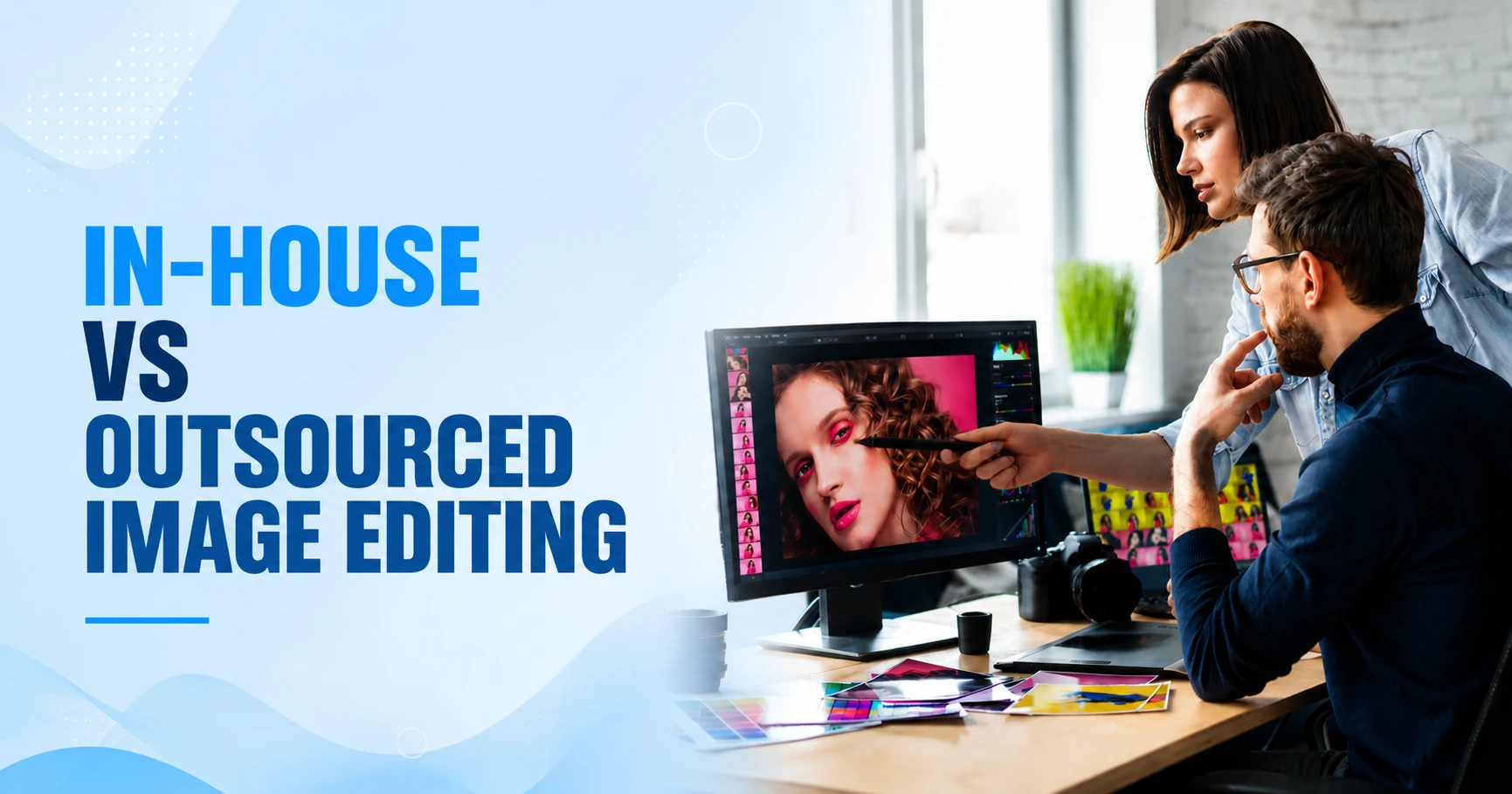
So the images matter. The real question is how you produce them and what it actually costs you. If you run an e-commerce brand, manage a product catalog, or handle creative for a retail operation, you’ve likely asked yourself: should we keep editing in-house, or hand it to an external team?
In terms of in-house vs. outsourced image editing for e-commerce, outsourcing delivers the same (or better) quality at a fraction of the cost, with faster turnaround and zero overhead. In-house editing makes sense only when you need constant, daily creative control over a very small catalog. For everyone else, especially for growing brands, outsourcing wins on cost, speed, and scalability.
Key Takeaway
- A single in-house editor in the USA costs $91,000–$143,000 per year when you add up salary, benefits, software, hardware, workspace, training, and management overhead.
- Outsourcing the same work costs $0.25–$5.00 per image with quality checks, revisions, and scalability built in.
- At 2,500 images/month, in-house runs $10,000+/month. Outsourcing runs ~$1,250/month.
- The math isn’t close.
What In-House Editing Really Costs You
Most e-commerce teams underestimate what in-house editing actually costs. They see the editor’s salary on the budget sheet and assume that’s the number. It’s not even close.
When you run an in-house editing operation in the USA, every layer adds cost:
- Recruitment fees before day one
- Benefits that add 30% on top of salary
- Software licenses that increase every renewal cycle
- Hardware that depreciates every three years
- Office space your editors sit in
- The management hours your team lead spends reviewing batches instead of growing revenue.
And these costs are fixed. Whether you edit 500 images this month or 50, you pay the same amount. Your editor’s salary doesn’t adjust for slow seasons. Your Adobe license doesn’t pause when your catalog isn’t changing. Your lease doesn’t shrink when volume drops.
The True Cost of Running an In-House Editing Team
Most e-commerce managers think the cost of in-house editing is just the editor’s salary. That number is barely half the story. When you compare in-house vs. outsourced image editing for e-commerce, you need to see every dollar that goes into keeping an in-house operation running.
Salary, Benefits, and Hiring Overhead
An e-commerce photo retoucher in the USA earns an average of $33.92/hour, with most workers falling between $27.40 and $38.22/hour. That translates to roughly $57,000–$79,500 per year in base salary alone.
– ZipRecruiter, 2026
Glassdoor in 2026 puts the average photo editor salary at $77,402/year. But salary is just the starting point. According to the U.S. Bureau of Labor Statistics, benefits add 29.7% on top of wages for private industry workers.
That means a $70,000 salary actually costs $91,000–$98,000 once you factor in health insurance, retirement contributions, paid leave, and FICA taxes. Claimed by BLS
Then there’s hiring. SHRM’s Benchmarking Report puts the average cost per hire at $5,475 for non-executive roles. BambooHR breaks it down further. Hard costs range from $7,500 to $28,000, and soft costs like lost productivity can add up to 60% more. And here’s the kicker: retouchers often leave after 12–18 months. So you’re likely running this recruitment cycle again before the next holiday season.
Software, Hardware, and Licensing Costs
Every editor needs software. Adobe Creative Cloud’s business license runs $33.99–$79.99 per user per month, depending on the plan. That’s $408–$960 per editor per year. And Adobe raised prices by 8–12% across most SKUs, with renewal pricing designed to capture the full increase, according to Atonement Licensing.
Hardware is another real line item. A professional photo editing desktop that meets all recommended specifications costs $1,500–$2,200). A color-accurate monitor, the kind that doesn’t silently sabotage your color correction, runs $620 for a Dell UltraSharp 4K up to $1,500 for a BenQ SW272U . Add a colorimeter at $100–$500, a Wacom Intuos Pro at $379.95, and you’re looking at $2,300–$4,500 per workstation replaced every three years.
Training and Onboarding Time
Employers spend an average of $103 per hour on training, with roughly 62 hours per year per employee, claimed by BambooHR. That’s a direct cost. But the bigger drain is the ramp-up period.
A new retoucher typically needs 1–3 months before they’re producing at full speed on your brand-specific workflows. Learning your style guide, your marketplace requirements, and your naming conventions.
For fashion brands managing thousands of SKUs across Amazon, Shopify, and Walmart simultaneously, that onboarding gap directly delays product launches.
Management and QA Overhead
Someone has to review every batch. Someone has to brief new editors, distribute workloads, maintain the style guide, and handle re-edits when quality slips under deadline pressure. Industry estimates place management overhead at roughly $1,000/month for a small studio with two editors. That’s described as “The biggest cost – spent checking edits instead of growing revenue.”
When image editing ownership is fragmented across photography, marketing, and operations teams, decision-making slows further, and revisions multiply. For e-commerce managers already stretched thin across campaigns, marketplace compliance, and product launches. QA becomes one more task competing for limited bandwidth.
What Happens to In-House Teams When Volume Grows

An in-house setup might hold up fine at 200 SKUs. But e-commerce doesn’t stay at 200 SKUs. Catalogs expand. New marketplaces demand new specs. Seasonal campaigns double your workload overnight. This is where the in-house vs. outsourced image editing for the e-commerce question stops being theoretical and starts costing real money.
Bottlenecks During High-Volume Periods
Image editing bottlenecks in e-commerce are rooted in workflow design, not editing capability. They hit hardest during catalog refreshes, seasonal campaigns, and large assortment drops. Without a scalable workflow, this demand becomes a recurring bottleneck that slows your time-to-market and delays revenue.
Limited Bandwidth for Seasonal Spikes and Launches
In-house teams run at fixed capacity. During a holiday season push or a flash product launch, your two or three editors can’t suddenly become ten. The only options are hiring temporary contractors (expensive, slow to onboard) or pushing your existing team into overtime (burnout, errors, turnover). Either way, publishing timelines slip and listing quality drops.
Difficulty Hiring Specialized Skills Quickly
Ghost mannequin editing, jewelry retouching, and advanced color corrections. These require specialized skills. Finding a retoucher who can handle high-end fashion product shots and marketplace-compliant packshots at the same time is a narrow hire. The recruitment cycle alone takes weeks. And with retoucher turnover averaging 12–18 months, you may be hiring again before your current editor has fully ramped up.
Turnaround Time and Flexibility With an In-House Setup
How Turnaround Compares to Dedicated Editing Teams
An in-house editor handles multiple responsibilities beyond just editing. These include coordinating with photographers, attending briefs, and managing file organization. Batch product editing competes with other priorities. A dedicated outsourced team, by contrast, focuses entirely on editing and typically delivers within 12–24 hours. Also, overnight turnaround is possible through time-zone advantages.
Downtime, Sick Leave, and Turnover Gaps
Your salaried editor gets 10–15 paid days off per year, plus sick days. During those periods, the cost continues, but the output stops. And when an editor leaves, which happens every 12–18 months on average, you’re looking at a vacancy that costs roughly $500 per day in lost productivity, according to SHRM. Plus 1–3 months to hire and onboard a replacement.
Single Point of Failure in Small Teams
If your editing operation relies on one or two people, every absence is a production halt. There’s no backup. No redundancy. For brands selling across Amazon, Shopify, and Walmart, listings need 7–12 images per SKU, and every marketplace has different specs. A single-person bottleneck can delay entire catalog launches.
Keeping Style Consistent Across an In-House Team
Editor-to-Editor Style Variation
Even two editors working from the same style guide will produce slightly different results. Shadow angles, skin tone correction, and background white balance – the variations are subtle but visible across a product catalog. For fashion and apparel brands where visual consistency drives brand trust, this matters. Research shows that consistent visual branding increases perceived trustworthiness by 52%.
Quality Under Deadline Pressure
When deadlines tighten, quality loosens. Corners get cut on retouching. Color correction becomes approximate instead of precise. And in fashion e-commerce, even a slight color mismatch leads to higher return rates. Salsify reports that 45% of shoppers have returned items due to inaccurate product content.
Where an In-House Team Gets It Right
Let’s be fair. In-house editing isn’t wrong for everyone. It has real strengths just for specific situations.
Full Creative Control Over Every Edit
If you’re a boutique brand doing 50–100 SKUs and you need your creative director reviewing every single edit in real time, in-house gives you that control. You can walk to your editor’s desk, point at a shadow, and fix it in five minutes. That feedback loop is immediate.
Faster Feedback Loops With In-House Staff
In-house editors sit in your Slack channels, join your standups, and absorb context from your broader team. For brands running frequent creative campaigns that shift direction daily, this proximity speeds up iteration.
Deeper Familiarity With Your Brand Over Time
An editor who’s been with your brand for a year knows your aesthetic instinctively. They don’t need a brief for every batch. That institutional knowledge is genuine, though it walks out the door when they leave.
What Does the Outsourced Editing Brings to the Table

You’ve seen the numbers on the in-house side. Now flip the model.
When you outsource your e-commerce image editing, you eliminate every fixed cost layer. These are salary, benefits, recruitment cycles, software licenses, hardware depreciation, office space, and management overhead. All of it. Gone from your balance sheet.
Instead, you pay per image. You send a batch. You get edited files back. That’s the transaction.
But cost is only half the story. The real reason e-commerce brands, photography studios, and creative agencies across the USA and UK are shifting to outsourced editing isn’t just the savings. It’s what those savings come with. Faster turnaround through overnight editing teams. Instant scalability during product launches and holiday pushes. Access to specialist editors for ghost mannequins, jewelry retouching, and advanced color correction. Skills you’d struggle to hire for individually.
The concern most brand owners raise is quality. If someone else is touching your product images, can they match the standard your customers expect? Can they stay consistent across 5,000 SKUs? Can they follow your style guide as precisely as someone sitting in your office?
The answer depends entirely on the provider you choose and the workflow you set up. Below, we break down exactly what outsourced image editing delivers. These are based on cost, speed, skill access, and brand consistency. So you can measure it directly against the in-house setup we just costed out.
Lower Cost Without Compromising on Quality
What You Actually Pay For With Outsourced Editing
With outsourcing, you pay per image. No salary. No benefits. No hardware. No software licenses. No office lease. Rates start as low as $0.25 per image for basic clipping paths and typically range from $0.50 to $5.00 for standard e-commerce edits. These include background removal, color correction, ghost mannequin, and retouching.
That’s the complete cost. The outsourcing provider absorbs everything else. The editing software, the calibrated monitors, the QA team, the project management.
How Per-Image Pricing Compares to In-House Overhead
Here’s where the in-house vs. outsourced image editing for e-commerce comparison becomes impossible to ignore.
| Cost Factor | In-House (Annual, per Editor) | Outsourced (2,500 images/month) |
|---|---|---|
| Salary + Benefits | $91,000–$98,000 | Included in the per-image rate |
| Software Licenses | $408–$960/year | Included |
| Hardware (amortized) | $800–$1,500/year | Included |
| Recruitment (amortized) | $5,475/cycle | None |
| Training & Onboarding | $1,100–$6,400/year | None |
| Management & QA | $12,000+/year | Included |
| Office Space | $2,400–$18,000/year | None |
| DAM / File Storage | $1,308–$30,000/year | Typically included |
| TOTAL (Annual) | $102,000–$143,000+ | $15,000–$60,000 (at $0.50–$2.00/image) |
For a brand processing 2,500 images monthly, outsourcing at $0.50/image costs $1,250/month, versus $10,000+/month for an equivalent in-house setup. At 10,000 images/month, the gap widens further: $3,500–$5,000 outsourced versus $38,000+ in-house.
How the Outsourced Editors Match In-House Quality Standards
Professional outsourcing teams work with calibrated monitors, licensed software, and structured QA workflows. The same infrastructure an in-house setup requires, but shared across a larger volume of work. The result is consistent output at lower unit cost.
Photoroom’s report surveying 500+ brands found that 96% of e-commerce brands experienced higher conversion rates after upgrading their product imagery. Regardless of whether the editing was done internally or externally.
Faster Turnaround and Built-In Scalability
Around-the-Clock Editing Teams
Professional outsourcing providers operate editing teams across time zones. You upload a batch at the end of your workday. When you open your laptop the next morning, the edited files are waiting. Standard turnaround sits at 12–24 hours for most outsourced teams, with rush options available for campaign deadlines.
Handling Volume Spikes Without Hiring
This is where outsourcing shows its clearest advantage for growing brands. Scalable editing platforms absorb volume fluctuations. This ramps up during holiday seasons, product launches, and catalog refreshes, then scales back during quieter periods. You pay only for actual images processed. No idle salary costs. No contractor scramble.
For SKU managers handling thousands of fashion and apparel products across multiple marketplaces, this elasticity isn’t a nice-to-have. It’s operational infrastructure.
Meeting Launch and Campaign Deadlines Reliably
When you outsource to a dedicated team, delivery commitments are contractual. There’s no risk of your editor calling in sick on launch day or requesting PTO during your biggest campaign push. The provider maintains the bench depth. You maintain your timeline.
Access to Specialized Skills and Tools
Dedicated Editors for Complex Tasks
Ghost mannequin photography, high-end jewelry retouching, and product shadow creation aren’t general Photoshop skills. They’re specializations that take years to develop. An outsourcing provider with a team of 50–300 editors has specialists for each category. An in-house team of two doesn’t.
For e-commerce and other photography studios and creative agencies serving e-commerce clients, outsourcing these frees up your in-house talent. This allows you to focus on shooting, art direction, and client relationships that directly generate revenue.
Access to Advanced Editing Software and AI-Assisted Tools
Professional outsourcing providers invest in advanced editing infrastructure because it’s their core business. That includes AI-assisted background removal, batch color correction pipelines, and automated quality checks. These are the tools that would require significant investment to deploy and maintain in-house.
How Outsourced Providers Maintain Brand Consistency

The most common concern when evaluating in-house vs. outsourced image editing for e-commerce is consistency. Will an external team produce images that look like they came from your brand?
The short answer is yes. If you choose the right provider and set up the workflow properly.
Style Guides and Brand Reference Sheets
Professional outsourcing teams start every client relationship by building a detailed style guide. These include background treatment, shadow type, color profile, retouching limits, crop ratios, and file naming conventions. This document becomes the single source of truth. Every editor on the team references it for every image.
Sample Batches and Approval Workflows
Before production begins, reputable providers process a sample batch of 10–20 images for your review. You approve the output and flag adjustments, and the team calibrates before touching your full catalog. This eliminates the “wait and hope” anxiety that stops many brand owners from outsourcing.
Dedicated Editors vs. Rotating Teams
The best outsourcing providers assign dedicated editors to your account. The same people, working on your images consistently. They build the same brand familiarity that an in-house editor would, but without the overhead. If one editor is unavailable, the style guide and QA system ensure the replacement produces identical output.
Revision Policies and Quality Checks
Professional providers build multi-layer QA into every order. Editor self-check, peer review, and a QA supervisor final pass before delivery. Most include free unlimited revisions. That’s a stronger quality guarantee than most in-house setups can offer, where the editor and the reviewer are often the same person.
Where Outsourcing Has Real Trade-Offs
Outsourcing isn’t perfect for every situation. Here’s where the real limitations sit.
Less Day-to-Day Creative Control
You can’t tap an outsourced editor on the shoulder and ask for a quick tweak during a meeting. Communication happens through briefs, messages, and review cycles. For brands that require real-time creative iteration on every image. Think luxury brands with 30-SKU catalogs and an in-house art director. This distance can feel limiting.
Communication and Time-Zone Considerations
If your provider is in a different time zone, real-time calls require scheduling. However, many established providers turn this into an advantage. You get overnight turnaround because their workday starts when yours ends. And with clear briefs and a solid style guide, most communication becomes asynchronous anyway.
Onboarding Time to Get a New Vendor Up to Your Standard
Switching to an outsourced provider isn’t instant. Expect 1–2 weeks of sample batches, style guide development, and feedback cycles before the team is fully calibrated to your standards. But compare that to 1–3 months of ramp-up for a new in-house hire, and the onboarding gap shrinks considerably.
In-House vs. Outsourced: Side-by-Side Comparison Table
| Criteria | In-House | Outsourced |
|---|---|---|
| Cost per image | $4.50–$12.25 (fully loaded) | $0.25–$5.00 |
| Annual cost (1 editor) | $102,000–$143,000+ | Pay per image only |
| Turnaround | Dependent on bandwidth | 12–24 hours standard |
| Scalability | Fixed capacity; requires new hires | Instant scale up/down |
| Peak season handling | Overtime, temp hires, delays | Built-in capacity |
| Specialized skills | Limited to your team’s ability | Full specialist bench |
| Quality control | Self-managed; varies under pressure | Multi-layer QA + free revisions |
| Brand consistency | High if team is stable | High with style guide + dedicated editors |
| Creative control | Full, real-time | Brief-based; less immediate |
| Risk of downtime | High (single point of failure) | Low (team redundancy) |
| Recruitment cost | $5,475–$28,000 per hire cycle | None |
| Turnover impact | 12–18 month replacement cycle | Provider manages staffing |
Which One Should You Choose?
The answer depends on your volume, your budget, and your growth trajectory. Here’s a practical guide.
Signs You Should Stick With In-House
Keep editing in-house if:
- You process fewer than 200 images per month
- Have a creative director who needs to review every individual edit in real time
- Run a boutique brand with a tiny catalog that rarely changes
- Your editing needs are tightly integrated with ongoing creative campaigns that shift direction daily.
In these cases, the control justifies the overhead.
Signs You’re Ready to Outsource
Outsource your editing if:
- Your monthly volume exceeds 300 images and is growing,
- You sell across multiple marketplaces with different image requirements,
- Seasonal spikes regularly overwhelm your team’s capacity,
- You’re spending more on editing infrastructure than on revenue-generating activities, or
- Your editors are burning out under deadline pressure.
For marketing managers, e-commerce operations leads, and brand owners managing growing catalogs, in-house vs. outsourced image editing for e-commerce stops being a debate once you run the numbers. The cost difference funds actual growth.
Not sure which model fits your workflow?
Start with a free trial at Offshore Clipping and test both side by side.
Get My Free Trial!
Final Thoughts: The Right Choice for You
In-house editing costs $102,000–$143,000 per editor per year. Outsourcing the same work costs a fraction of that with faster delivery, scalability, and quality checks built in.
If your catalog is small and your creative director needs real-time control over every image, in-house works. For growing brands, multi-marketplace sellers, and studios handling volume, outsourcing wins.
When you measure in-house vs. outsourced image editing for e-commerce against your actual numbers, the math points one direction. Outsourcing doesn’t just cut costs; it frees your team to focus on growth.
FAQs
Is outsourced photo editing as good as in-house editing?
Yes. Professional providers use calibrated monitors, licensed software, and multi-layer QA checks. They often produce more consistent results than small in-house teams that self-review their own work.
Why is outsourced image editing cheaper than in-house?
You only pay per image edited. No salary, no benefits, no software, no hardware, no office space. The provider absorbs all fixed costs. You pay for output, not overhead.
Can outsourced editors match my brand’s exact style?
Yes. Providers build a detailed style guide for your brand, process sample batches for your approval, and assign dedicated editors to your account for consistency.
How long does it take to get edited images back from an outsourced team?
Standard turnaround is 12–24 hours. Rush delivery is available for tight deadlines. Time-zone differences often mean you upload at the end of the day and receive finished files by morning.
What types of e-commerce image editing can be outsourced?
All standard types: clipping paths, background removal, ghost mannequin, retouching, color correction, shadow creation, image masking, and marketplace-specific formatting for Amazon, Shopify, Walmart, and other platforms.
Is outsourcing safe for bulk orders with thousands of product images?
Yes. Bulk volume is where outsourcing performs best. Providers scale capacity to match your order size, per-image costs drop at higher volumes, and batch-level QA maintains consistency across large catalogs.
How do I transition from in-house editing to outsourcing without disrupting my workflow?
Start with a test batch of 10–20 images. Review, give feedback, and let the provider calibrate. Then shift non-urgent batches first. Most brands complete the full transition within 2–4 weeks.