Your wedding day will be filled with moments you’ll want to relive for years: your vows, first look, heartfelt speeches, and the celebrations that follow. That’s why wedding videography is about more than recording events; it’s about preserving memories in motion.
But planning wedding videography can quickly become overwhelming. When should you book your videographer? What shots are essential? What should be included in the contract? And how long will it take to receive your final film?
This complete wedding videography checklist answers all of those questions and more. From hiring the right videographer and building a shot list to reviewing contracts, planning timelines, and understanding delivery expectations, you’ll find everything you need in one place to ensure no important detail gets missed.
How to Use This Wedding Videography Checklist
Planning wedding videography can feel overwhelming, especially when you’re juggling dozens of vendors, timelines, and decisions. That’s exactly why this checklist exists.
Whether you’re a couple preparing for your wedding day or a professional videographer managing multiple events, this guide is designed to help you stay organized, avoid costly mistakes, and ensure no important moments are missed.
Rather than reading every section from start to finish, use the guide as a roadmap and focus on the areas most relevant to your role.
If You’re a Couple Planning Your Wedding
The goal is simple: hire the right videographer, communicate your expectations clearly, and make sure every meaningful moment is captured.
To get the most value from this guide, focus on these sections in order:
- Hiring a Wedding Videographer: Learn how to evaluate portfolios, compare packages, and ask the right questions before signing a contract.
- Wedding Videography Shot List: Build a list of must-have moments, family members, traditions, and details you want captured.
- Wedding Day Timeline Planning: Structure your day to allow enough time for getting-ready footage, portraits, ceremonies, and reception coverage.
- Contract Checklist: Understand exactly what should be included in your agreement, from deliverables and turnaround times to cancellation policies.
- Post-Wedding Delivery: Know what to expect after the wedding, including delivery timelines, revisions, and video formats.
Following this path will help you move confidently from booking to final delivery without overlooking important details.
If You’re a Wedding Videographer
For videographers, this guide serves as both a client-planning resource and an operational workflow checklist.
Start with these sections:
- Gear Checklist: Verify that all cameras, lenses, audio equipment, batteries, memory cards, and backup systems are ready before the event.
- Wedding Shot List: Review essential coverage requirements and identify any custom requests from the couple.
- Day-of Workflow & Timeline Planning: Coordinate coverage windows, travel logistics, setup times, and key events throughout the day.
- Client Communication Checklist: Confirm expectations, venue restrictions, special requests, and final timelines well before the wedding date.
Using a standardized workflow helps reduce mistakes, improve consistency, and create a smoother experience for both you and your clients.
How Far in Advance Should You Start Planning Wedding Videography?
One of the most common questions couples ask is: “When should I book a wedding videographer?”
The answer depends on your wedding date, location, and the popularity of the videographer you’re considering.
However, most industry professionals recommend securing your videographer as early as possible, especially for spring and fall weddings when demand is highest.
Wedding Videography Planning Timeline
The table below provides a simple timeline for planning wedding videography, from booking your videographer to final wedding-day preparations.
Following these milestones mentioned in the table helps ensure better communication, smoother coverage, and fewer last-minute surprises.
| Timeline | What to Do |
|---|---|
| 12–18 Months Before | Research styles, compare portfolios, schedule consultations, and secure your videographer. |
| 9–12 Months Before | Review package details, discuss coverage needs, and begin planning your wedding-day timeline. |
| 3–6 Months Before | Share venue information, discuss special traditions, and identify must-have moments. |
| 2–3 Months Before | Finalize your wedding videography shot list and confirm major timeline milestones. |
| 2–4 Weeks Before | Review logistics, venue restrictions, family dynamics, and audio requirements. |
| Wedding Week | Confirm arrival times, emergency contacts, and any last-minute schedule updates. |
| Wedding Day | Relax and enjoy the celebration while your videography team captures every important moment. |
The Pre-Booking Checklist: How to Find and Hire the Right Videographer
Choosing a wedding videographer is one of the most important decisions you’ll make during wedding planning. Long after the flowers fade and the cake is gone, your wedding film will help you relive the emotions, voices, and moments that made the day special.
The challenge is that many videographers can create an impressive highlight reel. That doesn’t always mean they’ll deliver a great experience or a complete wedding film. Before you sign a contract, take time to understand your preferred style, compare professionals carefully, and ask the right questions.
This checklist will help you hire a videographer with confidence and avoid common mistakes that couples often regret later.
Define Your Wedding Video Style First
Before you start comparing videographers, take a step back and think about the type of wedding film you want to watch years from now.
Every videographer has a unique creative approach. Some focus on cinematic storytelling. Others prioritize documenting events exactly as they happen. A videographer can be highly skilled, but if their style doesn’t match your vision, you may not be happy with the final film.
That’s why choosing a wedding video style should come before comparing prices, packages, or availability.
A five-minute highlight film can look beautiful, but the editing style behind it may be very different from what you envisioned.
Common Wedding Videography Styles
Every wedding videographer has a unique creative approach. The table below explains the most common wedding videography styles, what makes each one different, and which type of couple they are best suited for.
Understanding these styles can help you choose a videographer whose work matches your vision and expectations.
| Style | Description | Best For |
|---|---|---|
| Cinematic | Film-like visuals, dramatic music, creative camera movements, color grading, and emotional storytelling. | Couples who want a polished, movie-style wedding film. |
| Documentary | Events unfold naturally with minimal direction. Real moments take priority over staged shots. | Couples who prefer authentic and unscripted coverage. |
| Traditional | Straightforward event coverage with minimal creative effects. Focuses on documenting the full day. | Couples who want complete records of the ceremony and reception. |
| Storytelling / Editorial | Narrative-driven editing that may include interviews, voiceovers, letters, or vows throughout the film. | Couples who want a personalized story rather than simple event coverage. |
Where to Find Wedding Videographers
Finding wedding videographers is easy. Finding the right one takes more research.
Start with trusted wedding platforms, but don’t stop there. The best referrals often come from professionals who regularly work alongside videographers.
Consider these sources during your search:
- The Knot, Zola, WeddingWire, Instagram, vendor referrals
- Photographer referrals as a trusted source
- Local wedding planner networks
25 Questions to Ask a Wedding Videographer Before Booking
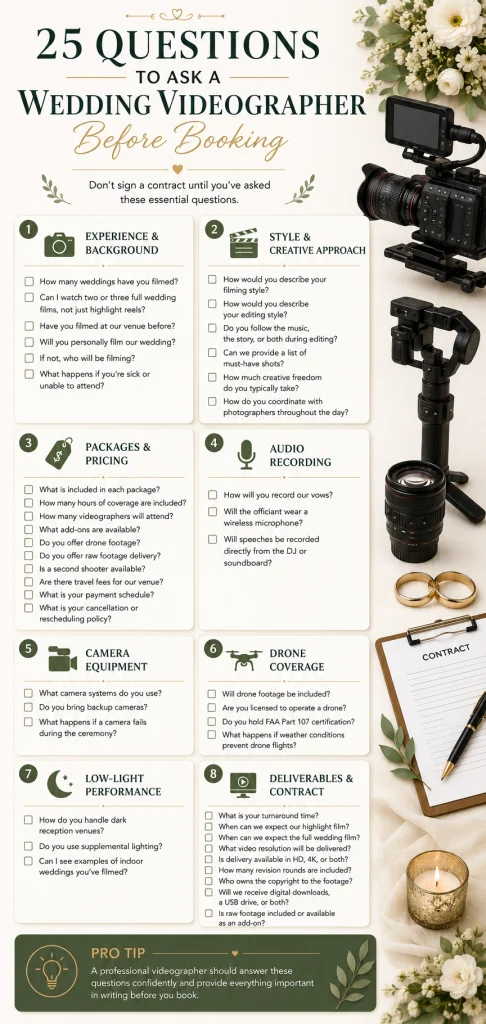
The consultation call is your opportunity to evaluate more than just pricing.
A professional videographer should be able to answer technical questions, explain their workflow, and clearly communicate what happens before, during, and after your wedding.
Use the following checklist during every consultation.
- Experience & Background
☐ How many weddings have you filmed?
☐ Can I watch two or three full wedding films, not just highlight reels?
☐ Have you filmed at our venue before?
☐ Will you personally film our wedding?
☐ If not, who will be filming?
☐ What happens if you’re sick or unable to attend?
- Style & Creative Approach
☐ How would you describe your filming style?
☐ How would you describe your editing style?
☐ Do you follow the music, the story, or both during editing?
☐ Can we provide a list of must-have shots?
☐ How much creative freedom do you typically take?
☐ How do you coordinate with photographers throughout the day?
- Packages & Pricing
☐ What is included in each package?
☐ How many hours of coverage are included?
☐ How many videographers will attend?
☐ What add-ons are available?
☐ Do you offer drone footage?
☐ Do you offer raw footage delivery?
☐ Is a second shooter available?
☐ Are there travel fees for our venue?
☐ What is your payment schedule?
☐ What is your cancellation or rescheduling policy?
- Audio Recording
☐ How will you record our vows?
☐ Will the officiant wear a wireless microphone?
☐ Will speeches be recorded directly from the DJ or soundboard?
- Camera Equipment
☐ What camera systems do you use?
☐ Do you bring backup cameras?
☐ What happens if a camera fails during the ceremony?
- Drone Coverage
☐ Will drone footage be included?
☐ Are you licensed to operate a drone?
☐ Do you hold FAA Part 107 certification?
☐ What happens if weather conditions prevent drone flights?
- Low-Light Performance
☐ How do you handle dark reception venues?
☐ Do you use supplemental lighting?
☐ Can I see examples of indoor weddings you’ve filmed?
- Deliverables & Contract Questions
☐ What is your turnaround time?
☐ When can we expect our highlight film?
☐ When can we expect the full wedding film?
☐ What video resolution will be delivered?
☐ Is delivery available in HD, 4K, or both?
☐ How many revision rounds are included?
☐ Who owns the copyright to the footage?
☐ Will we receive digital downloads, a USB drive, or both?
☐ Is raw footage included or available as an add-on?
The Contract Checklist: What Every Wedding Videography Agreement Must Include
A wedding videography contract is more than paperwork. It is the document that protects both you and your videographer if something unexpected happens.
Many couples spend hours comparing portfolios and pricing, but very little time reviewing the contract. That’s a mistake.
A beautiful highlight reel means very little if there is confusion about delivery dates, ownership rights, or what happens if the videographer cannot attend your wedding.
Before signing anything, make sure every important detail is clearly written into the agreement.
What Should a Wedding Videography Contract Include?
A wedding videography contract should clearly define the wedding date, venue, coverage hours, deliverables, payment schedule, turnaround time, revision policy, copyright terms, cancellation clauses, and backup plans. Every promise made during consultations should be documented in writing before booking.
Non-Negotiable Contract Terms
Think of these items as your minimum checklist. If any of them are missing, ask questions before signing.
- Exact date, venue, and hours of coverage
- Names of the videographer(s) who will film
- Full list of deliverables (highlight film length, full film, raw footage)
- Turnaround timeline with specific dates
- Revision policy (number of revisions, scope of changes)
- Copyright and usage rights
- Deposit amount and full payment schedule
- Cancellation, rescheduling, and force majeure clauses
- Backup plan if the primary videographer cannot attend
Music Licensing: The Most Overlooked Contract Issue
Many couples assume their favorite songs can automatically be used in their wedding film.
Unfortunately, that’s not how music licensing works.
- Why your videographer cannot legally use popular songs by default
- Difference between licensed music libraries (Musicbed, Artlist, Epidemic Sound) and personal use
- What does “personal use only” delivery mean for sharing your video online
- How to request a specific song (and the realistic limitations)
Red Flags in a Videography Contract
Not all warning signs are obvious. Watch for these common issues before signing.
- No written contract or verbal-only agreement
- Vague delivery timelines (“a few months”)
- No backup plan was stated
- No named videographer, only a “company representative”
- Copyright is fully retained by the videographer, with no usage rights for the couple
Wedding Videography Contract Checklist
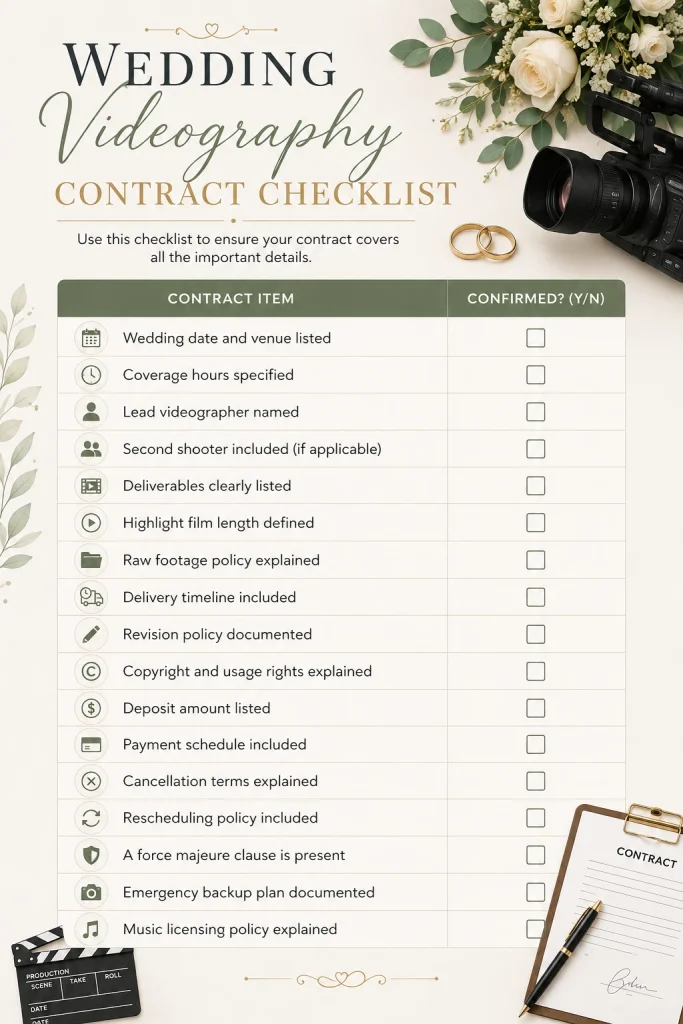
Before signing any wedding videography agreement, review the contract carefully to ensure all essential details are documented.
This checklist covers the key terms that protect both you and your videographer, including coverage, deliverables, payment schedules, usage rights, cancellation policies, and delivery expectations. Use this quick checklist before signing.
| Contract Item | Confirmed? (Y/N) |
|---|---|
| Wedding date and venue listed | ☐ |
| Coverage hours specified | ☐ |
| Lead videographer named | ☐ |
| Second shooter included (if applicable) | ☐ |
| Deliverables clearly listed | ☐ |
| Highlight film length defined | ☐ |
| Raw footage policy explained | ☐ |
| Delivery timeline included | ☐ |
| Revision policy documented | ☐ |
| Copyright and usage rights explained | ☐ |
| Deposit amount listed | ☐ |
| Payment schedule included | ☐ |
| Cancellation terms explained | ☐ |
| Rescheduling policy included | ☐ |
| A force majeure clause is present | ☐ |
| Emergency backup plan documented | ☐ |
| Music licensing policy explained | ☐ |
The Shot List Checklist: Every Moment Your Wedding Video Must Include
A shot list is the single best way to make sure nothing important gets missed. Walk through it phase by phase with your videographer.
Getting Ready Shots
Getting-ready footage captures the anticipation and emotions before the ceremony. Focus on meaningful details, candid interactions, and key preparation moments to create a strong visual introduction that sets the tone for the wedding film. Here are the following points to take care:
- Hair and makeup
- Detail shots: rings, shoes, bouquet, invitations, jewelry, dress hanging
- The bride sees herself in the mirror for the first time
- Emotional moments with bridesmaids or the mother of the bride
- Groom and groomsmen getting dressed
- The groom’s reaction to a letter or gift, if one is planned
- Detail shots: boutonniere, watch, suit
Pre-Ceremony Shots
Pre-ceremony footage helps establish the setting, atmosphere, and anticipation before the wedding begins. These shots provide important visual context, capture venue details at their best, and document candid interactions that help create a more complete and cinematic wedding film. Here are the following points to take care of:
- Guests arriving and being greeted
- Venue exterior and establishing shots
- Ceremony space décor before guests are seated
- Florals, signage, candles, and programs
- Musicians or DJs setting up
- The First Look, if you’re doing one
- Wedding party portraits
Ceremony Shots
The ceremony is the emotional centerpiece of the wedding day and the most important part of the wedding film. These shots focus on key moments, genuine reactions, and clear audio capture. Here are the following points to take care of:
- Processional, wide-angle, plus close-ups of each person walking
- The groom’s reaction to seeing the bride is an essential shot
- The bride walking down the aisle from multiple angles
- Officiant’s opening remarks
- Exchange of vows (confirm mic placement in advance — audio quality here matters more than anything)
- Close-up of the ring exchange
- The first kiss, captured wide and tight
- Recessional
- Candid guest reactions throughout
- An aerial or drone shot of the ceremony space, if permitted
Cocktail Hour Shots
Cocktail hour offers some of the most natural and candid footage of the day. These shots help bridge the ceremony and reception while capturing guest interactions, venue details, and relaxed moments. Here are the following points to take care of:
- Guests mingling and chatting
- The couple’s private moment, often their first time alone all day
- Venue and décor establishing shots
- Appetizers and signature cocktails
- Live band or musician footage
Reception Shots
The reception is where the energy, personality, and celebration of the wedding truly come to life. These shots capture key traditions, emotional speeches, candid interactions, and memorable moments on the dance floor. Here are the following points to take care of:
- Grand entrance of the wedding party and the couple
- First dance, wide shot plus close-up expressions
- Parent dances
- Toasts and speeches (confirm audio setup beforehand)
- Cake cutting
- Bouquet and garter toss, if included
- Open dancing
- Guest well-wishes and table visits
- Cultural traditions or special performances
- Grand exit
Must-Request Special Moments
Every wedding has meaningful moments that go beyond the standard shot list. These personal details often become some of the most treasured parts of the final film. Here are the following points to take care of:
- Surprise performances or flash mobs
- Reaction shots of specific VIP guests, like grandparents or young children
- Sentimental details, such as a photo honoring a deceased loved one
- Cultural or religious customs specific to your background
The Timeline Checklist: Planning Your Wedding Day for Video Coverage
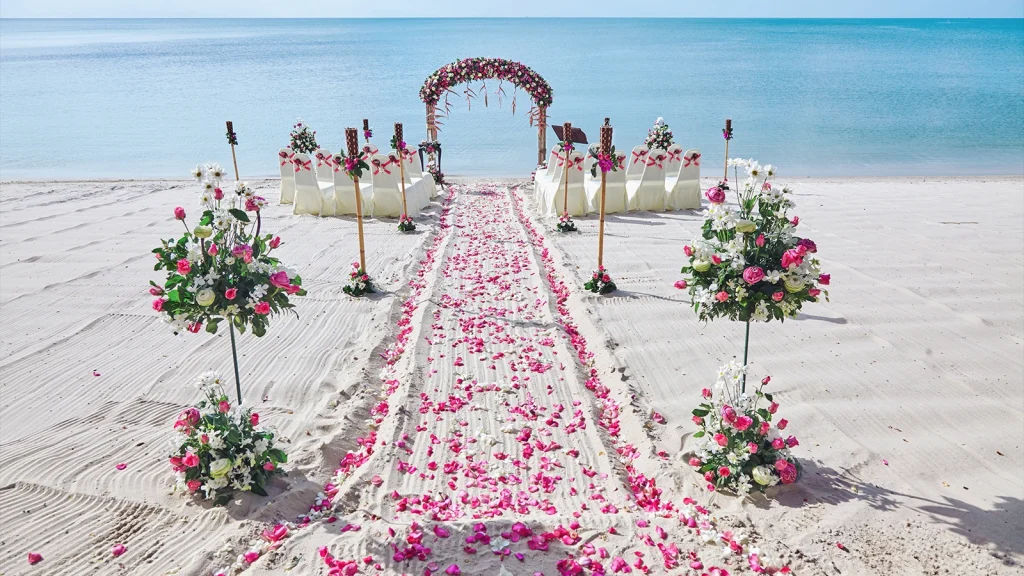
A great wedding film starts with a great timeline. Even the most talented videographer cannot capture moments that are rushed, poorly scheduled, or missed altogether.
A well-planned wedding day gives your videography team enough time to record meaningful moments, capture clean audio, and create cinematic footage without adding stress to your day.
You don’t need a complicated schedule. You simply need a timeline that works for both the celebration and the filming process.
How Long Does Wedding Videography Coverage Take?
Wedding videography packages are typically based on the number of coverage hours included. The right package depends on your timeline, planned events, and how much of the day you want documented. The table displays the common videographer coverage package:
| Coverage Length | Typically Includes |
|---|---|
| 6 Hours | Ceremony, portraits, cocktail hour, and major reception moments |
| 8 Hours | Getting ready, ceremony, portraits, and reception highlights |
| 10 Hours | Full wedding story from preparation through evening celebrations |
| Full-Day Coverage | Complete documentation from morning preparations to final send-off |
Building a Video-Friendly Wedding Day Timeline
A wedding timeline should do more than keep the day organized. It should create opportunities for beautiful footage while reducing unnecessary stress.
Small adjustments can make a huge difference in the final film.
- Allow travel time between locations
- Build in a buffer before the ceremony starts (30 min minimum for audio setup)
- Scheduling the First Look early, if desired, gives you extra portrait time and a private moment
- Block time for a couple of portraits at golden hour (even 15 min makes a dramatic difference)
- Coordinate toast timing with lighting/ambient conditions
- Plan a grand exit strategically (not when guests are already leaving)
Sample Wedding Videography Timeline
Every wedding is unique, but this sample schedule provides a strong starting point for planning video coverage.
| Time | Event / Videography Note |
|---|---|
| 10:00 AM | Getting ready coverage begins |
| 11:00 AM | Detail shots, dress, rings, invitations, venue footage |
| 12:00 PM | Bride and groom preparations |
| 1:00 PM | First Look (if planned) |
| 1:30 PM | Couple portraits |
| 2:00 PM | Wedding party portraits |
| 3:00 PM | Ceremony setup and audio checks |
| 3:30 PM | Ceremony begins |
| 4:30 PM | Cocktail hour and guest interactions |
| 5:00 PM | Golden hour portrait session |
| 6:00 PM | Reception begins |
| 7:00 PM | Toasts and speeches |
| 7:30 PM | First dance and parent dances |
| 8:30 PM | Open dancing and candid coverage |
| 10:00 PM | Grand exit and coverage end |
Communicating the Timeline with Your Videographer
Creating the timeline is only half the process. Sharing it properly is just as important. The earlier your videographer receives key details, the better they can prepare.
- Share the master timeline 4–6 weeks in advance
- Confirm with the coordinator and photographer that all timelines align
- Designate a family liaison for coordinating family formal shots
- Flag any moments where audio setup is required in advance
These moments often require microphones, audio recorders, or special setup procedures.
The Venue & Logistics Checklist: Preparing Your Location for Video
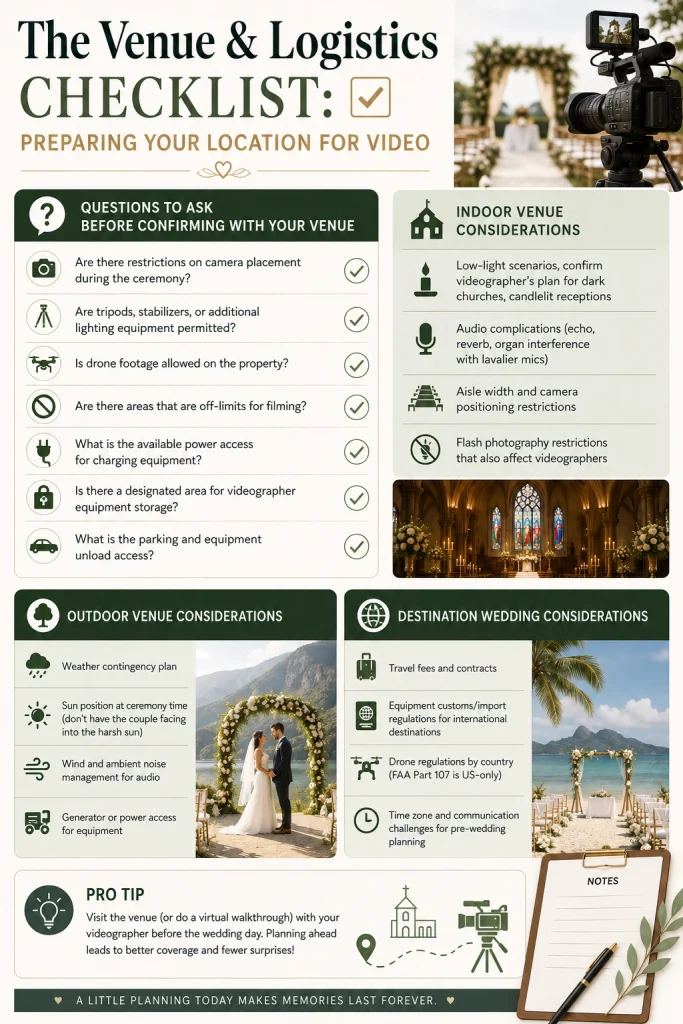
A beautiful wedding venue can elevate your wedding film. But even the most stunning location can create challenges if videography logistics are not planned.
Many couples focus on décor, seating layouts, and guest experience. Meanwhile, practical videography considerations often get overlooked until the wedding day.
That’s when issues like restricted camera placement, poor lighting, audio problems, or drone limitations can become expensive surprises.
Questions to Ask Before Confirming With Your Venue
- Are there restrictions on camera placement during the ceremony?
- Are tripods, stabilizers, or additional lighting equipment permitted?
- Is drone footage allowed on the property?
- Are there areas that are off-limits for filming?
- What is the available power access for charging equipment?
- Is there a designated area for videographer equipment storage?
- What is the parking and equipment unload access?
Indoor Venue Considerations
- Low-light scenarios, confirm videographer’s plan for dark churches, candlelit receptions
- Audio complications (echo, reverb, organ interference with lavalier mics)
- Aisle width and camera positioning restrictions
- Flash photography restrictions that also affect videographers
Outdoor Venue Considerations
- Weather contingency plan
- Sun position at ceremony time (don’t have the couple facing into the harsh sun)
- Wind and ambient noise management for audio
- Generator or power access for equipment
Destination Wedding Considerations
- Travel fees and contracts
- Equipment customs/import regulations for international destinations
- Drone regulations by country (FAA Part 107 is US-only)
- Time zone and communication challenges for pre-wedding planning
The Videographer’s Day-of Gear Checklist
The difference between a smooth wedding day and a stressful one often comes down to gear readiness. A dead battery, a missing memory card, or an audio failure can turn a dream project into a nightmare.
This wedding videography equipment checklist will help you prepare for every stage of the day,
Camera Body Checklist
Your camera system is the foundation of your wedding coverage. Reliability matters just as much as image quality.
- Primary camera body (cleaned, charged, formatted memory cards loaded)
- Backup camera body (same model preferred for color-matching in edit)
- Extra batteries (minimum 4 per camera body)
- Memory cards (minimum 2x capacity needed, formatted and labeled)
- Camera straps and cages
Lens Checklist
Wedding videography requires flexibility. You’ll move between tight preparation rooms, large ceremonies, emotional portraits, and crowded dance floors.
- 24–70mm f/2.8 (versatile all-day workhorse)
- 70–200mm f/2.8 (ceremony coverage from distance without intrusion)
- 50mm f/1.4 or 85mm f/1.8 (low-light, shallow depth of field)
- Wide-angle (for getting-ready spaces, venue establishing shots)
Stabilization Checklist
Shaky footage can instantly reduce the quality of an otherwise beautiful wedding film. Every stabilization tool serves a different purpose.
- Gimbal (charged, balanced for primary camera)
- Slider (for detail shots and reception décor)
- Tripod with fluid head (ceremony wide shot, speeches)
- Monopod (mobile ceremony coverage)
Audio Checklist: The Most Overlooked Part of Wedding Video Prep
Many beginning videographers obsess over cameras and lenses. Professionals obsess over audio. Couples will forgive a slightly dark image. They will never forgive inaudible vows.
- Wireless lavalier system for the officiant (primary audio source for vows)
- Wireless lavalier for the groom (backup audio)
- Dedicated audio recorder (Zoom H5/H6 or Tascam DR-40X), not camera audio
- XLR cables and adapters
- Backup batteries for all wireless transmitters/receivers
- Confirm DJ or band will provide an audio feed line-in
Lighting Checklist
Wedding venues aren’t always designed for cameras. Proper lighting ensures consistent image quality throughout the day.
- On-camera LED light (for getting ready, low-light reception)
- Portable LED panels with diffusers
- Reflectors for natural light outdoor situations
- Extra power banks for LED lights
Support & Miscellaneous Checklist
These are the items many videographers forget until they need them.
- Drone (charged batteries × 3, propeller guards, remote)
- Laptop + external drives for offloading backup during the day
- Gaffer tape (essential, never leave without it)
- Business cards for vendor networking on the day
- Printed shot list and timeline
- Chargers for all devices
- Snacks and water
Wedding Videography Gear Checklist
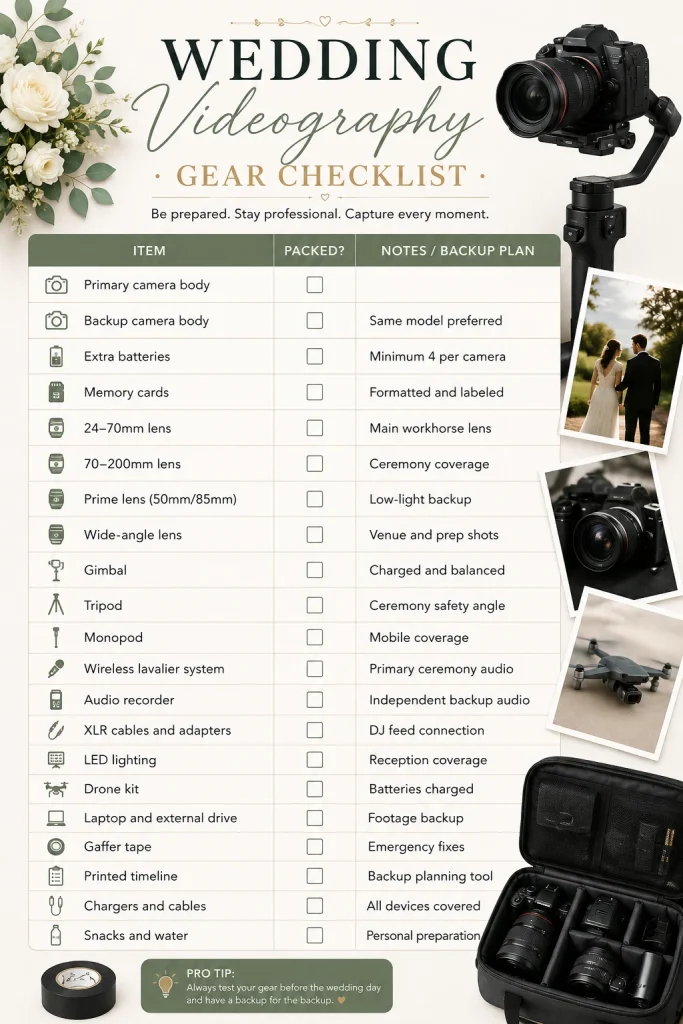
A wedding day leaves little room for technical mistakes. Having a complete gear checklist helps videographers stay organized, reduce risks, and prepare for unexpected situations. Use the table below to verify that all essential equipment, backups, and support items are packed and ready before heading to the venue.
| Item | Packed? | Notes / Backup Plan |
|---|---|---|
| Primary camera body | ☐ | Backup camera available |
| Backup camera body | ☐ | Same model preferred |
| Extra batteries | ☐ | Minimum 4 per camera |
| Memory cards | ☐ | Formatted and labeled |
| 24–70mm lens | ☐ | Main workhorse lens |
| 70–200mm lens | ☐ | Ceremony coverage |
| Prime lens (50mm/85mm) | ☐ | Low-light backup |
| Wide-angle lens | ☐ | Venue and prep shots |
| Gimbal | ☐ | Charged and balanced |
| Tripod | ☐ | Ceremony safety angle |
| Monopod | ☐ | Mobile coverage |
| Wireless lavalier system | ☐ | Primary ceremony audio |
| Audio recorder | ☐ | Independent backup audio |
| XLR cables and adapters | ☐ | DJ feed connection |
| LED lighting | ☐ | Reception coverage |
| Drone kit | ☐ | Batteries charged |
| Laptop and external drive | ☐ | Footage backup |
| Gaffer tape | ☐ | Emergency fixes |
| Printed timeline | ☐ | Backup planning tool |
| Chargers and cables | ☐ | All devices covered |
| Snacks and water | ☐ | Personal preparation |
The Post-Wedding Delivery Checklist: What Happens After the Big Day
The wedding may be over, but the videography process is not.
Many couples assume the final wedding film will arrive within a few days. In reality, professional wedding videography involves weeks or even months of post-production work.
Your videographer still needs to organize footage, back up files, synchronize audio, color grade footage, edit the story, select music, export deliverables, and complete quality checks before anything is delivered.
Understanding what happens after the wedding helps set realistic expectations and prevents unnecessary stress while waiting for your film.
Typical Wedding Video Delivery Timeline Checklist
Wedding video delivery doesn’t happen overnight. Professional editing, audio refinement, color grading, and quality checks all take time.
The table below outlines common delivery timelines for different wedding video formats and highlights important questions to ask so you know exactly what to expect after the wedding.
| Deliverable | Typical Timeline | What to Ask About |
|---|---|---|
| Social Media Teaser | 2–4 Weeks | Length and platform formats |
| Highlight Reel | 6–12 Weeks | Film length and revision policy |
| Full Ceremony Film | 2–4 Months | Editing style and audio quality |
| Full Reception Film | 3–6 Months | Included events and coverage |
| Raw Footage | Varies | Delivery method and pricing |
| Same-Day Edit (SDE) | Wedding Day | Included or add-on service |
What You Should Receive, Deliverables Checklist
One of the biggest sources of confusion is assuming certain deliverables are included when they are not.
Every wedding videography package is different. Before booking, confirm exactly what you will receive after the wedding. Here is the checklist to ensure:
- Highlight reel (confirm length, typically 3–7 minutes)
- Full ceremony film (unedited or lightly edited)
- Full reception film
- Speeches cut separately (optional add-on worth requesting)
- Same-day edit (SDE) if booked
- Social media teaser (vertical format, 60–90 seconds for Reels/TikTok)
- Raw footage (confirm if included or available for purchase)
- Delivery format: digital download, USB drive, streaming platform link
How to Request Revisions Without Damaging the Relationship
Receiving your wedding film is exciting, but sometimes small changes are needed. The key is providing clear, constructive feedback.
- What counts as a minor vs. a major revision
- How to give specific, actionable feedback
- Typical revision policy: 1–2 rounds included
- What to do if you’re genuinely unhappy with the final product
Storing and Sharing Your Wedding Video
Receiving your wedding film is only the beginning. Protecting those memories is equally important.
- Back up in multiple locations (cloud + external hard drive)
- Privacy settings on platforms when sharing publicly
- Music licensing limitations for public social media sharing
- How to make a wedding video shareable with family members
Post-Wedding Delivery Checklist
Before closing the chapter on your wedding videography experience, confirm that you have received:
- Highlight reel
- Full ceremony film
- Full reception film
- Speeches and toasts edit (if included)
- Same-Day Edit (if purchased)
- Social media versions
- Raw footage (if purchased)
- Download links and backups
- Usage rights information
- Final revision completion
Red Flags Checklist: Warning Signs to Watch For
Choosing a wedding videographer is about more than finding someone with a good camera. You’re trusting them to capture moments that can never be recreated. If something goes wrong, there are no second chances.
Most couples spend hours comparing highlight reels, but far fewer know how to identify warning signs before signing a contract. The reality is that some red flags appear long before the wedding day. Learning to spot them early can save you from disappointment, missed memories, and unnecessary stress.
A bad wedding videographer isn’t always easy to identify. Many problems only become obvious after the wedding, when it’s too late to make changes.
Watch for these warning signs during your research, consultations, and booking process.
Red Flags When Evaluating a Videographer
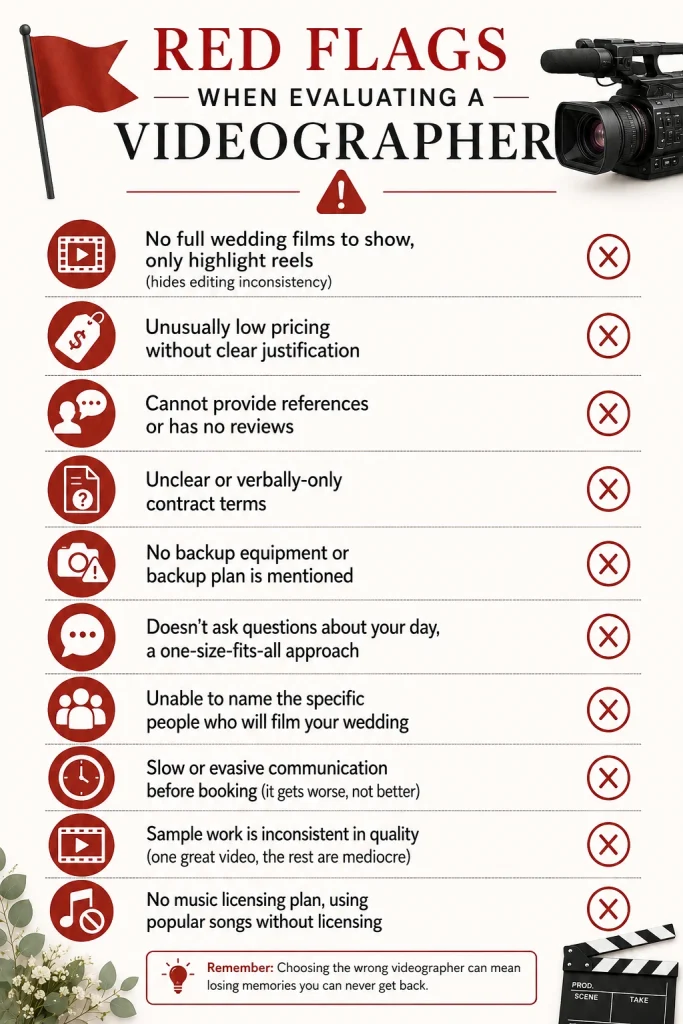
- No full wedding films to show, only highlight reels (hides editing inconsistency)
- Unusually low pricing without clear justification
- Cannot provide references or has no reviews
- Unclear or verbally-only contract terms
- No backup equipment or backup plan is mentioned
- Doesn’t ask questions about your day, a one-size-fits-all approach
- Unable to name the specific people who will film your wedding
- Slow or evasive communication before booking (it gets worse, not better)
- Sample work is inconsistent in quality (one great video, the rest are mediocre)
- No music licensing plan, using popular songs without licensing
Green Flag Sign: You’ve Found the Right Videographer
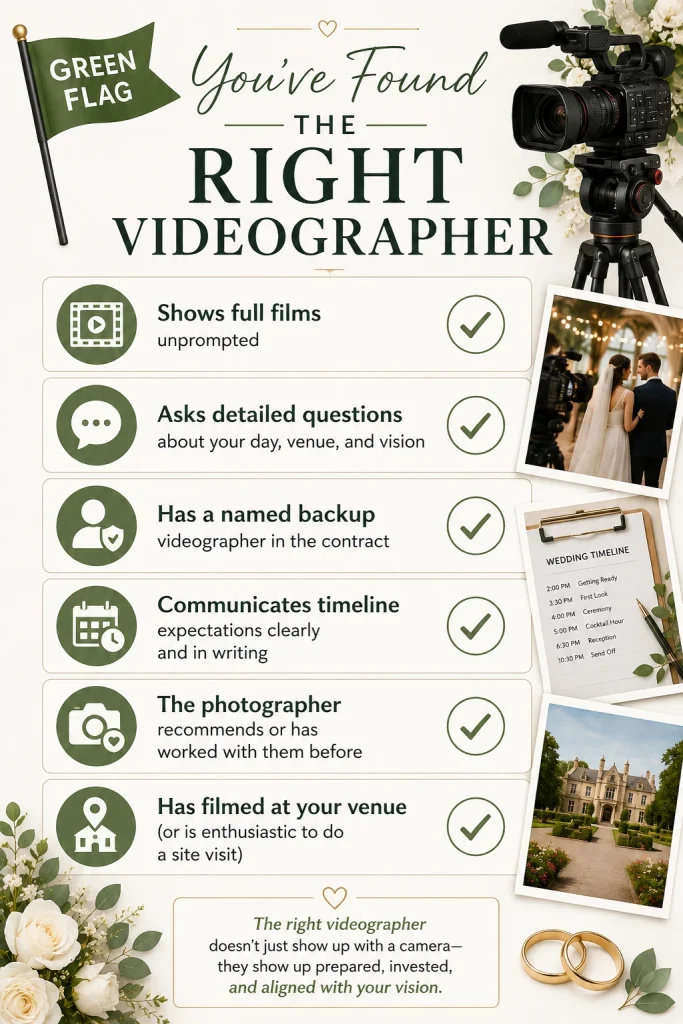
- Shows full films unprompted
- Asks detailed questions about your day, venue, and vision
- Has a named backup videographer in the contract
- Communicates timeline expectations clearly and in writing
- The photographer recommends or has worked with them before
- Has filmed at your venue (or is enthusiastic to do a site visit)
Frequently Asked Questions
Do I really need a shot list for my wedding video?
Yes. A shot list helps capture must-have moments, family members, and special details while ensuring your expectations align with your videographer’s coverage plan.
What is the difference between a highlight reel and a full wedding film?
A highlight reel is a 3–7 minute cinematic recap of your wedding day. A full wedding film includes longer coverage of the ceremony, speeches, and reception events.
Should I hire the same person for wedding photography and videography?
Combining saves money and simplifies coordination, but separate specialists often produce stronger results in each medium.
Can I use my own music in my wedding video?
Usually not for public sharing. Professional videographers use licensed music from platforms like Musicbed or Artlist to comply with copyright laws and avoid takedowns.
Do I need a second videographer at my wedding?
A second videographer is recommended for larger weddings, multiple locations, or simultaneous preparations. It provides more angles, better coverage, and greater flexibility throughout the day.
What should I do if I’m unhappy with my wedding video?
Review your contract’s revision policy and provide clear, specific feedback. Most professional videographers offer revision rounds and will work with you to address reasonable concerns.
How do I store my wedding video long-term?
Follow the three-copy rule: save your wedding video to cloud storage and an external hard drive, and keep the original delivery link for added protection.
What is a same-day edit (SDE)?
A same-day edit is a short wedding film, typically 3–5 minutes long, edited during the event and shown to guests during the reception.
What resolution should my wedding video be delivered in?
At minimum, request Full HD (1080p). However, 4K is the current professional standard and offers better image quality and long-term viewing flexibility.