When Was Color Photography Invented? This question takes us back to the early experiments that shaped modern photography. Color photography is a method of capturing and reproducing images with natural colors by recording light in red, green, and blue components. It helps photographers create realistic visuals for artistic, commercial, and everyday purposes.
The invention of color photography began with RGB-based experiments in the 19th century and later developed into practical processes like Autochrome and Kodachrome. Early color results were often unreliable, but advances in film and digital technology gradually improved color accuracy and consistency. Today, modern cameras and editing software make it easier than ever to produce vibrant, natural, and highly controlled color images.
Early Experiments Before Color Photography
In the early days, photographers used hand-tinting black-and-white prints to experiment with colors. Artists applied pigments to simulate real tones. Scientists tested light separation using filters and prisms. These methods helped them study how light behaves and how images could reproduce natural color accurately.
First Color Ideas Breakdown
Early color ideas focused on separating light into primary components. Color photography ideas developed step by step through scientific discovery and experimentation.
Here’s the chronological order of colors in photography.
- In 1666, Isaac Newton proved that white light splits into a color spectrum using a prism. This discovery explained that color exists within light itself.
- In 1802, Thomas Young proposed that humans see color through three receptors: red, green, and blue. This theory guided later photographic experiments.
- In 1861, James Clerk Maxwell demonstrated the first color image using three filtered exposures. He combined red, green, and blue projections to recreate color. It was the event of the color photography invention.
- In 1862, Louis Ducos du Hauron began experimenting with color photography. He applied the trichromatic theory that James Clerk Maxwell developed. He worked on methods to reproduce color images using separate color components.
- In the late 1800s, photographers tested multi-exposure techniques using glass plates and filters. These methods proved the concept but remained impractical due to long exposure times and alignment issues.
How Do Colors Work in Photography?
Color in photography works through light interaction and sensor or film response. Light reflects from objects and carries wavelength information. Cameras capture this data using color filters or chemical layers.
Film uses dye layers sensitive to red, green, and blue light. Digital sensors use filter arrays to record similar data. The system processes these signals to produce full-color images. Accurate color depends on lighting, white balance, and material reflectivity.
When Was the First Color Photo Taken?
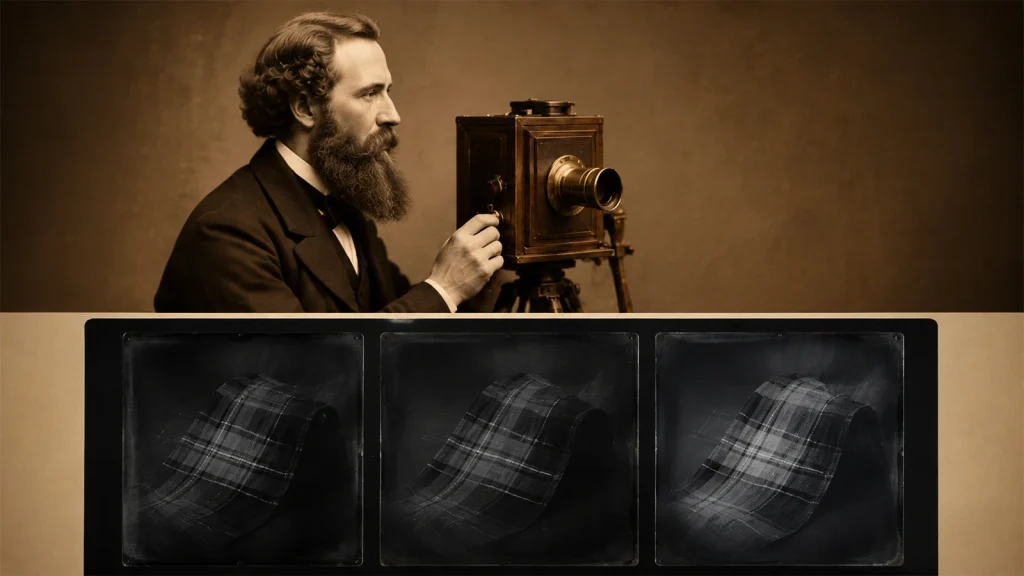
The first color photograph was taken in 1861 by physicist James Clerk Maxwell. He photographed a tartan ribbon with red, green, and blue filters. He projected the images together to recreate color, which showed fabric patterns. As a result, it was proved that color photography could work.
1861 Color Photography Breakthrough
The year 1861 marked the first successful color photography demonstration. James Clerk Maxwell presented his results at the Royal Institution. He proved that combining three filtered images could reproduce color. His experiment validated the trichromatic theory in practical imaging.
First Color Photograph by James Clerk Maxwell
James Clerk Maxwell created the first color photograph of a tartan ribbon. The subject remained static to avoid misalignment. His assistant exposed the same object three times, each time using a different filter. The final projected image displayed recognizable colors. But the accuracy remained limited by materials and exposure control.
How the First Color Image Was Made?
The first color image was made by using three separate exposures. The photographer placed red, green, and blue filters in front of the lens. Each exposure captured one part of the color spectrum. The images were later projected together. The overlapping projections recreated a full-color image through additive color mixing.
Process Behind Early Color Photos
Early color photos relied on additive color theory; photographers captured multiple exposures. They used glass plates for each filtered image. They combined results through projection rather than printing. The process required precise alignment and controlled lighting to avoid color distortion.
Color Photography in the 19th Century
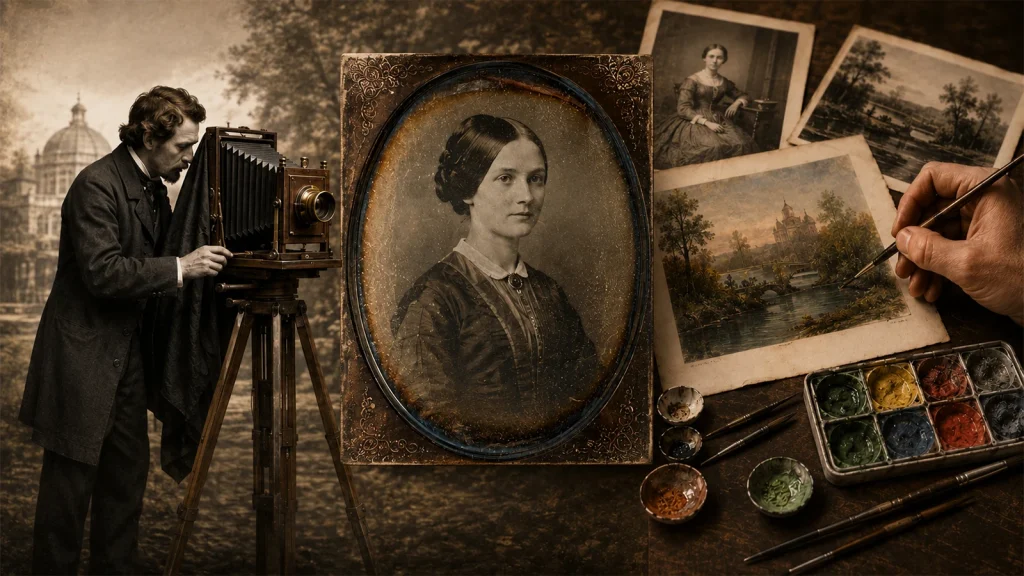
19th-century color photos were decorated in hand-coloring black-and-white prints. Artists applied pigments to add realistic tones. Scientists tested multi-exposure color methods. But the results remained experimental, resulting in a lack of true color in images. Photographers depended on manual coloring to simulate lifelike scenes for portraits and landscapes.
Early Colored Camera Processes
Photographers used hand-drawing and many other processes to create color-like images. Artists painted over albumen prints and daguerreotypes to simulate skin tones and fabrics.
In the late 1800s, several experimenters explored additive color methods based on James Clerk Maxwell. They captured multiple exposures through colored filters. They combined these images using projection or layering.
Another approach was early color screens and interference methods. Gabriel Lippmann in 1891 developed some recording color using light wave interference. However, it required long exposures and complex viewing conditions, which limited practical use.
Limitations of Early Color Photos
Early color photography faced many technical and practical issues, both with photographers and photos. Shooting processes required multiple exposures, long shooting times, and controlled conditions. Colors often appeared unstable or inaccurate. Equipment remained complex and costly.
8 common limitations of early color images are as follows.
- Long exposure time forced subjects to stay completely still
- Multiple exposures caused misalignment in moving scenes
- Colors appeared faded or inaccurate due to weak sensitivity
- Materials and chemicals increased the overall cost
- Results lacked consistency across different attempts
- Printing true color images was not practical at that time
- Equipment setup remained complex and difficult to manage
- Viewing methods like projection are limited to everyday use
Autochrome Era: First Practical Color Photography (1907)
The Autochrome era began in 1907 when practical color photography was starting. The process used a single glass plate with color filters to capture images. It simplified earlier methods and enabled real-life color documentation. Despite slower exposure times, photography became more accessible for professionals and publications.
What is an Autochrome?
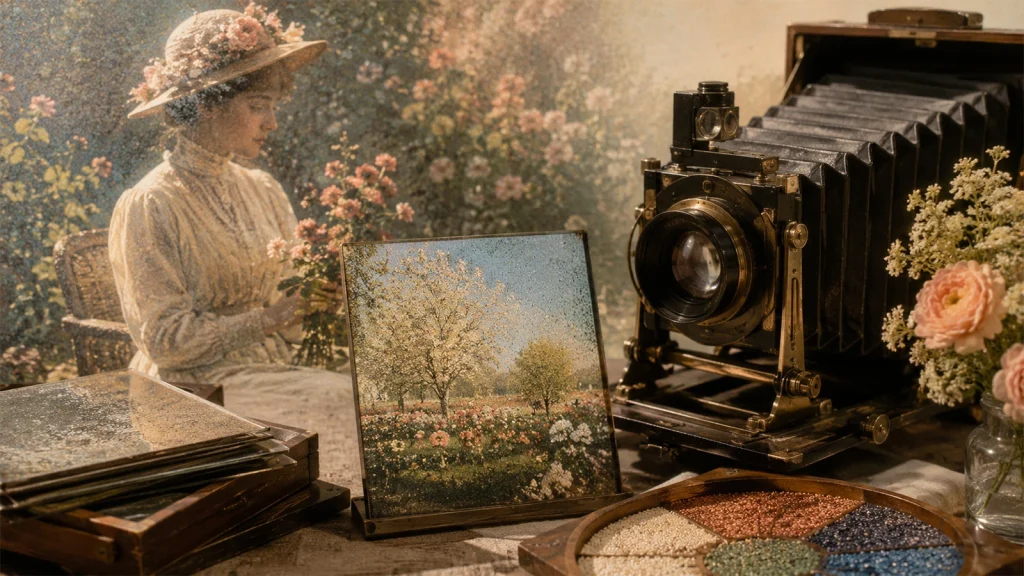
Autochrome was a 20th-century color photography process. It used a glass plate coated with microscopic dyed potato starch grains in red, green, and blue. These grains acted as a color filter layer. Auguste Lumière and Louis Lumière introduced Autochrome in 1907.
When light passed through the color filter layer and reached the photosensitive surface, the plate recorded the image in a single exposure. The viewer placed the developed plate against a light source. The image displayed natural colors through transmitted light. This method eliminated the need for multiple exposures.
Why Was Autochrome Important?
Autochrome was important to make color photography practical for real-world use. It allowed photographers to capture color images in a single exposure instead of multiple shots. It simplified the workflow and improved consistency across results.
Here are the reasons for using autochrome as follows.
- Enabled single-exposure color photography
- Improved consistency in color reproduction
- Expanded use in publishing and visual storytelling
- Supported documentary and portrait photography in color
- Reduced complexity compared to multi-exposure methods
- Marked the shift from experimental to practical color photography.
When Did Color Film Come Out?
Color film came out in the early 20th century, when Eastman Kodak (a photography company) introduced Kodachrome in 1935. Scientists Leopold Godowsky Jr. and Leopold Mannes developed the process. It enabled practical, vibrant color capture on flexible film for still and motion pictures.
1930s Innovations in Color Film
In 1930, several reliable color film systems were introduced. Film manufacturers improved multi-layer film technology. Films contained separate layers sensitive to red, green, and blue light. Each layer recorded part of the color spectrum during exposure. Some major events in 1930s color films are as follows.
- Eastman Kodak launched Kodachrome in 1935.
- Agfa introduced Agfacolor in 1936. Agfacolor included dye couplers inside the film to simplify processing. It results in more accurate colors and an easy workflow. Also, it reduced multiple exposures and unstable color reproduction.
Kodak Kodachrome: Major Breakthrough in Color Photography
The year 1935 marked a milestone for color photography. It was the time when modern color photography created consistent results and was widely adopted.
In 1935, Eastman Kodak released Kodachrome film to capture still photographs in color. The images appeared stable and vibrant due to the use of a complex multilayer process.
Later in 1936, Kodak expanded Kodachrome to 35mm film. It allowed more photographers access to color photos.
In the late 1930s, publications and filmmakers adopted Kodachrome for its color accuracy and archival stability. The film produced rich tones and fine detail.
When Did Color Photos Become Popular?
Color photos became popular in the 1950s after World War II. At that time, films started to become affordable, and the color photography process was faster. Photography companies like Eastman Kodak improved consumer color film. Gradually, people preferred color for a more realistic look in family photos and advertising.
Did Color Photos Exist in 1940?
Yes, color photos existed in 1940. Photographers, professionals, and publishers used films like Kodachrome. But it was costly and complicated. So, the black-and-white photography stayed more common for everyday photography.
Shift From Black and White to Color
The shift from black-and-white to color happened after 1940. At that time, color films became cost-effective, faster, and more reliable. So, people choose realistic and vibrant memories in photos.
Besides, color photos were used in advertising and magazines to attract attention. Printing technology also improved to support mass color reproduction. Black-and-white photos got sidelined and used for artistic and budget purposes. By the 1960s and 1970s, color photography became the standard for most uses.
Evolution of Color Cameras
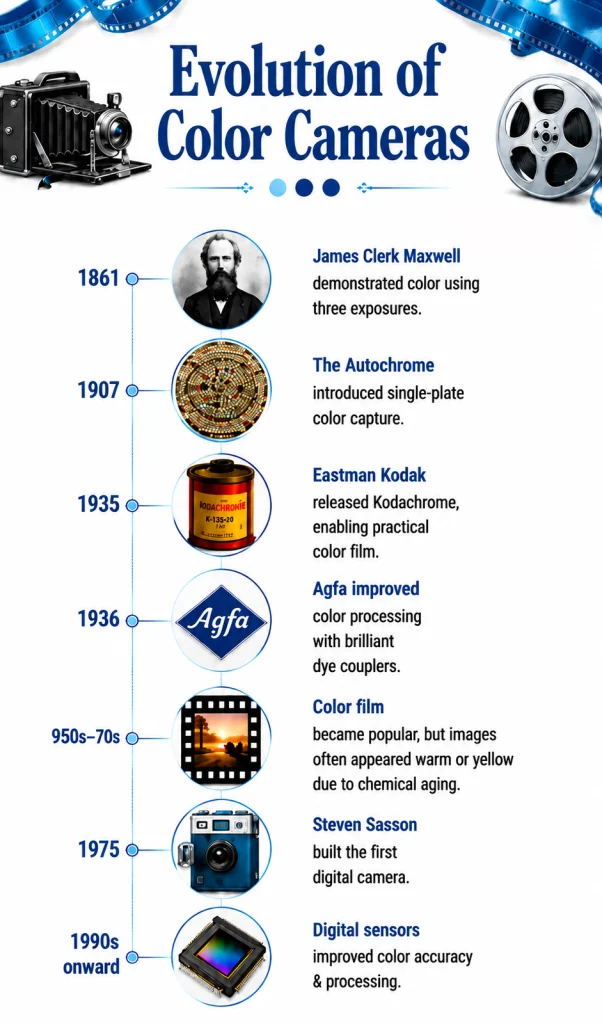
Cameras have evolved, from capturing only monochrome images in the 1800s to capturing color images in the 1900s.
- In 1861, James Clerk Maxwell demonstrated color using three exposures.
- In 1907, the autochrome introduced single-plate color capture.
- In 1935, Eastman Kodak released Kodachrome, enabling practical color film.
- In 1936, Agfa improved color processing with built-in dye couplers.
- By the 1950s–70s, color film became popular, but images often appeared warm or yellow due to chemical aging.
- In 1975, Steven Sasson built the first digital camera.
From the 1990s onward, digital sensors improved color accuracy, white balance, and image processing. Modern cameras deliver precise, consistent colors using advanced sensors and software.
How Modern Cameras Capture Color?
Modern cameras capture color by using sensors and filters. Light enters through the lens and reaches the camera sensor. The sensor contains millions of pixels, and each pixel records light intensity. A color filter array, usually a Bayer filter, sits above the sensor. It separates light into red, green, and blue components. Each pixel captures only one color value.
The camera processor combines nearby pixel data to form a full-color image through demosaicing. It then applies white balance to correct color temperature. The processor also adjusts contrast, saturation, and overall color accuracy. Advanced systems use algorithms to improve skin tones, dynamic range, and low-light color results.
Color in Motion Pictures
Color in motion pictures was achieved by hand-painting frames in the early 1900s. Later, it changed to advanced digital color grading. Early systems used tinting and two-color processes. In the 1930s, Technicolor Motion Picture Corporation introduced stable color films. Filmmakers adopted color for realism and storytelling. Today, digital cameras and software deliver precise, cinematic color control.
Early Color Films and Experiments
Early filmmakers used hand-painting for each frame or applied tinting techniques. These techniques colored entire scenes rather than specific objects. Later, two-color systems recorded limited color ranges using filters. Audiences always preferred colorful visuals for realism. But the results looked unnatural and required complex processing. Even so, filmmakers started using color in short films. It turned the mass interest toward developing more practical and realistic color systems.
Technicolor and the Rise of Color Movies
In the 1920s and 1930s, Technicolor Motion Picture Corporation developed advanced color processes. Early versions used two-color systems, but they lacked full color accuracy. In 1932, Technicolor introduced a three-strip process that captured red, green, and blue. It produced rich and stable colors, one example is the Hollywood movie The Wizard of Oz.
Why Do Old Photos Have Unique Colors?
Old photos have unique colors due to several technical, processing, and environmental reasons, causing vintage photos to appear warm, faded, or stylistically colored compared to modern images.
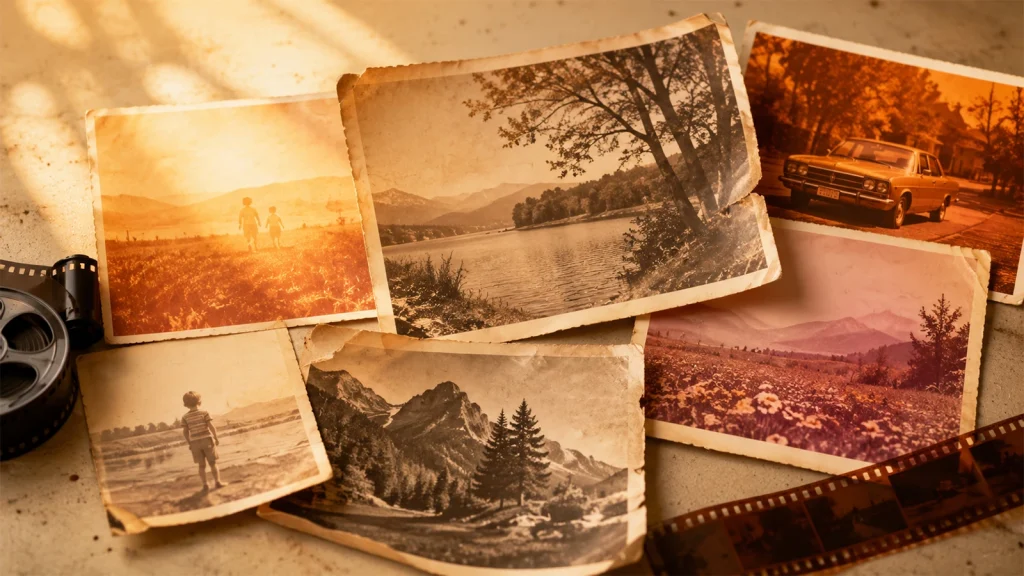
6 reasons for old images having unique colors are as follows.
- Photographers used tinting and printing techniques for added tones.
- Early film chemistry emphasized warm tones like yellow, brown, and orange.
- Dyes faded unevenly over time, shifting colors toward sepia or red.
- Storage factors like heat, light, and humidity alter color balance.
- Limited color sensitivity reduced accurate color reproduction.
- Lighting conditions affected how colors were captured.
Color Fading Explained
Color fading refers to the gradual color changes in photos over time. It is caused by the photos’ chemical dyes breaking down due to light, oxygen, heat, and humidity. Old photos faded because early color films had less stable dye layers. Those dyes degrade at different rates. It shifted colors toward red, yellow, or magenta. Fading colors also occurred due to improper storage.
Modern color techniques solve the fading issue with improved dye stability and digital imaging. Films now have more durable color layers. Modern digital cameras store color as data instead of chemical dyes. Image files preserve original colors without physical degradation. Backup systems and editing tools also help maintain consistent color over time.
Why Do 1970s Photos Look Orange?
1970s photos look orange or show a strong warm color cast because the color film used three dye layers: red, green, and blue. These layers worked together to create full color. Over time, the blue dye layer faded faster than the red and green layers. When blue faded, warm colors became dominant. This shift made photos look orange or brown. Moreover, heat, light, and poor storage accelerated the fading.
Key Milestones in Color Photography
Color photography evolved through scientific theory, experimental methods, and industrial innovation. Key milestones include early RGB experiments, practical Autochrome plates, color film breakthroughs, and digital imaging. Each stage improved accuracy, usability, and accessibility, shaping how photographers capture and reproduce color today.
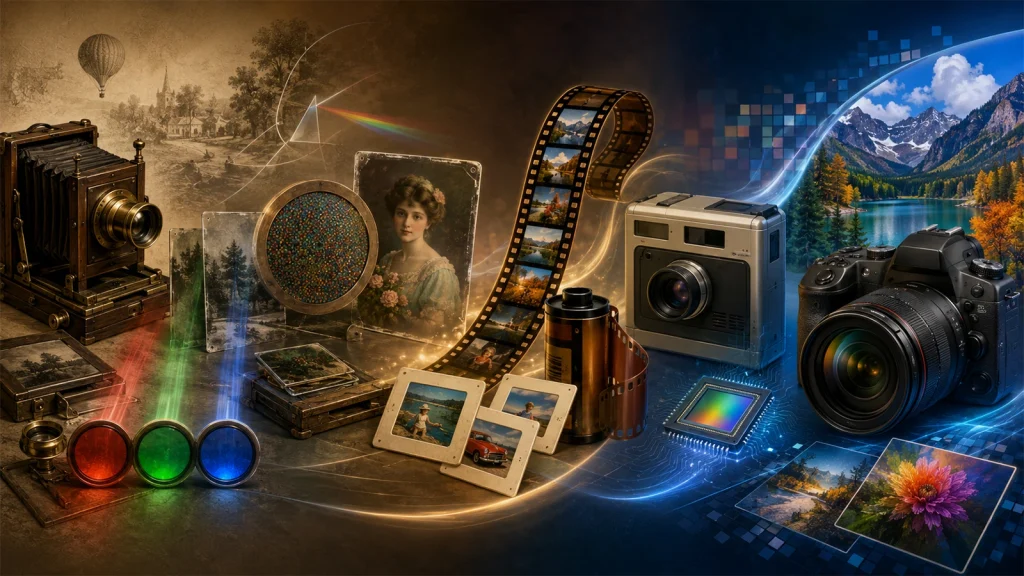
Timeline: 1861 to the Digital Era
- 1861: James Clerk Maxwell demonstrated color photography using three filtered images. Thomas Sutton captured the exposures.
- 1862: Louis Ducos du Hauron applied trichromatic theory to develop practical color methods.
- 1907: Auguste Lumière and Louis Lumière introduced Autochrome, enabling single-exposure color images.
- 1935: Eastman Kodak released Kodachrome, making color film practical.
- 1936: Agfa introduced integrated dye couplers for easier processing.
- 1975: Steven Sasson built the first digital camera.
- 1990s: Digital cameras improved sensors, enabling accurate color capture and processing.
- 2000s–Present: Advanced digital imaging, AI processing, and editing tools deliver precise and consistent color reproduction.
Major Innovations and Turning Points
- 1861 – RGB Principle Applied
James Clerk Maxwell proved that three-color separation could reproduce images. This established the scientific base for all future color systems.
- 1907 – Autochrome Process
Auguste Lumière and Louis Lumière enabled single-exposure color photography. This shifted color from experimental to usable practice.
- 1935–1936 – Color Film Commercialization
Eastman Kodak and Agfa introduced stable and scalable color film. This expanded color photography in media, advertising, and personal use.
- 1975 – Digital Imaging Begins
Steven Sasson created the first digital camera. This removed reliance on chemical film and enabled electronic color capture.
- 1990s–Present – Digital and AI Color Processing
Modern sensors and software have improved color accuracy, consistency, and editing flexibility. This transformed photography across industries, from e-commerce to cinematic production.
Modern Color Photography

Modern color photography prioritizes accuracy, consistency, and creative control. Photographers use digital sensors, advanced processors, and editing software to achieve precise colors. Trends also shape moderate color preference and favor natural skin tones, cinematic grading, and brand-specific palettes. Modern marketing, e-commerce, and social media demand consistent color. It maintains trust, improves product appeal, and strengthens visual identity across platforms.
How Digital Color Works?
Digital cameras capture color using sensors with red, green, and blue filters. Each pixel records light intensity. The processor combines data through demosaicing, applies white balance, and adjusts tones to produce accurate, full-color images.
Editing and Color Correction
Editing and color correction refine the final image after capture. Photo editing tools such as Adobe Photoshop, Adobe Lightroom, etc., are used for adjusting white balance, exposure, contrast, and color tones. Color correction ensures accurate and natural colors by fixing lighting and color cast issues. Color grading goes further by applying a creative look or mood.
Applying color correction helps maintain consistency across multiple images. Photographers can match specific color standards, improve visual appeal, and deliver professional-quality results.
6 Color Photography Techniques
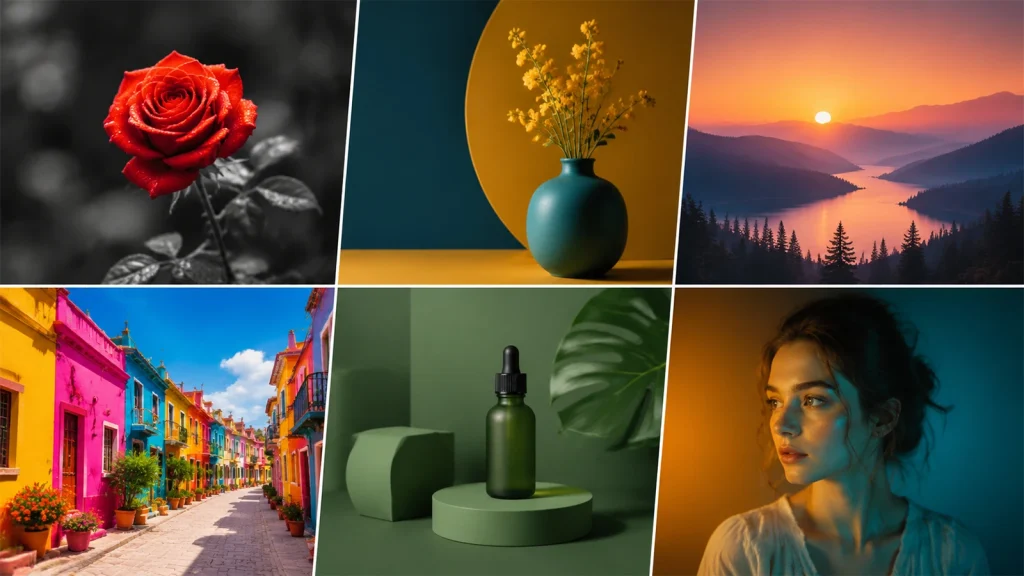
Color photography techniques control mood, improve focus, and retain brand consistency across industries. Color techniques such as color isolation, complementary schemes, and grading are widely used. Photographers, photography studios, e-commerce, and social media digital platforms use color techniques to guide viewers, enhance product visibility, and create emotional impact. Modern tools and editing software allow precise color control for consistent visual storytelling.
Color Isolation Photography
Color isolation photography is the technique of highlighting one color while desaturating others. The editor converts most of the image to black-and-white and keeps a selected color visible. The isolation technique draws strong attention to a subject, so it is mostly applied to portraits, product photography, and social media visuals to create focus and contrast.
Color Combinations in Photography
Color combinations use color theory, pairing colors as complementary or analogous tones. It is generally used for creating a visual fulfillment in appearance. It covers models’ clothing, background, or objects to match a color scheme, to create visual harmony or contrast. These techniques appear in brand photos, fashion shoots, product photography, and advertising.
Color Grading Photography
Color grading adjusts tones, contrast, and color balance during editing. Professional photo editors apply presets or manual adjustments to create a specific mood. This technique shapes storytelling and brand identity. Grading is mostly used in films, advertisements, cinematic images, ad campaigns, social content, etc.
High Saturation Photography
High saturation photography is the process of using high color intensity to make images vivid. By adjusting camera settings or using photo editing software, you can boost color strength. It creates bold and eye-catching visuals. High-contrast images appear in travel, food, and e-commerce photography where bright colors attract attention.
Monochromatic Color Photography
Monochromatic photography uses variations of a single color across the image. Photographers select similar tones for subjects and backgrounds, intending to create a cohesive look. Monochromatic color photography is common in minimalistic photography, product shoots, and artistic compositions.
Split Toning Photography
Split toning applies different colors to highlights and shadows. Photo editors use one color to brighten areas and another to darken areas to add depth and mood. Split toning is found in portraits, cinematic edits, and creative projects to enhance visual storytelling.
FAQ’s
1. Why did the first color photographs require such long exposure times?
Early color processes, like James Clerk Maxwell’s 1861 experiment, involved taking three separate images through different colored filters (Red, Green, and Blue). Because the photographic plates of that era were not very sensitive to red or green light, it took several minutes of exposure to capture enough light, making a tripod mandatory.
2. Is it true that the first color photos were made using potatoes?
Yes! The Autochrome Lumière (the first practical color process) used millions of microscopic grains of potato starch dyed red-orange, green, and violet. These acted as tiny color filters on a glass plate, creating a beautiful, pointillist effect similar to an impressionist painting.
3. What is the difference between “Additive” and “Subtractive” color processes?
Additive (The Beginning): Created colors by mixing light (Red, Green, Blue). Used by Maxwell and in Autochromes.
Subtractive (Modern Era): Created colors by removing light using dyes (Cyan, Magenta, Yellow). This is the foundation of Kodachrome (1935) and modern printing.
4. Why was color photography considered “unartistic” for so many years?
For much of the 20th century, many “serious” photographers (like Henri Cartier-Bresson) viewed color as distracting or “vulgar.” They felt it was too realistic for art and better suited for advertising or family snapshots. It wasn’t until the 1970s (led by artists like William Eggleston) that color was fully accepted in the fine art world.
5. How has digital technology changed the way we capture color compared to film?
In the film era, the color “look” was determined by the chemical makeup of the film (e.g., the high saturation of Kodachrome). In the digital era, your camera sensor captures light through a Bayer Filter (a digital version of the color filters used in the 1800s), allowing you to manipulate and change color profiles entirely after the photo is taken.