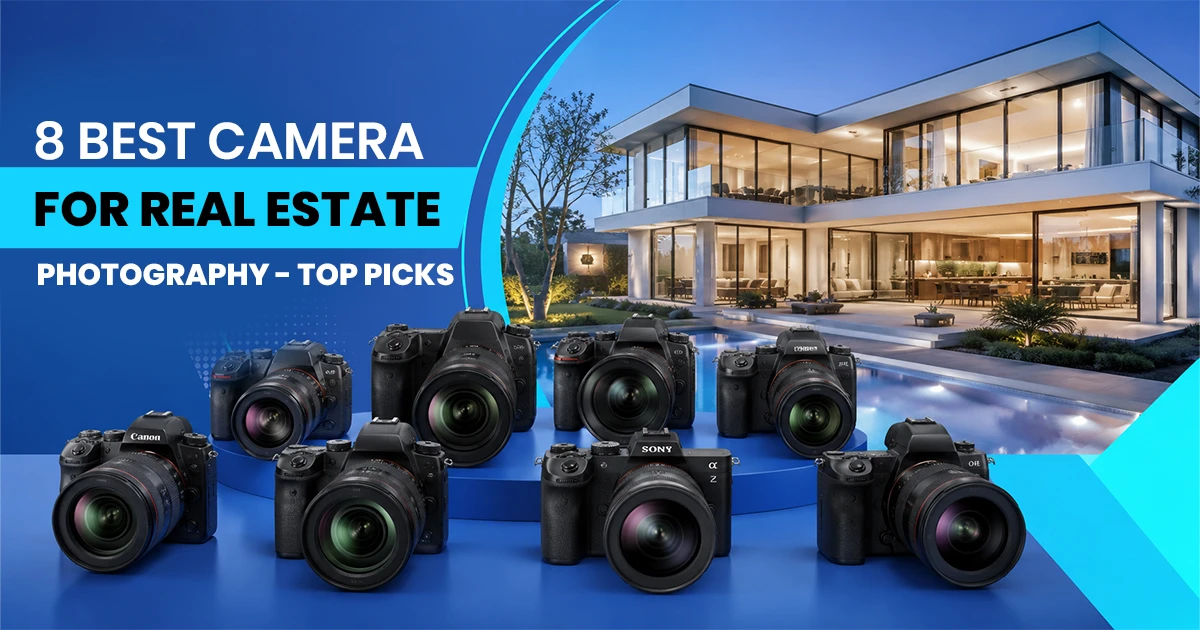
Choosing the best camera for real estate photography is not just about megapixels. Real estate photography is a difficult mix of bright windows, dark rooms, tight spaces, straight architectural lines, mixed indoor lighting, and high client expectations.
A good real estate camera should help you capture rooms that look bright, spacious, sharp, and natural without making the property feel fake. It should also support the right wide-angle lenses, shoot RAW files, handle HDR bracketing, and perform well in low light.
This matters because listing photos are one of the most important features buyers look at online. NAR reported that 81% of buyers rated listing photos as the most useful feature during their online home search.
Quick Answer: What Is the Best Camera for Real Estate Photography?
The Sony A7 IV is the best overall camera for real estate photography for most photographers because it offers a strong balance of full-frame image quality, 33MP resolution, 4K/60p video, excellent lens support, and professional flexibility. Sony lists the Alpha 7 IV with a 33MP full-frame sensor and 4K/60p recording, making it a reliable hybrid option for both listing photos and property walkthrough videos.
For beginners, the Canon EOS R50 is a better starting point because it is lightweight, affordable, and simple to use. For professionals shooting luxury homes, the Canon EOS R5 Mark II and Sony A7R V offer higher resolution and more editing flexibility.
Best Cameras for Real Estate Photography: Comparison Table
| Camera | Best For | Sensor | Key Strength | Watch Out For |
|---|---|---|---|---|
| Sony A7 IV | Best overall | 33MP full-frame | Great photo/video balance | More expensive than APS-C bodies |
| Canon EOS R50 | Beginners | 24.2MP APS-C | Easy, light, affordable | Needs an ultra-wide APS-C lens |
| Canon EOS R10 | Budget mirrorless | 24.2MP APS-C | Strong value and 4K | No in-body stabilization |
| Nikon Z5II | Best full-frame value | 24.5MP full-frame | Affordable full-frame quality | 4K/60p uses crop |
| Canon EOS R8 | Lightweight full-frame | 24.2MP full-frame | Compact, clean files, strong video | No IBIS |
| Canon EOS R5 Mark II | Professionals | 45MP full-frame | Luxury listings and video | Expensive |
| Sony A7R V | High-resolution work | 61MP full-frame | Huge detail for architecture | Large files |
| Nikon D850 | Best DSLR | 45.7MP full-frame | Proven still-image quality | Older DSLR system |
How We Chose These Cameras
For real estate photography, the most important camera features are not the same as sports, portraits, or street photography. We focused on:
Dynamic range: Interior photography often includes bright windows and dark shadows in the same frame.
HDR bracketing: A camera should make it easy to shoot multiple exposures for HDR blending.
Wide-angle lens support: Lens choice is often more important than the camera body.
RAW image quality: RAW files give more flexibility when correcting exposure, white balance, shadows, and highlights.
Low-light performance: Many rooms are darker than they look to the human eye.
Video capability: Modern real estate marketing often includes walkthrough videos, reels, and social clips.
Upgrade path: Beginners should avoid buying into a camera system with limited lens options.
A wide-angle lens is essential. For full-frame cameras, a 14–24mm or 16–35mm lens is usually the sweet spot. For APS-C cameras, look for a 10–18mm, 10–20mm, or 11–20mm lens to get a similar field of view.
1. Sony A7 IV Best Overall Camera for Real Estate Photography
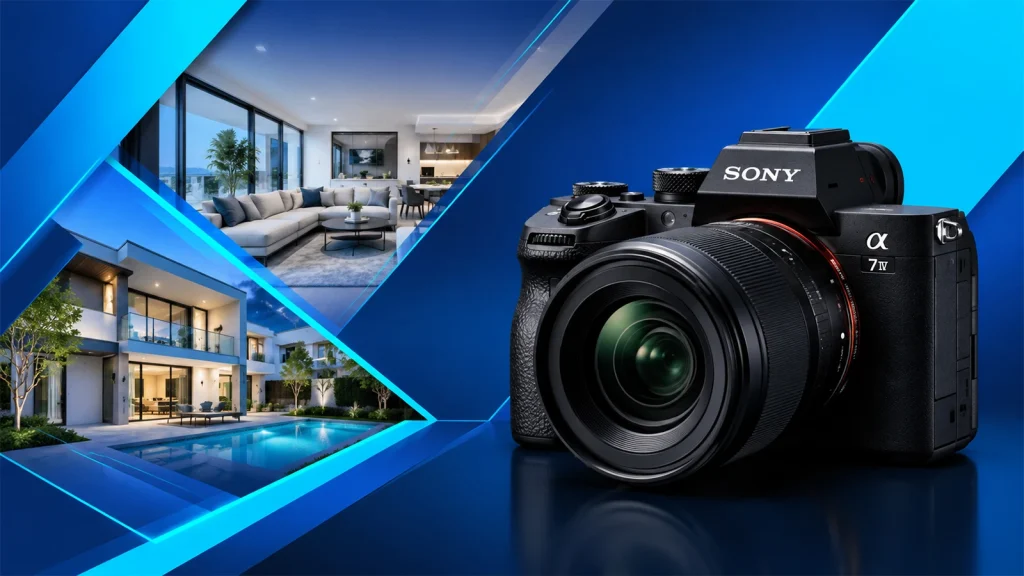
The Sony A7 IV is the best overall camera for real estate photography because it gives you the right mix of image quality, dynamic range, video features, lens choice, and professional reliability.
Its 33MP full-frame sensor gives enough resolution for MLS listings, websites, brochures, social media, and moderate cropping. It is not as file-heavy as a 61MP camera, which makes it easier to manage large property shoots. Sony also gives the A7 IV 4K/60p video and 10-bit 4:2:2 recording, making it useful for hybrid photographers who shoot both stills and video tours.
The biggest advantage is the Sony E-mount lens system. You can pair it with a Sony FE 16–35mm lens, third-party ultra-wide zooms, or compact primes, depending on your budget.
Why it is good for real estate
The A7 IV handles mixed lighting well, produces sharp RAW files, and gives you strong flexibility in post-production. For interiors with bright windows, you can shoot bracketed exposures and merge them into a balanced HDR image. For video, the full-frame look and reliable autofocus make walkthroughs cleaner and more professional.
Best for
Real estate photographers who want one camera for listing photos, walkthrough videos, social media clips, interiors, exteriors, and long-term business growth.
Skip it if
You only shoot basic rental listings and need the cheapest possible setup.
2. Canon EOS R50 Best Beginner Camera for Real Estate Photography
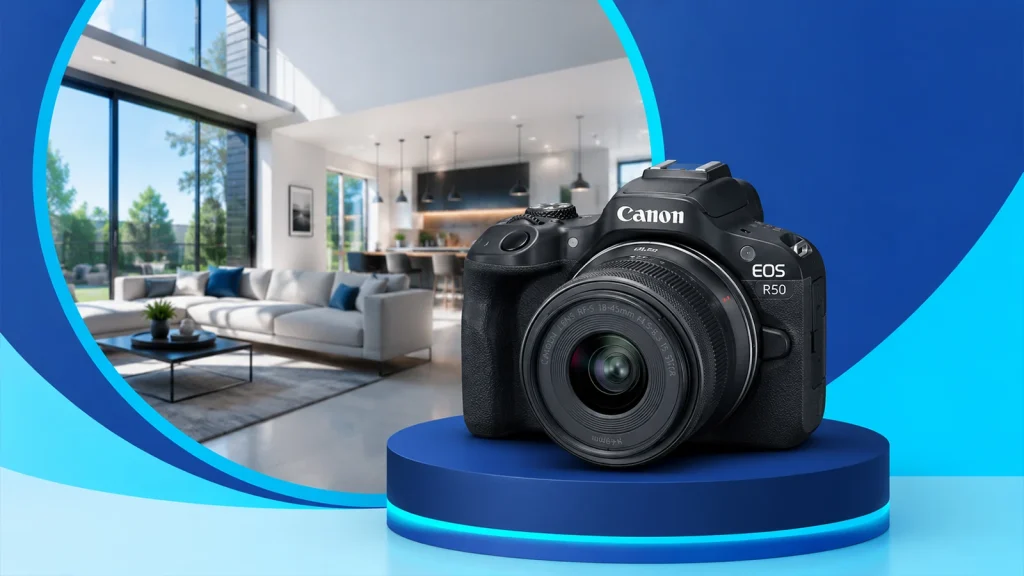
The Canon EOS R50 is one of the best beginner cameras for real estate photography because it is small, simple, and affordable while still producing high-quality images when paired with the right lens.
Canon lists the EOS R50 with a 24.2MP APS-C CMOS sensor, 4K 30p video oversampled from 6K, and a lightweight body of about 375g.
For a beginner, that is more than enough to start shooting apartments, rental properties, Airbnb listings, small homes, and agent-owned listings. The key is not to rely on the kit lens. You need a wider lens for interiors.
Why it is good for real estate
The R50 is easy to carry, easy to learn, and good enough for clean listing photos in controlled conditions. It works especially well on a tripod with HDR bracketing and RAW editing.
Because it is an APS-C camera, you need to understand crop factor. A 16mm lens on APS-C will not look as wide as 16mm on full frame. For interiors, look for an RF-S ultra-wide lens or an adapted EF-S wide-angle lens.
Best for
Beginners, real estate agents, rental hosts, and new photographers who want a low-cost entry into real estate photography.
Skip it if
You already shoot luxury properties or need stronger low-light performance and wider full-frame lens coverage.
3. Canon EOS R10 Best Budget Mirrorless Camera for Real Estate Photography
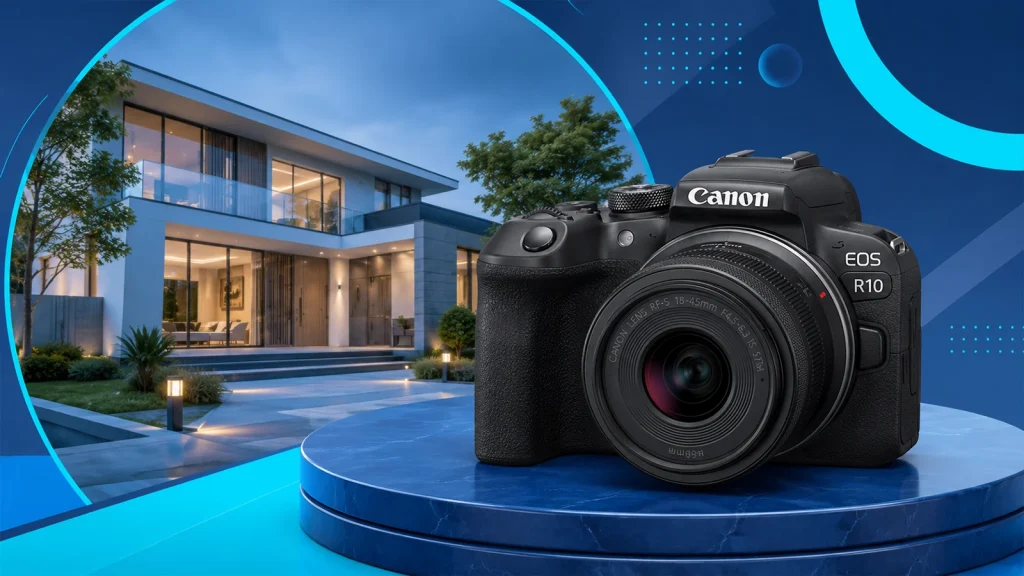
The Canon EOS R10 is a strong budget mirrorless option because it gives you better controls and performance than Canon’s most basic entry-level cameras.
Canon lists the EOS R10 with a 24.2MP APS-C sensor, 1.6x crop factor, fast continuous shooting, 4K UHD from 6K oversampling, and 4K 60p recording.
For real estate photography, speed is not the main selling point. The real value is that the R10 gives you a modern Canon RF system body with solid stills, strong autofocus, and useful video features.
Why it is good for real estate
The EOS R10 is a smart choice if you want more control than the R50 but still want to stay within a beginner-friendly budget. On a tripod, it can produce sharp images for listings, especially when shooting RAW and bracketing exposures.
Pair it with a 10–18mm or similar ultra-wide APS-C lens, and you can cover most rooms without needing a full-frame camera.
Best for
Budget-conscious beginners who want a more capable Canon mirrorless camera than the R50.
Skip it if
You want full-frame image quality, in-body stabilization, or a pro-grade build.
4. Nikon Z5II Best Full-Frame Value Camera for Real Estate Photography
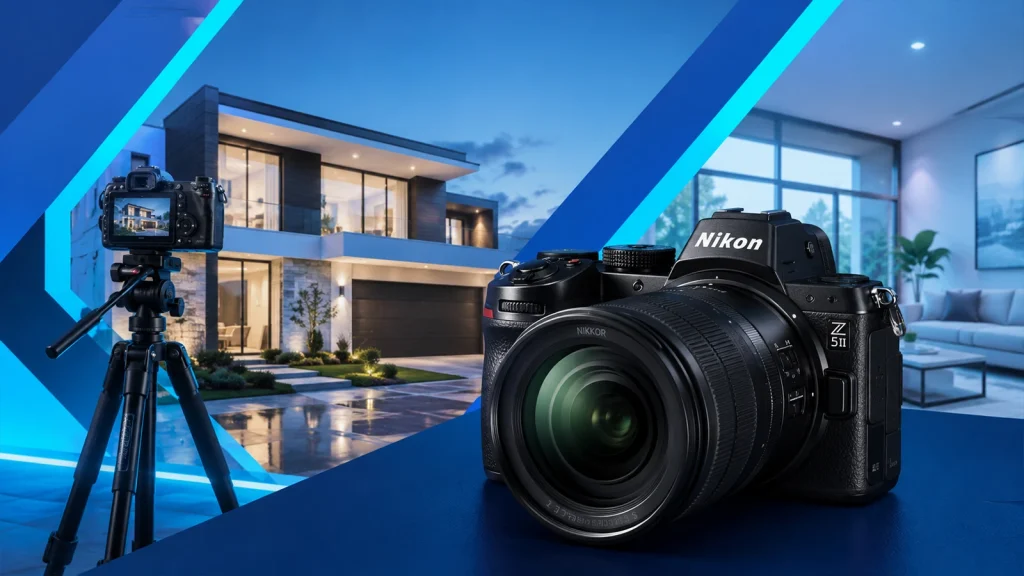
The Nikon Z5II is one of the best value full-frame cameras for real estate photography in 2026. It gives you full-frame image quality without the price of a flagship body.
Nikon lists the Z5II with a 24.5MP FX full-frame sensor, EXPEED 7 processor, ISO 100–64000 for stills, 7.5 stops of image stabilization, and subject detection across multiple subject types.
For interiors, the full-frame sensor is useful because it makes it easier to get a wide, natural-looking field of view. A 14–30mm or 16–35mm lens on full frame gives you a practical range for bedrooms, kitchens, living rooms, and exterior front elevations.
Why it is good for real estate
The Z5II gives you clean files, full-frame depth, good stabilization, and access to Nikon Z wide-angle lenses. It is especially attractive for photographers who want to upgrade from APS-C but do not need a 45MP or 61MP professional body.
Best for
Photographers moving into full-frame real estate work without spending flagship money.
Skip it if
You shoot a lot of high-end video and need the strongest uncropped video modes.
5. Canon EOS R8 Best Lightweight Full-Frame Camera for Real Estate Photography
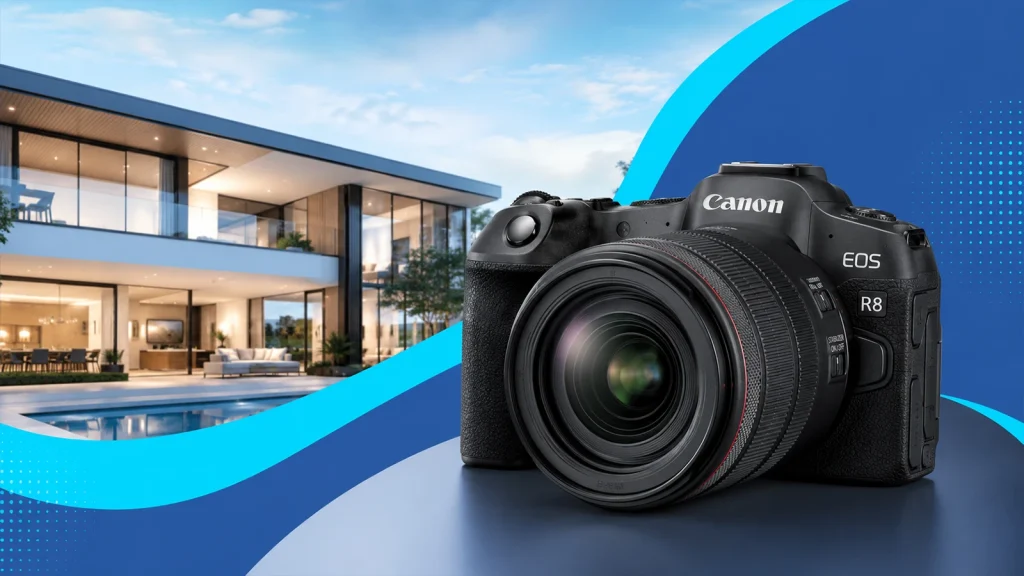
The Canon EOS R8 is a compact full-frame camera that makes sense for real estate photographers who want full-frame image quality in a lightweight body.
Canon lists the EOS R8 with a 24.2MP full-frame CMOS sensor, 4K 60p video oversampled from 6K, Canon Log 3, and a body weight of about 461g.
This is an excellent option for photographers who move between multiple properties in one day and want to keep their setup light.
Why it is good for real estate
The EOS R8 gives you the full-frame look without the size or price of Canon’s professional bodies. It works well with Canon RF ultra-wide lenses and can deliver clean, sharp images for online listings.
The main limitation is the lack of in-body stabilization. For still real estate photography, this is not a major issue because you should usually be using a tripod anyway. For handheld video, it matters more.
Best for
Real estate photographers who want a compact full-frame body for stills and occasional video.
Skip it if
You need dual card slots, IBIS, or a heavier professional body.
6. Canon EOS R5 Mark II Best Professional Camera for Real Estate Photography
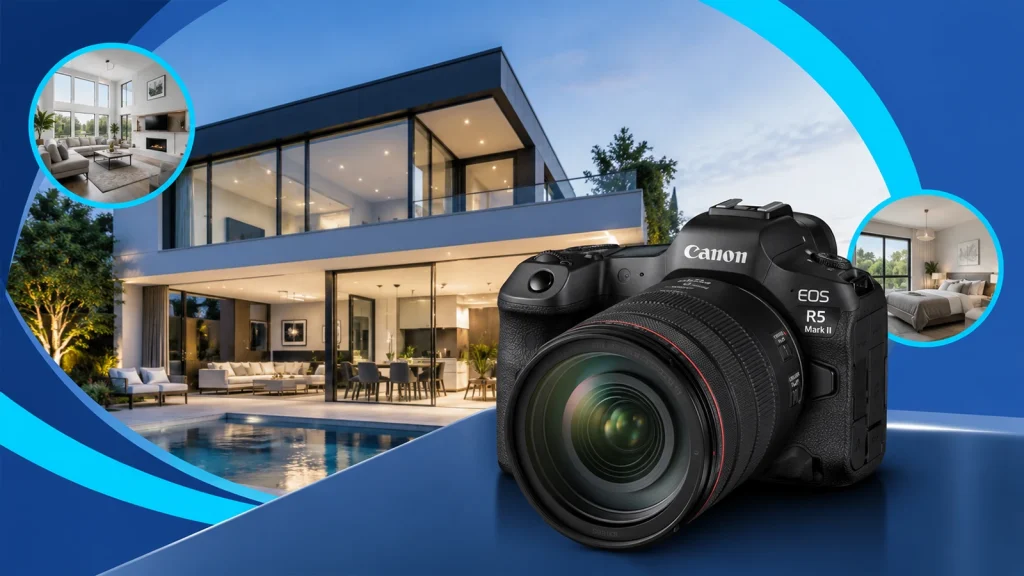
The Canon EOS R5 Mark II is one of the best professional cameras for luxury real estate, architecture, interiors, and high-end marketing content.
Canon lists the EOS R5 Mark II with a 45MP full-frame back-illuminated stacked CMOS sensor, DIGIC Accelerator and DIGIC X processing, in-camera 8K 60p RAW video, 4K 120p recording, and up to 30 fps shooting.
For real estate photography, you do not need 30 fps. But you can benefit from the 45MP resolution, high-end video features, strong autofocus, and professional body design.
Why it is good for real estate
The R5 Mark II is ideal when image quality matters more than budget. Luxury listings, commercial interiors, design portfolios, hotels, resorts, and architectural shoots benefit from the extra detail.
The files give you more room to crop, straighten verticals, correct perspective, and produce both web and print deliverables.
Best for
Professional real estate photographers, luxury listings, commercial spaces, architects, designers, and premium agencies.
Skip it if
You are just starting out or mostly shoot basic online listings.
7. Sony A7R V Best High-Resolution Camera for Real Estate and Architecture
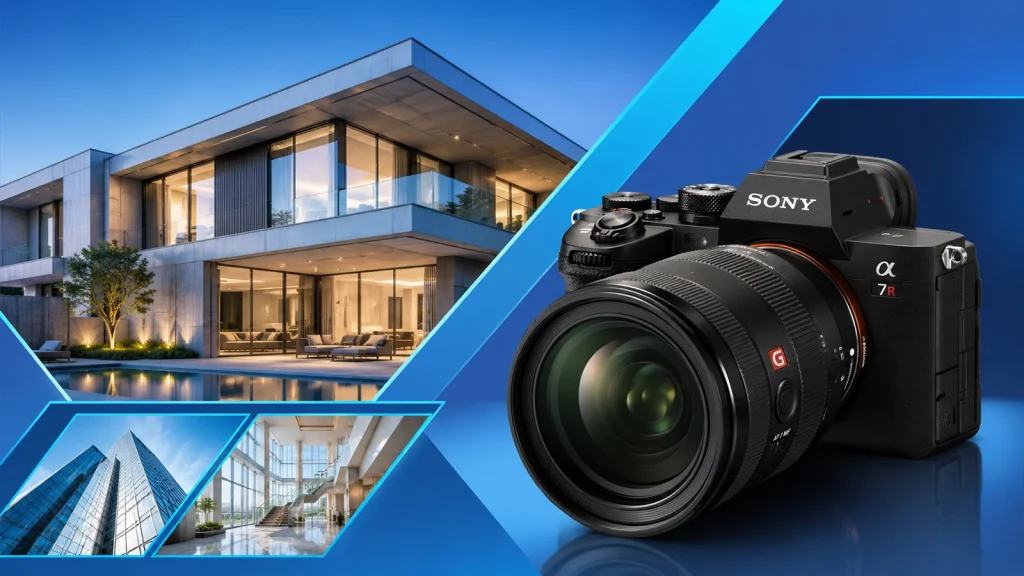
The Sony A7R V is a high-resolution powerhouse for real estate photographers who need maximum detail. Sony lists the A7R V with a 61MP full-frame back-illuminated Exmor R CMOS sensor, AI processing, BIONZ XR processing, 8K 24p/25p video, and 4K 60p/50p video.
This camera is overkill for many standard listings, but it is excellent for luxury real estate, architectural photography, commercial property marketing, and interior design portfolios.
Why it is good for real estate
The 61MP sensor captures fine details in wood grain, tile, countertops, fixtures, flooring, exterior materials, and architectural lines. It also gives you major cropping flexibility.
That said, larger files take more storage, more editing power, and more time. If your clients only need MLS images, a 24MP or 33MP camera may be more efficient.
Best for
Luxury homes, architecture, interiors, design portfolios, commercial spaces, and large-format marketing materials.
Skip it if
You need a fast, lightweight workflow for high-volume listings.
Note on Sony A7R VI
Sony announced the Alpha 7R VI in May 2026 with a 66.8MP full-frame fully stacked sensor, and Sony’s release information lists availability from June 2026. Because it is not widely field-proven yet as of May 25, 2026, it is better treated as a premium upcoming option rather than the default recommendation for most real estate photographers.
8. Nikon D850 Best DSLR Camera for Real Estate Photography
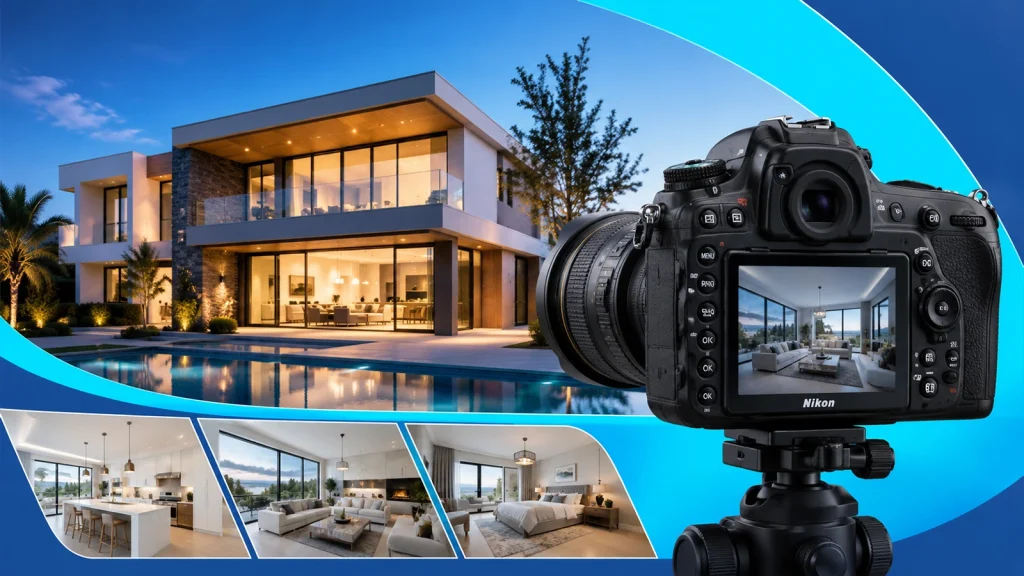
The Nikon D850 is still one of the best DSLR cameras for real estate photography, especially for photographers who already own Nikon F-mount lenses.
Nikon lists the D850 with a 45.7MP FX-format sensor, ISO 64–25,600, 7 fps continuous shooting, and 4K UHD video.
Even though mirrorless cameras are now easier to recommend for new buyers, the D850 remains a strong stills camera. Its resolution, dynamic range, and image quality make it useful for interiors, exteriors, and print marketing.
Why it is good for real estate
The D850 is a reliable workhorse. It produces detailed files and works with many excellent Nikon wide-angle DSLR lenses. It is heavier than modern mirrorless bodies, but if you already own Nikon glass, it can still be a smart investment.
Best for
Photographers who already use Nikon DSLR gear or prefer an optical viewfinder.
Skip it if
You are building a new system from scratch and want the latest mirrorless lens ecosystem.
Full-Frame vs APS-C: Which Is Better for Real Estate Photography?
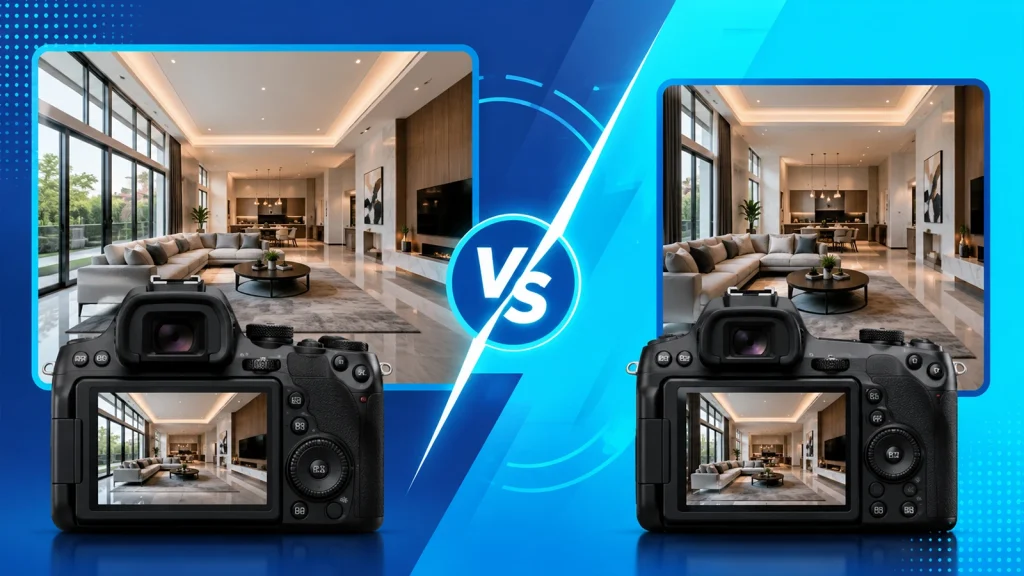
Full-frame cameras are usually better for professional real estate photography because they make wide-angle shooting easier. A 16mm lens on a full-frame camera gives a genuinely wide field of view, which is helpful in small rooms.
APS-C cameras can still work very well, especially for beginners and budget buyers. The key is using the correct lens. Because APS-C sensors crop the image, you need a wider lens to get the same interior coverage.
For example:
| Camera Type | Good Interior Lens Range |
|---|---|
| Full-frame | 14–24mm or 16–35mm |
| APS-C | 10–18mm, 10–20mm, or 11–20mm |
| Micro Four Thirds | 7–14mm or 8–18mm |
If you are a beginner, do not avoid APS-C. A Canon EOS R50 or R10 with the right ultra-wide lens can produce strong listing photos. If you are shooting luxury properties or want better low-light flexibility, full frame is worth the upgrade.
Best Lens for Real Estate Photography
The camera body matters, but the lens often matters more. A great camera with the wrong lens will still produce weak real estate photos.
For Canon full-frame users, the Canon RF 14–35mm f/4L IS USM is a strong real estate lens because it covers an ultra-wide 14–35mm range, has a constant f/4 aperture, and Canon describes it as suitable for interiors, architecture, and smooth video.
For Nikon Z users, the NIKKOR Z 14–30mm f/4 S is a strong option because it covers 14–30mm, has a constant f/4 aperture, and uses ED and aspherical elements designed for edge-to-edge performance.
For Sony full-frame users, a Sony FE 16–35mm f/4 lens is a practical real estate choice. Sony’s ZEISS 16–35mm f/4 lens offers a constant f/4 aperture, Optical SteadyShot, anti-reflective coating, and dust/moisture resistance.
Should You Use an Ultra-Wide Lens?
Yes, but carefully. Ultra-wide lenses help small rooms look open, but going too wide can make furniture stretch, walls bend, and rooms feel misleading.
For most real estate interiors, 16–24mm on full frame is a natural-looking range. Wider than 14mm can be useful for very tight spaces, but it should not be your default for every room.
Camera Settings for Real Estate Photography
A great camera will not fix poor settings. For clean real estate photos, start with these settings:
| Setting | Recommended Starting Point |
|---|---|
| File format | RAW |
| Mode | Manual |
| Aperture | f/7.1 to f/11 |
| ISO | 100–400 |
| White balance | Manual or custom |
| Focus | Single-point AF or manual focus |
| Tripod | Yes |
| Bracketing | 3–5 exposures |
| Lens height | Around chest height |
| Flash | Optional for flambient workflow |
HDR bracketing is especially important for rooms with bright windows. Nodalview explains that exposure bracketing captures multiple photos at different exposures and merges them to solve backlighting and low-light problems, which is why it is widely used in real estate photography.
Common Mistakes When Buying a Real Estate Camera
Spending too much on the camera and too little on the lens
This is the biggest mistake. A camera body is important, but the lens determines how much of the room you can capture and how natural the space looks.
Buying a camera without checking bracketing features
Real estate photographers often need HDR. Make sure the camera supports auto exposure bracketing and gives you enough exposure range.
Choosing megapixels over workflow
A 61MP camera sounds impressive, but it creates larger files and slower editing. For most MLS listings, 24MP to 33MP is enough.
Ignoring crop factor
APS-C cameras are not bad, but they require wider lenses. A normal kit lens is usually not wide enough for real estate interiors.
Relying on auto white balance
Mixed lighting can create yellow, green, or blue color casts. Use manual white balance or correct carefully in RAW editing.
Going too wide
A room should look attractive, not deceptive. Overly wide images can damage trust when buyers visit the property in person.
Final Verdict: What Is the Best Camera for Real Estate Photography?
The Sony A7 IV is the best camera for real estate photography for most people because it offers the best balance of full-frame image quality, manageable resolution, video features, lens support, and long-term flexibility.
Choose the Canon EOS R50 if you are a beginner. Choose the Canon EOS R10 if you want a better budget mirrorless body. Choose the Nikon Z5II or Canon EOS R8 if you want affordable full-frame quality. Choose the Canon EOS R5 Mark II or Sony A7R V if you shoot luxury homes, architecture, commercial interiors, or premium marketing campaigns.
The best real estate setup is not just a camera. It is a complete workflow: camera body, wide-angle lens, sturdy tripod, HDR bracketing, RAW editing, and careful composition.
FAQs About the Best Camera for Real Estate Photography
What is the best camera for real estate photography?
The Sony A7 IV is the best overall camera for real estate photography because it combines full-frame image quality, 33MP resolution, strong video features, and a wide range of compatible lenses.
Do I need a full-frame camera for real estate photography?
No. Full-frame cameras are helpful because they make wide-angle interior photography easier, but APS-C cameras can still produce excellent results with the right ultra-wide lens.
How many megapixels do I need for real estate photography?
Most real estate photographers only need 24MP to 33MP for online listings. Higher-resolution cameras like 45MP or 61MP are useful for luxury properties, architecture, cropping, brochures, and print marketing.
Is mirrorless better than DSLR for real estate photography?
Mirrorless is better for most new buyers because it offers newer lens systems, lighter bodies, better video features, and modern autofocus. DSLRs like the Nikon D850 are still excellent if you already own compatible lenses.
Is the Canon EOS R50 good for real estate photography?
Yes. The Canon EOS R50 is good for beginner real estate photography when paired with a wide-angle lens and tripod. It is best for small homes, rentals, apartments, and entry-level listing work.
Is 4K video important for real estate photography?
It is important if you shoot walkthrough videos, social media reels, YouTube tours, or agent marketing clips. If you only shoot still photos, 4K video is useful but not essential.