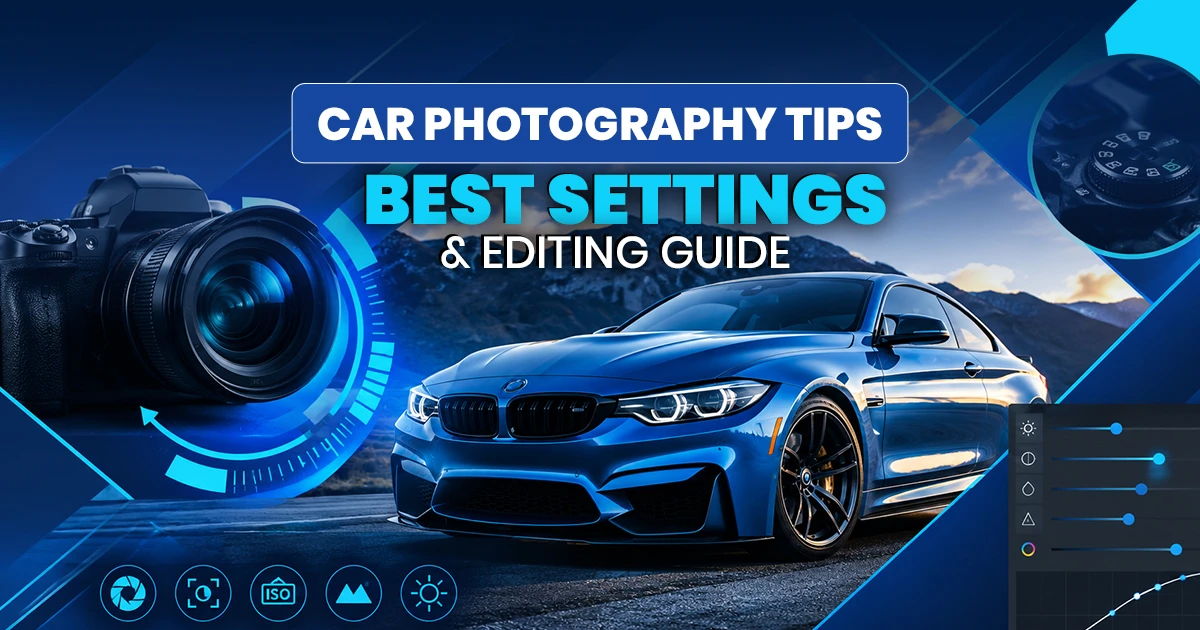
Car photography is not just about capturing a vehicle; it also involves presenting the machine with precision, visual appeal, and emotion that catches instant attention.
Nowadays, the difference between a professional photo and an average one can impact trust, engagement, and sales directly. Moreover, today’s automotive industry is very competitive. That’s why you have to know from the basics to the advanced car photography techniques to survive in this competition.
It doesn’t matter if you’re a beginner who is just trying to understand the camera basics. Or a professional photographer submerged in editing workloads, or a car dealer who’s looking to increase conversion with high-quality visuals. This entire car photography guide is curated for you.
What is Car Photography?
Car photography is a specialized sector of artistic and commercial photography. It focuses on capturing vehicles in a compelling and technically accurate way. It requires careful attention to angles, lighting conditions, reflections, and environment.
A well-captured car photo highlights its elegance, design language, power, and purpose. Sometimes you need to show a different approach with pictures for each kind of car. It can be a sports car, a commercial vehicle, or a luxury sedan.
Professionally captured and edited car images are widely used in the following:
- Automotive marketing campaigns
- Car dealership listings
- Social media promotions
- Brand advertisements
This is why both shooting and editing play equally important roles in achieving a premium result.
Types of Car Photography
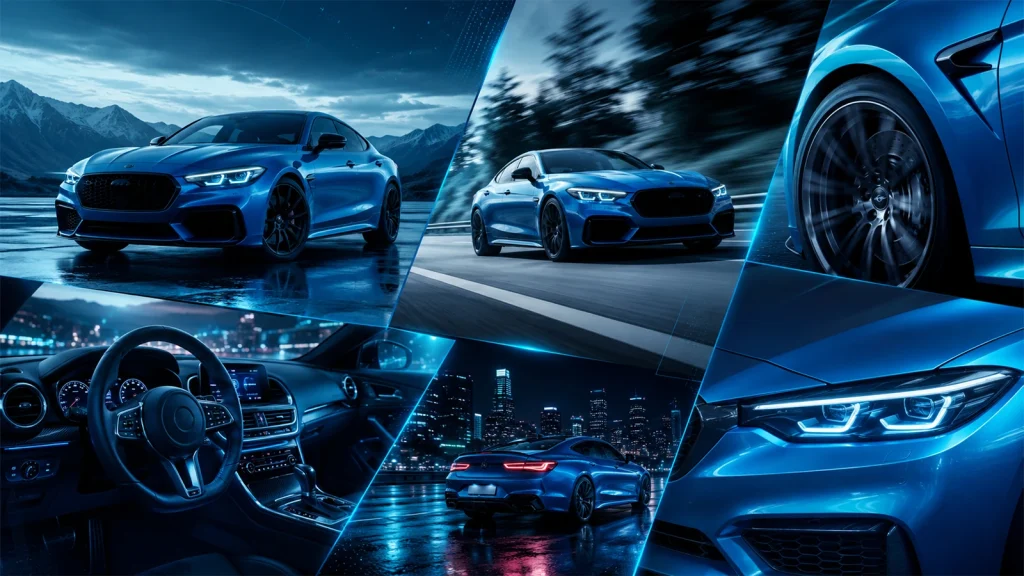
The automotive industry is one of the most demanding and leading industries in the world. Cars are photographed in various ways due to their use, purpose, and necessity. You need to understand the different styles and the proper time of photography to master car photography.
Static Car Photography
This genre is the most common type where the car is motionless. It allows you to focus on lighting, composition, and detail without worrying about motion.
Driving Car Photography
This type is also known as rolling shots. Rolling shots are captured when the car is in motion. It creates energy and realism. Driving car photography is often used in commercial and promotional content.
Car Night Photography
It is a low-light photography type that uses creative lighting techniques such as light trails, neon reflections, and long exposure to create dramatic visuals.
Commercial Car Photography
Commercial photographs are used by dealerships and brands. These photos have to be captivating and show that they are clean, sharp, and highly polished to attract buyers.
Detail-Oriented Photography
This type of photography focuses on close-up shots like headlights, interiors, wheels, logos, and textures to highlight craftsmanship. You can also call it feature-based photography, as it unveils the images of a car’s features and design.
Reflection-Based Photography
In terms of adding depth and creativity, reflection-based photography comes in first place. This style uses reflections intentionally on water, glass, or polished surfaces. It is a high-level technique where the glossy surface is treated as a canvas.
Studio Car Photography
Studio car photography is done in massive “cove” studios. The lighting is controlled by giant overhead softboxes or “scrims” to make smooth and unbroken highlights along the car’s curves.
Editorial/Magazine Photography
This photography is done for new car tests or vehicles built by enthusiasts for various publications. These images strike a balance between artistic style and technical accuracy for review.
Lifestyle Automotive Photography
Lifestyle car photography presents the vehicle in a real-world scenario where it typically operates. You can shoot the car on the highway, in the garage, or wherever it is usually used. It features people, travel, and candid moments to tell a story of freedom or status.
Event/Auto Show Photography
This is a fast-paced photography type that is captured in public or crowded settings. You won’t control lighting and location in event photography. You have to work around indoor harsh lighting, tight spaces, and moving crowds.
Concept Car Photography
This is a high-end and artistic field that focuses on taking pictures of unique prototype cars. Manufacturers make these cars to show off new design languages or technology that will be available in the future. They are even fully functional or often not street-legal.
Gear You Need for Car Photography
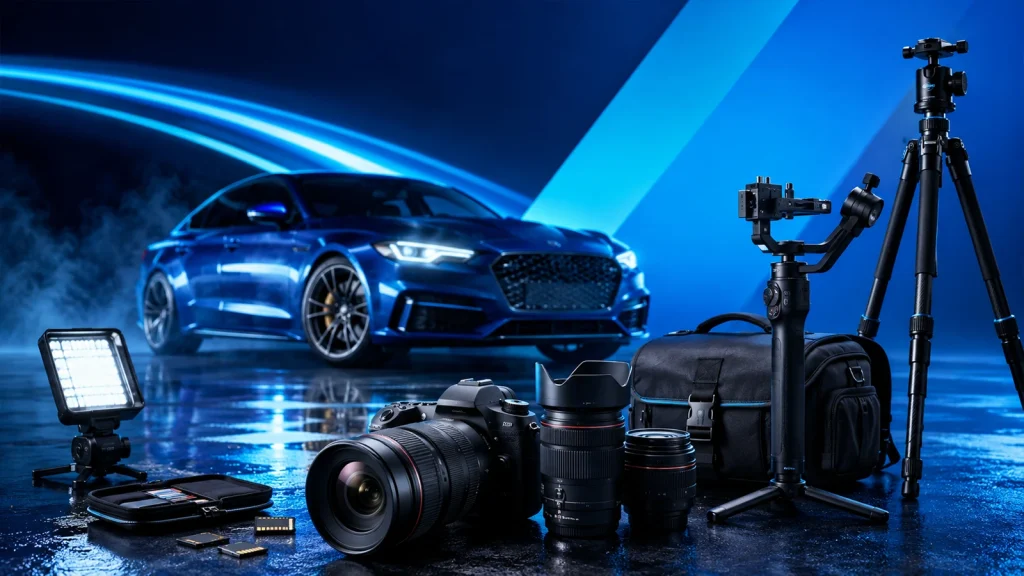
The gear used to take car pictures is pretty much the same as the equipment used for any other product photography. The right gear helps you demonstrate your skills better, even though abilities are the most important thing.
Car Photography Camera Settings (DSLR or Mirrorless)
You can properly control exposure, focus, and dynamic range with a quality camera and car photography settings. Mirrorless cameras are more popular because of their portability and performance.
Keep ISO as low as possible (ISO 100–200) to maintain image quality and avoid noise. Only increase ISO when shooting in low-light conditions and when a tripod is not an option.
Lenses
Wide-angle lenses capture the full car and environment
- Ultra-wide lens: 14mm – 24mm
- Standard wide lens: 24mm – 35mm
Prime lenses are excellent for sharp detail shots
- 35mm f/1.4: Great for street-style car product photography and “lifestyle” shots.
- 50mm f/1.2 or f/1.8: Known as the “Nifty Fifty.” It provides a very realistic perspective with zero distortion. Excellent for three-quarter views.
- 85mm f/1.4 or f/1.8: The gold standard for “portrait” shots of a car. It creates a creamy, blurred background that makes the car “pop” off the screen.
Telephoto lenses help isolate the subject
- 70mm – 200mm: Versatile and professional lens for cars
- 300mm – 400mm+: Used in motorsports or high-end commercial shoots primarily.
Tripod
A tripod provides the stability needed for long exposures at night. It is also crucial for light painting, where the camera has to remain perfectly still. A tripod allows a professional photographer to capture more than one identical frame to composite in post-processing. You can also prevent blur with a good tripod.
Polarizing Filter
CPL – Circular Polarizing filter is one of the most important tools in car reflection control in photography. It reduces glare and enhances color contrast. You can selectively remove reflections by rotating the filter on the front of your lens.
Extra batteries
Batteries can run out while taking car photos for a long time. It is safe to take extra batteries for day-long shoots to avoid any unwanted situations.
Memory cards
You can take more than one memory while going out for car photography. Having extra memory cards in your backpack is a smart idea, as you can transfer the captured files.
Lens filters
You can manipulate some shots creatively into stunning outcomes with lens filters. This can make your car photos look astounding.
Cleaning Tools
Even the best camera cannot fix a dirty car. Always clean the vehicle before shooting.
20 Car Photography Tips to Capture Professional Shots
A food photograph can make people think, give them new ideas, and make them wonder about the photographer’s idea. Check out these 25 tips that will help you take better car pictures, make some outstanding pictures, and elevate your skills to the next stage.
Car Photography Tips for Beginners
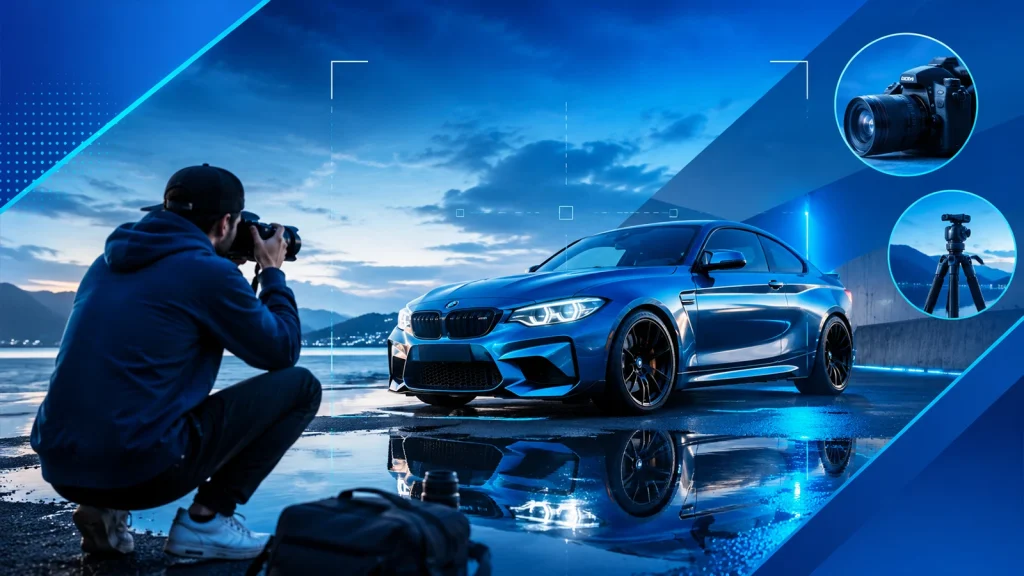
1. Shoot at the Right Time of Day (Golden Hour vs Harsh Light)
Lighting is the foundation of photography. Shooting during golden hour (shortly after sunrise or before sunset) gives you soft, diffused light that enhances the car’s curves and color.
Midday sunlight creates harsh shadows and strong reflections in photography. This makes it difficult to manage exposure.
2. Choose a Clean and Complementary Background
The background is not to compete with the subject; it is to support it. A distracting or cluttered environment may ruin a perfectly composed shot.
Good background choices include:
- Open roads
- Parking structures
- Natural landscapes
- Minimal urban settings
- Before the fences
3. Keep the Car Clean and Ready for the Shoot
Every dust particle, fingerprint, or scratch becomes visible in high-resolution photography. Preparing the car properly saves hours of editing later.
4. Understand Basic Camera Settings (ISO, Aperture, Shutter Speed)
Understanding exposure is crucial:
Balancing these three settings is key to achieving professional results.
5. Use Natural Light for Better Results
Natural light is easier to control and often more flattering than artificial lighting, especially for beginners.
6. Select the Right Gear (Camera, Lens, Tripod)
You don’t need expensive equipment to start. Even basic gear, when used correctly, can produce impressive results.
Intermediate Car Photography Tips
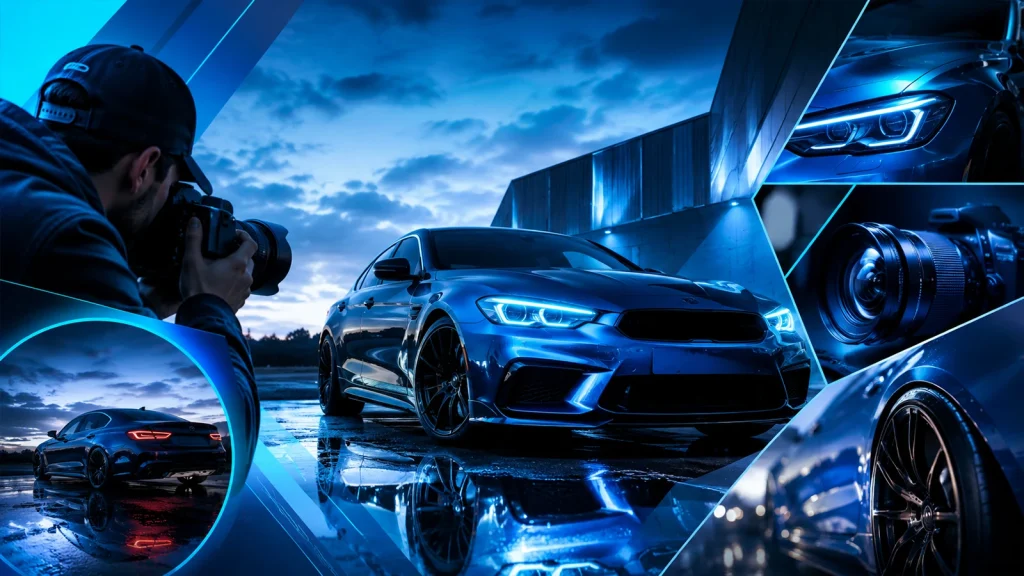
You are moving from basic understanding to creative control at this stage.
7. Use the Best Car Photography Angles (Front 3/4, Low Angle)
Angles determine how the car is viewed. The front 3/4 angle is widely used because it captures both the front and side profiles. This angle gives a complete view.
Low angles make the car look more aggressive and powerful.
8. Apply Composition Techniques (Rule of Thirds, Framing)
Composition helps to guide the viewer’s eye. Placing the car slightly off-center creates a more natural and engaging image.
Rules of Thirds: The Rule of Thirds is a compositional guideline that places your subject in the left or right third of an image. It leaves the other two-thirds more open.
9. Use Leading Lines to Highlight the Car
Roads, fences, and architectural elements can act as visual guides directing attention toward the car. This creates a sense of depth and motion when it is used correctly.
10. Capture Details and Close-Up Shots
You’re telling the story of a car’s quality and personality when you focus on details. Detail shots bring depth to your portfolio. These are crucial for commercial work. Focus on materials, texture, and craftsmanship.
Capture high-quality car details by focusing on specific, intricate elements like badges, headlight textures, wheel rims, and interior stitching.
11. Control Reflections and Glare Effectively
Controlling reflections can be called a “boss level” of car photography. To avoid changing the proportions, use telephoto lenses (50mm+). Shoot during the “golden hour” to get rid of harsh reflections on slick surfaces.
12. Use Polarizing Filters for Cleaner Shots
A polarizer significantly reduces unwanted reflections and enhances the richness of colors. A higher aperture (f/5.6+) is important for sharpness and polarizing filters. These two control reflections.
Cars are reflective surfaces. This makes controlling reflections one of the biggest challenges in car photography techniques.
13. Experiment with Different Locations
- Urban environments for a modern feel: Urban settings accentuate the car as a part of technology and a tool for city life. It gives things a modern feel.
- Nature for contrast and calmness: Nature creates an “adventurous” vibe by placing a man-made machine in an organic world. Seek open fields, coastal lookouts, or winding forest roads to capture car photos.
- Indoor setups for controlled lighting: You can learn to master lighting techniques in indoor shooting. Even without the sun’s unpredictability. The places can be a showroom, a clean garage, or something like that.
Advanced Car Photography Techniques
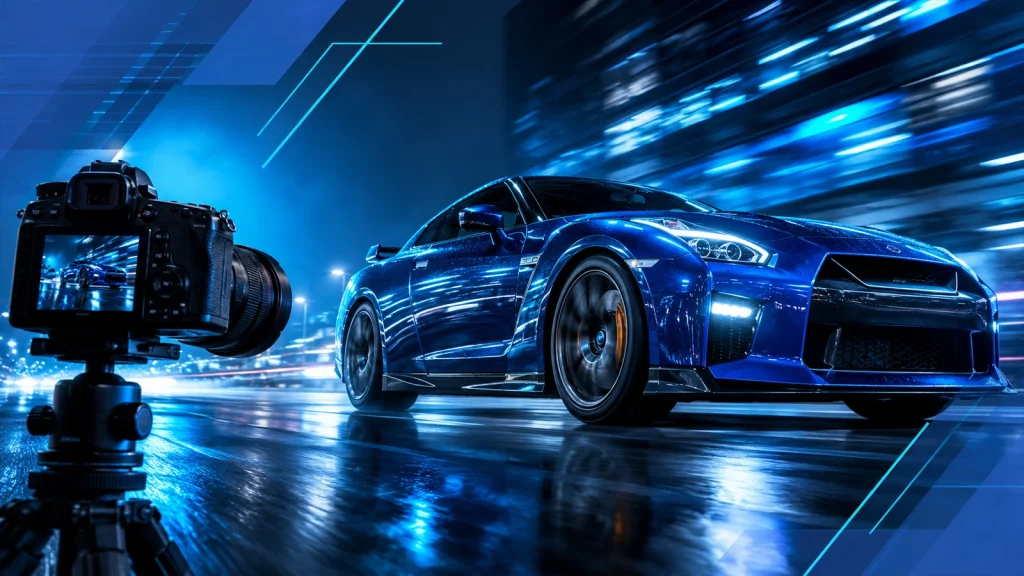
If you have mastered the intermediate level of car photography techniques, this guide is for you. Now you move into professional-level execution.
14. Capture Motion with Rolling Shots (Driving Car Photography)
Rolling shorts are the gold standard of automotive media. This involves shooting from another moving vehicle. It creates realistic motion. Rolling shorts are widely used in advertisements.
Set your camera to either 1/30s or 1/60s. This speed is slow enough to make the wheels and road blurry. But fast enough to keep the car sharp if the driver is steady.
15. Use Panning Technique for Motion Blur
The panning technique is a fundamental skill that separates professional automotive photographers from amateurs. It conveys a strong sense of motion by keeping the car in focus and transforming the background into a series of horizontal lines.
In short, panning keeps the car sharp while blurring the background, creating a strong sense of speed.
16. Master Night Car Photography (Low-Light Techniques)
Night car photography turns a car into a work of art by using darkness. This is to hide things that might distract you, and light to highlight the shape of the car. You can take full control of the “mood” of the picture when there is no sun.
Car night photography requires the following:
- Tripod for stability
- Long exposure
- Controlled lighting sources
17. Use Light Trails for Creative Effects
You can turn a static car photo into a dynamic scene with light trails. Light trails from passing vehicles add energy and movement to your composition. It uses the movement of surrounding traffic to make streaks of glowing color.
A sense of “urban speed” or “nighttime energy” can be conveyed perfectly with this technique. Location is important for light trails. You need a blend of consistent movement and a stationary subject.
18. Try Light Painting for Professional Automotive Shots
Light painting is the procedure of utilizing a portable light source to sculpt a car’s scheme in total darkness. You can use a small light instead of relying on a big one to highlight every individual curve. Then stack the images together to create a commercial-grade image.
In short, this technique involves manually lighting different parts of the car in a dark environment and blending them later.
19. Use HDR for Balanced Exposure
High Dynamic Range, aka HDR, is the solution for scenarios where the lighting is too excessive for a camera sensor. It can’t handle that in a single click. For instance, a dark car parked against a bright sunset.
HDR merges multiple exposures to ensure details are visible in both shadows and highlights. Most of the modern cameras and smartphones have an AEB (auto exposure bracketing) mode. Use a tripod while shooting. The car must be in the same pixel-perfect position in every frame.
20. Shoot with Depth of Field for Cinematic Look
A shallow depth of field gives car photography a high-end and cinematic look. It isolates the car from the background to pop out of the surroundings.
You strip away distractions and let the viewer’s eye lock onto the car by blurring the background and sometimes the foreground. You can control how shallow your focus is with the following things:
1. Aperture: The larger the hole in your lens, the shallower the focus
2. Focal Length (zoom): The more you zoom in, the more the background blurs.
3. Proximity (distance): The closer you are to the subject, the blurrier the background becomes.
Edit Your Car Photos Like a Pro (Color Grading & Retouching)
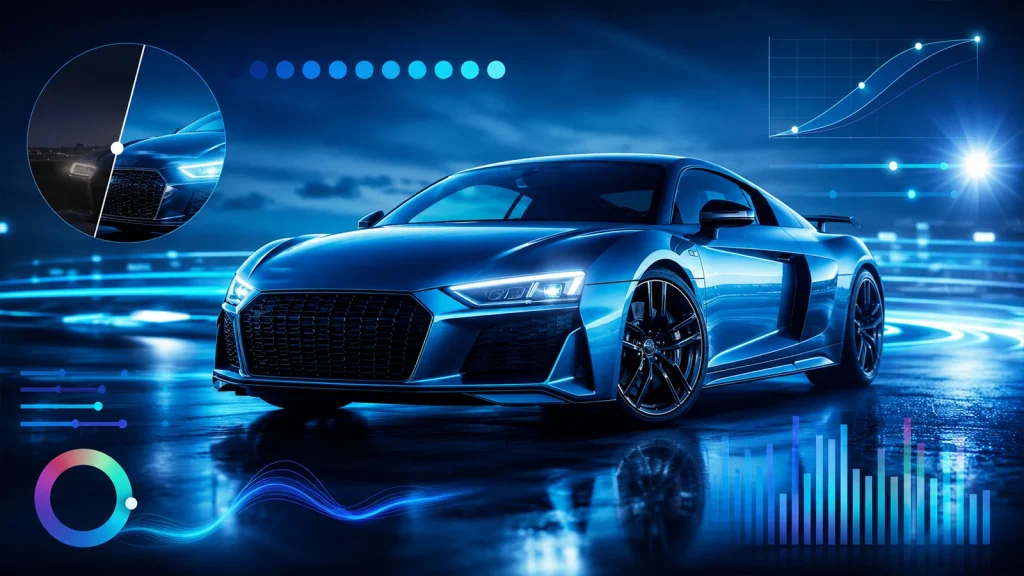
The journey doesn’t end just after clicking the shutter. To make the image lively and engaging, car photo editing is a must. It can fulfill your purposes, make the visuals stunning, and make you successful in outsourcing.
Professional editing includes:
- Color correction
- Reflection removal
- Background cleanup
- Image retouching
- Drop shadow and highlight balancing
- Image manipulation
Many photographers don’t get the proper time to edit their images. Outsourcing to experts ensures consistent and high-quality results.
Not only photographers, but also many car dealership companies and automotive industries feel the need for photo editing services. Find out the agencies that offer image and video editing services at your ease.
Avoid Common Car Photography Mistakes
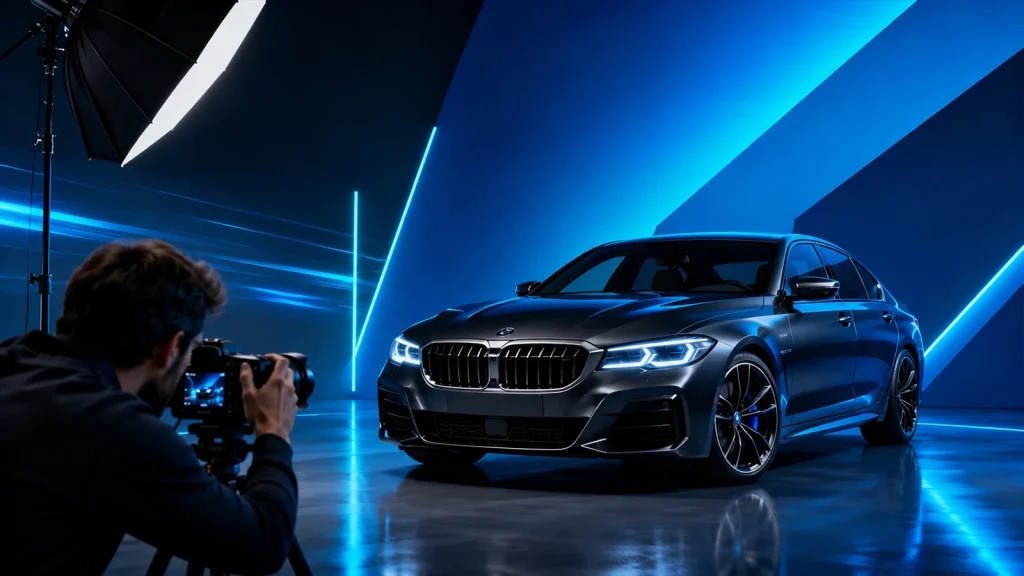
Even small mistakes can reduce the overall quality significantly.
Don’t Fill the Frame Edge-to-Edge
Don’t place the car so tightly in the frame that it touches or nearly touches the edges. This makes the image feel less professional and cramped. Leave some room around the car to create balance and give space for composition.
Avoid Distractions Behind the Car
Clutter such as poles, people, signage, messy environments, etc., in the background can ruin your great shots. Always make sure your subject’s background is good enough for shooting. Besides, adjust your angle or position if needed.
Don’t Shoot from Eye Level
Always shooting at normal standing height often results in uninteresting and flat images. When you click from a lower angle, car images look more dynamic and powerful. A higher angle can add context and creativity.
Avoid Shooting in Midday Sun
Midday sunlight creates strong reflections and harsh shadows on the car’s surface. This is a hindrance to capturing details and balanced exposure. If you need to shoot at this time, seek shaded areas or use shadows creatively.
Don’t Shoot with the Sun Directly Behind You
It makes flat lighting on the car with minimal depth when the sun is behind you. This minimizes contrast and can make the image look dull. You can position the light to come from the side of the car to create highlights and shadows.
Don’t Shoot Interiors in Direct Sunlight
It can make harsh highlights and deep shadows if sunlight enters the car interior directly. It can be difficult to balance exposure. This often causes blown-out areas. Try shooting interiors in shaded conditions or during softer light times.
Don’t Overexpose
Overexposure causes the images to lose important details. Especially on slick surfaces like car paint. It is very difficult to recover in editing once highlights are blown out. When it is necessary to preserve details, keep it slightly underexposed.
Don’t Use Wide-Angle Lenses for Exterior Shots
The shape of the car can be distorted with wide-angle lenses. It can make it look stretched or unrealistic. Shooting too close to the subject makes it noticeable. Use focal lengths like 50mm or more for a proper, natural, and professional look.
Don’t Rely Too Much on Lighting Gear (Strobes)
Lighting gear is helpful. But relying too much on it can make your workflow unnatural and complicated. Natural light produces more realistic and appealing results. Strobes are to enhance your shots, not to replace good technique.
Don’t Fixate on Gear
Expensive cameras or lenses can’t guarantee great photos. Skills are the main thing. Beginners focus too much on gear instead of improving their skills. Level up your skills with the necessary equipment. You can produce professional results with a basic camera if you use it correctly.
Plan Your Shoot for Better Results
Prepare before you shoot something. Set up your gear properly, select a quality location, preplan the time slot you want to shoot in, and everything should be ready before shooting car photos. These improve efficiency and output quality.
Build a Consistent Style for Automotive Photography
A consistent style makes your work instantly recognizable. A distinct visual identity attracts high-end clients and builds a professional portfolio. Consistency is all about applying a unified visual logic to every shoot.
Optimize Photos for Social Media or Commercial Use
Two different mindsets are required in optimizing photos. Each platform requires different formatting, resolution, and style.
- Social Media: This focuses on catching the eyes during a fast scroll. Social platforms compress images heavily. So you must edit specifically to survive their algorithms.
- Commercial Use: This focuses on technical perfection and brand standards. Commercial clients (dealerships, parts brands, magazines) require files that are flexible and high-quality.
Best Angles for Car Photography in short
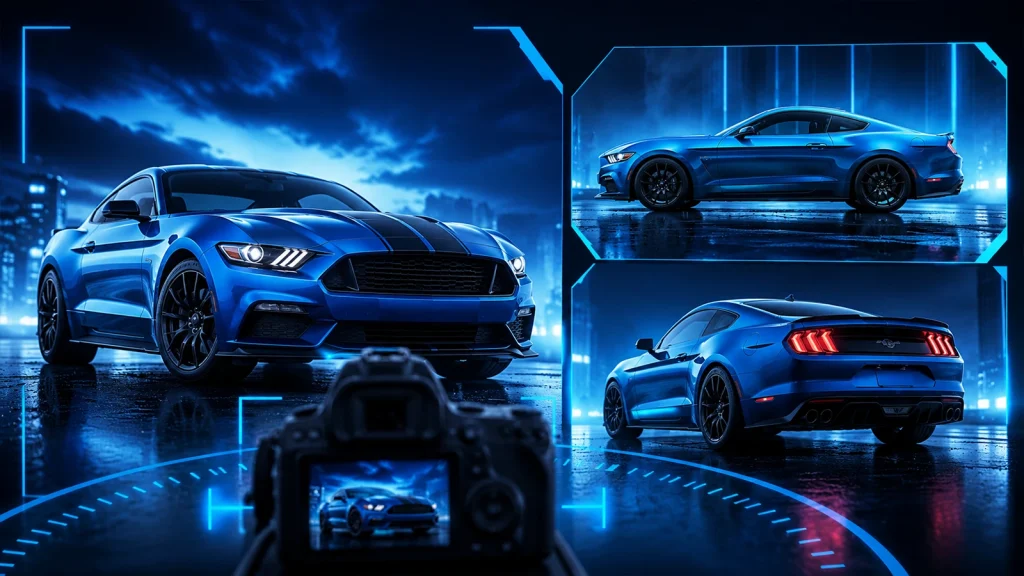
Each angle serves a specific purpose:
- The front 3/4 Angle is the most balanced and popular
- Side profile shot highlights design
- Low angle adds power and dominance
- Interior shot shows luxury and detail
- A top-down shot is a unique and modern perspective
Car Photography Ideas to Try
Good photographs require creativity. You can try the following car photography ideas. These will help you master different technical skills. To improve your creativity, experiment with the following:
Rainy reflections
Rain turns asphalt into a mirror. This doubles the visual impact of the car. So, shooting after rain can add a cinematic vibe to your photos. Set the car near reflective surfaces to capture mirror-like effects. Low-light or evening shoots are perfect for this.
Night city shots
City lights make a car look futuristic. It provides a variety of colors and textures. Get locations with neon signs or bright store windows. Use long exposure and a tripod to capture sharp details with glowing backgrounds. This technique is widely used in commercial automotive photography.
Motion blur on highways
Motion blur brings out speed and energy in your car photos. Keep the car in focus to blur the surroundings with a slower shutter speed. It provides a dynamic and storytelling element to your shots.
Minimalist compositions
Minimalism focuses on the art of the car’s design and simplicity by reducing distractions. Use open spaces, clean backgrounds, and limited elements to highlight the car. This idea creates a high-end and modern aesthetic often seen in ads.
FAQs

What is the best time for car photography?
The best time for car photography is the golden hour. It gives the most flattering natural light. But the ideal time depends on the paint finish and the vibe you want to create.
What lens is best for car photography?
There is actually no single perfect lens. But the standard for car photography is 24–70mm f/2.8. This is versatile.
How do you take pictures of a moving car?
It requires a balance between camera movement and shutter speed. Stay still while the car moves (panning) or move alongside the car (Rolling shots).
What settings should I use for car photography?
You can use a low ISO (100-200) for clear images. The aperture is around f/2.8–f/8; it depends on depth. Adjust shutter speed based on lighting. Shoot in RAW for better editing flexibility.
Beginners can also learn more about manual camera settings from the Canon Camera Settings Guide.
How do you avoid reflections in car photography?
Use polarizers and adjust angles carefully to avoid distracting reflections in car photography.
Can you do car photography with a smartphone?
Yes, professional-looking car photos can be captured with a smartphone. Use proper lighting, composition, and editing apps to enhance the final image.
How do you take professional car photos at night?
To take professional photos at night, use a tripod, shoot with a long exposure, lower the ISO, take advantage of city lights, and use light painting.