Product photography is one of those rare career paths where creative skill and consistent demand actually meet. Every brand selling online needs quality product images. Most successful marketplace listings, social media campaigns, and digital ads rely on photography that makes people stop scrolling and start buying.
If you are thinking about building a product photography career, you are entering a space that keeps growing alongside ecommerce. But the honest answer to whether this career is right for you depends on more than just market size. It depends on your skills, your patience, and your willingness to treat photography as a business.
I have spent over a decade working inside the product photography and photo editing industry. I have seen beginners grow into full-time commercial product photographers, and I have seen talented shooters burn out because they ignored the business side. This guide covers everything I wish someone had told me when I started.
Looking to outsource your product photo editing? Professional ecommerce photo editing services help product photographers deliver faster, maintain color accuracy, and scale their client workload without sacrificing quality
What Does a Product Photographer Actually Do?
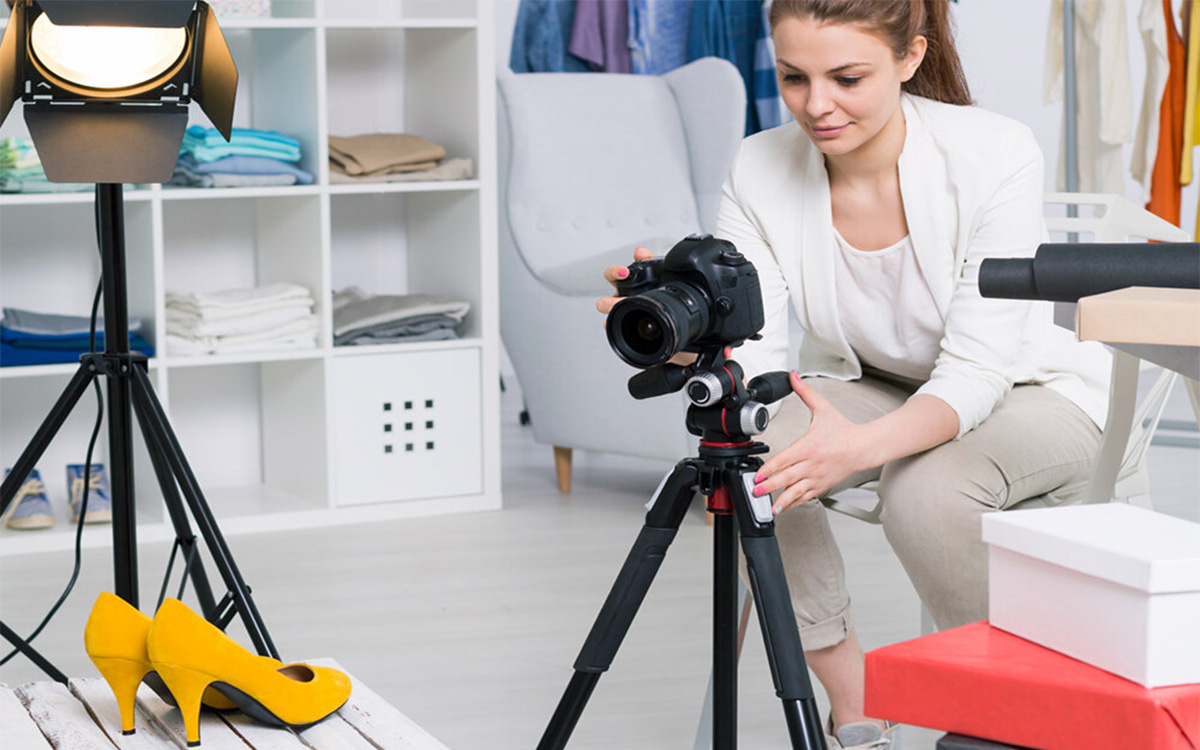
A product photographer captures images of physical products for commercial use. That sounds simple, but the job involves far more than pressing a shutter button. You are responsible for making objects look their absolute best while meeting specific brand guidelines, marketplace requirements, and marketing goals.
A typical workday starts with reviewing client briefs and understanding what each brand needs. Then you prep the studio, set up lighting, style products, and start shooting. After the shoot, you cull the best frames, handle post-production editing, and deliver final files in the formats and aspect ratios the client requested. Invoicing, client communication, and project management fill the rest.
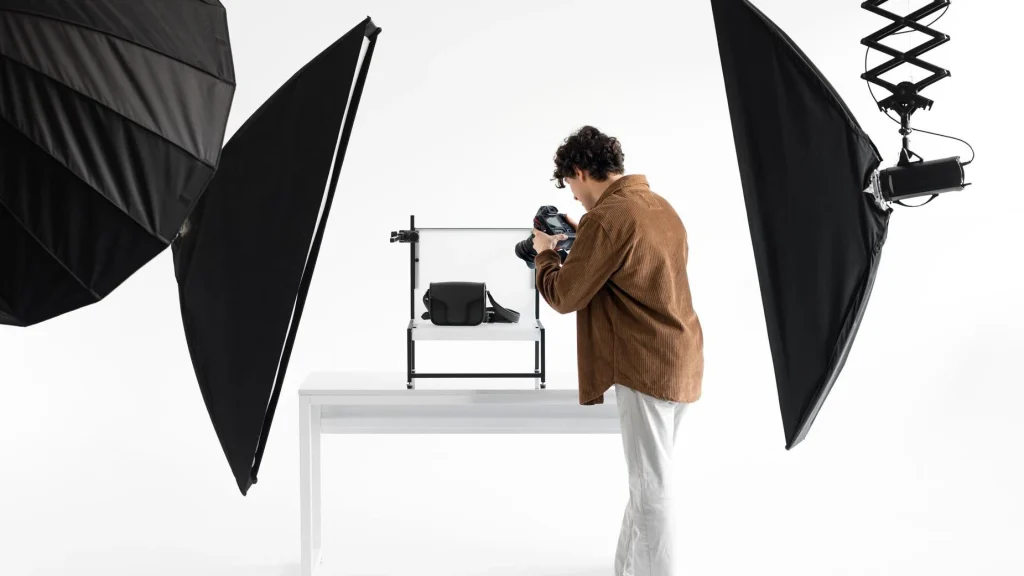
The job is mostly indoors. You shoot indoors in a controlled studio environment where you manage every detail from backdrop color to shadow direction. That level of control is what makes product photography technically demanding and creatively rewarding at the same time.
Types of Product Photography Work
The work itself breaks into several categories. Ecommerce photography is the most common. Think clean, white-backdrop shots for Amazon, Shopify, or marketplace listings. These images focus on accuracy, clarity, and compliance with platform image requirements.
Lifestyle shots place products in real-world settings to show context and usage. A candle on a nightstand, a jacket on a model walking through a city, a protein bar next to a gym bag. This style drives social media content creation and supports broader brand campaigns.
Then there is high-end commercial work. Advertising imagery for marketing campaigns, packaging photography, and hero shots used in digital ads. This tier pays significantly more but demands a strong photography portfolio and established brand connections. Some photographers also specialize in creative product photography techniques like flat lays, 360-degree photography, and 3D product renderings.
Is Product Photography a Good Career in 2026?
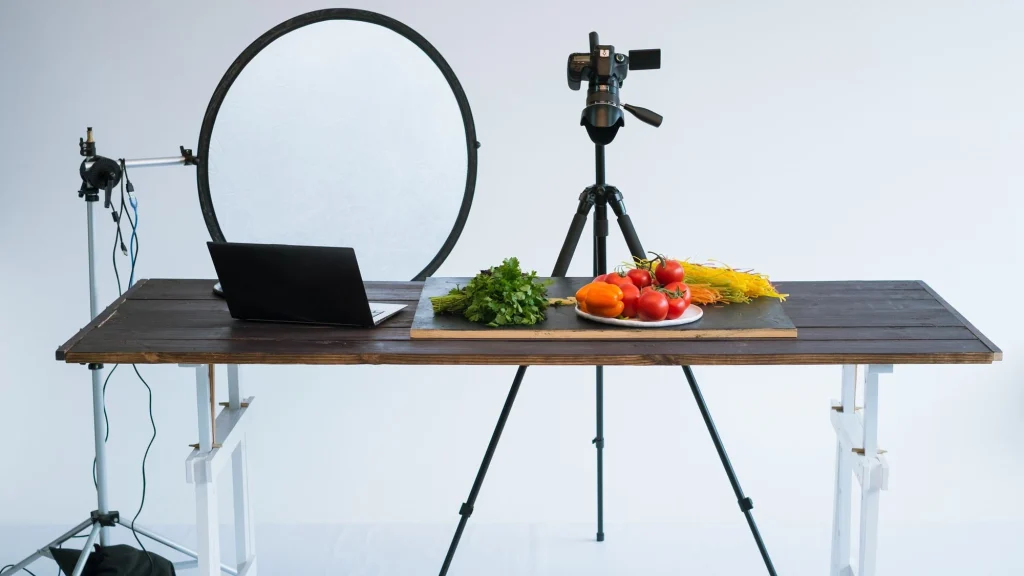
Yes, but with a realistic caveat. Product photography is a strong career choice if you understand the market and align your skills to what brands actually need right now. Global ecommerce sales crossed $6.3 trillion in 2024, according to eMarketer estimates, and that number keeps climbing. More products sold online means more product images needed. Period.
The demand drivers are clear: DTC brands launching every week, Amazon sellers competing for clicks, Shopify store owners upgrading from phone photos, and social commerce expanding across Instagram, TikTok, and Pinterest. The volume of visual content brands require has grown enormously, and that creates real opportunities for skilled photographers and ecommerce photographers.
But is product photography a good career for everyone? That depends on your personality and work preferences.
Product Photography Is a Great Fit If You…
Enjoy technical problem solving. Every product presents a unique lighting and composition challenge. Reflective surfaces, transparent materials, tiny jewelry pieces, and oversized furniture all require different approaches. If you like figuring out how to make tricky subjects look perfect, you will thrive here.
You are also a good fit if you are patient with repetitive refinement. Product photography means shooting the same product from multiple angles, tweaking lighting by inches, and adjusting product styling until everything sits exactly right. This is detail-oriented work, not fast-paced action shooting.
If you prefer working indoors, enjoy studio lighting setups, and find satisfaction in delivering clean, consistent results, this photography niche will suit you well.
It Might Not Be Right If You…
Crave variety and outdoor shoots in every session. Product photography is largely studio-based and process-driven. If you are the type who gets restless shooting the same category of products week after week, this career will feel repetitive.
It is also a tough fit if you struggle with client revisions or dislike following strict creative direction. Most commercial clients have specific brand consistency requirements. You are often executing their vision, not your own.
And if you expect fast income from day one, product photography requires an upfront investment of time and money before consistent revenue flows in. Building your client base takes months, not weeks.
Product Photographer Salary: What You Can Realistically Earn
Salary data for product photographers varies widely depending on the source, the location, and whether you are salaried or freelance. Here is what current data shows.
In-House Product Photographer Salary
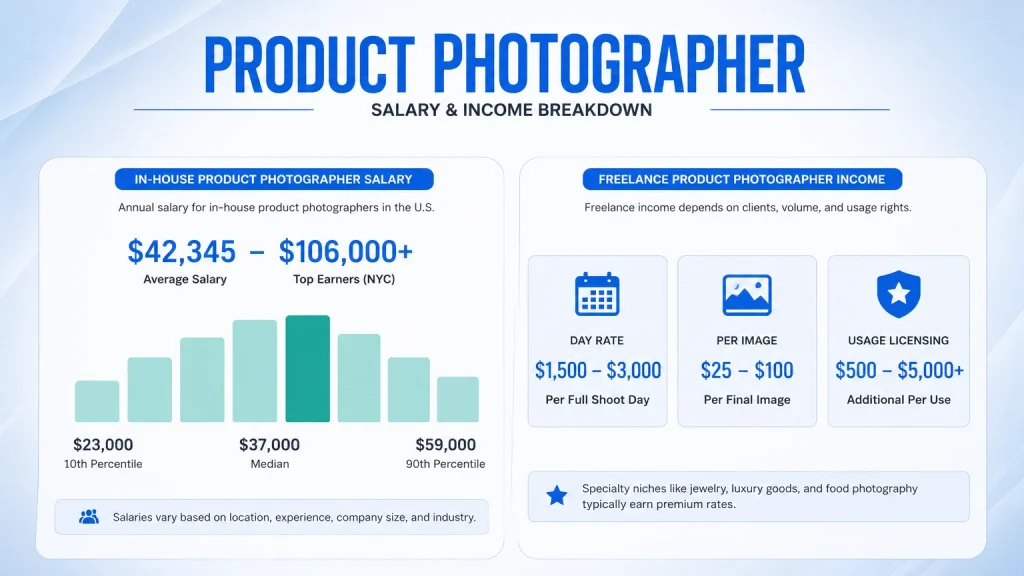
According to ZipRecruiter (2026), the average annual pay for a product photographer in the United States is approximately $42,345 per year, with top earners reaching $58,000 or more. Salary.com reports a higher average at around $57,749, and Comparably puts it closer to $60,850.
These differences reflect company size, industry, and geography. An in-house photographer at a large ecommerce retailer in New York or Los Angeles earns considerably more than someone in a mid-sized market. Glassdoor reports product photographer salaries averaging over $106,000 per year in New York City when factoring in total compensation.
Freelance Product Photographer Income
Freelance product photographer earnings are harder to pin down because they depend entirely on your client base, your volume, and your pricing structure. Experienced freelancers typically charge day rates between $1,500 and $3,000 for a full shoot day.
Per-image pricing is also common, ranging from $25 to $100 per final image depending on complexity, styling requirements, and usage rights. Specialists in jewelry photography, luxury goods, and food and beverage photography often command premium rates because these niches demand advanced lighting techniques and meticulous attention to detail.
Usage licensing can significantly multiply your income. A product shoot at $100 per image is one thing. But if a brand wants those images for paid advertising, usage fees can add $500 to $5,000 or more depending on scope, duration, and distribution. Many studio photographers build licensing into every proposal.
What Actually Affects Your Earning Potential
Your product photographer salary is shaped by several overlapping factors. Geographic location is the most obvious. Major metro areas with high concentrations of ecommerce brands and agencies pay significantly more.
Specialization matters enormously. A photographer who focuses on luxury goods or cosmetics earns more than a generalist shooting basic white-background ecommerce images. Client type also plays a role. Agency work and direct-to-brand contracts pay better than marketplace freelance gigs.
Editing efficiency is an underrated income factor. Photographers who handle their own post-production spend hours on color correction and retouching that could go toward shooting more clients. Many successful photographers outsource photo editing to scale their capacity without burning out.
How Much Does It Cost to Become a Product Photographer?
One of the most practical questions nobody talks about enough. Here is a realistic breakdown of what you will invest at different stages.
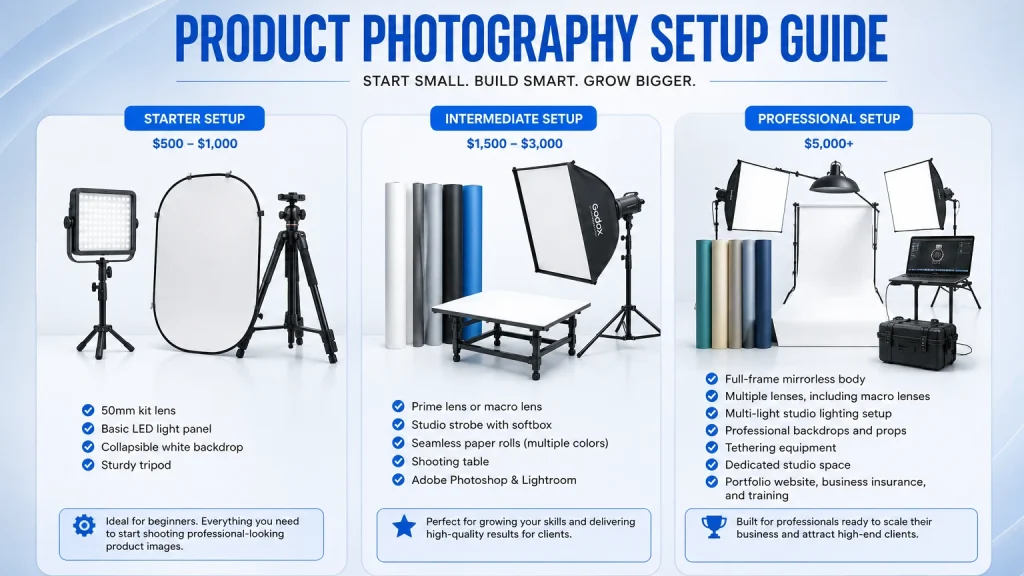
Starter setup ($500 to $1,000): An entry-level mirrorless or DSLR camera, a 50mm kit lens, a basic LED light panel, a collapsible white backdrop, and a sturdy tripod. This gets you shooting. If you need guidance on selecting cameras at this level, we covered entry-level cameras for product photography in detail.
Intermediate setup ($1,500 to $3,000): Better camera body, a prime lens or macro lens for detail shots, a studio strobe with a softbox, seamless paper rolls in multiple colors, and a shooting table. Add photo editing software subscriptions like Adobe Photoshop and Lightroom at this stage.
Professional setup ($5,000+): Full-frame mirrorless body, multiple lenses including macro lenses for close-up work, a multi-light studio lighting setup, professional backdrops and props, tethering equipment, and a dedicated studio space. At this level, factor in costs for a portfolio website, business insurance, and potentially online photography courses or workshops.
The key takeaway: you do not need professional-level gear to start. Many working product photographers began with a sub-$1,000 setup and upgraded as client revenue grew.
How to Become a Product Photographer (Step by Step)
There is no single path into product photography. Some people come from photography school, others transition from other photography niches, and some start entirely from scratch. But regardless of your starting point, these steps will get you there.
Learn the Technical Foundations
Lighting is the single most important skill in product photography. It is the dividing line between amateur snapshots and professional product images. Start by learning how natural window light behaves, then progress to single-light setups with a strobe or continuous LED.
Master lighting control: how to shape, diffuse, and direct light to eliminate harsh shadows and highlight product details. Learn how to work with reflective surfaces like glass and metal, which require specific lighting techniques. Once you understand light, everything else becomes easier. Setting up a proper photography studio does not require a massive space. A spare room or garage with controlled lighting will work.
Beyond lighting, you need solid camera operation skills. Understand aperture, shutter speed, and ISO and how they interact. Learn white balance and color accuracy, because brands need their products to look exactly as they appear in real life.
Start With the Right Equipment
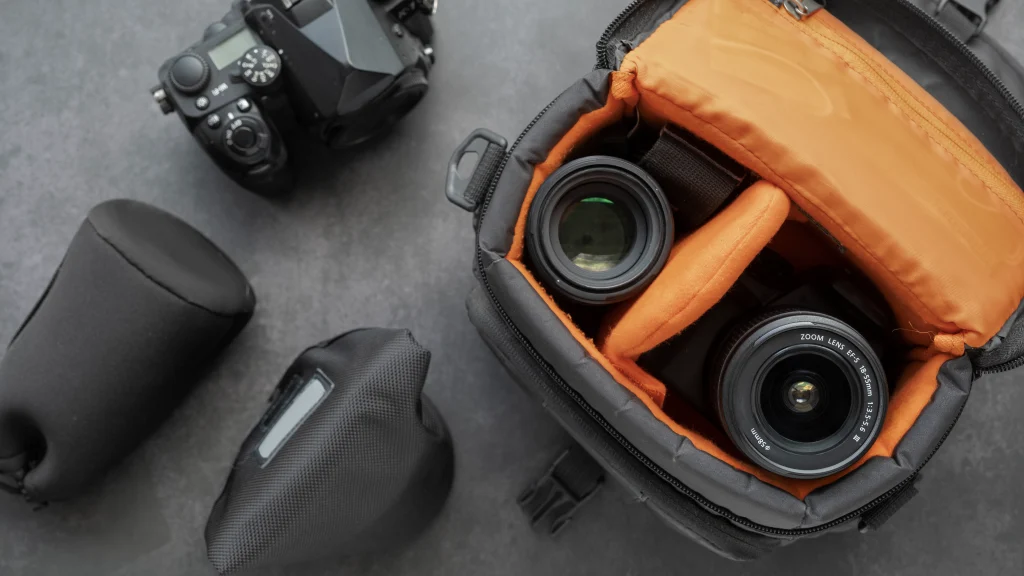
Do not overthink gear at the start. A capable mirrorless or DSLR camera, one or two quality lenses, a tripod, and a simple lighting setup will handle most starter projects. Many professionals still rely on DSLRs like the Canon 5D series or Nikon D850, so do not feel pressured to buy mirrorless. Invest more in lighting equipment than in camera bodies. A $600 camera with great lighting will outperform a $3,000 camera with bad light every single time.
For detailed guidance, our best lenses for product photography guide covers focal lengths and lens types matched to different product categories.
Master Post-Production Editing
Shooting is only half the job. Post-production editing is where raw captures become polished, client-ready product images. Every professional product photographer needs strong editing skills in at least one major photography software platform.
Adobe Photoshop remains the industry standard for advanced retouching, background removal, and compositing. Lightroom handles batch color correction and tonal adjustments efficiently. Capture One deserves special mention for studio work. Its tethered shooting, live preview, and color management tools make it the preferred choice in many commercial product photography workflows.
In most commercial studios, the photographer and retoucher are separate roles entirely. Shooting and editing require different skill sets and different workflows. Even solo commercial photographers increasingly operate this way, handling the capture work themselves and delegating post-production.
As your client workload grows, editing becomes the bottleneck. Many experienced product photographers delegate post-production to professional photo editing services so they can focus on shooting, client relationships, and growing their business. That single decision often doubles their effective capacity.
Build a Portfolio That Attracts Clients
You do not need paying clients to build a strong portfolio. Buy products from a store, shoot them professionally, and edit them to a finished standard. Ten to fifteen strong images across two or three product categories is enough to start conversations with real brands.
Organize your photography portfolio by product type or industry. A potential jewelry client does not want to scroll through shoe photos to find relevant work. Make your best work immediately visible, and cut anything that does not represent the quality level you want to be hired for.
Include shots that demonstrate technical range: clean white background images, styled lifestyle compositions, macro detail shots, and at least one example each of reflective objects and transparent products. These are the subjects that separate experienced commercial photographers from beginners, and clients notice.
Find Your Niche and Specialize
Generalist product photographers compete on price. Specialists compete on expertise. Once you have some experience, identify the product categories where your work is strongest and lean into them.
Jewelry photography, cosmetics, food and beverage photography, luxury goods, tech products, and fashion are all viable specializations. Each commands different rates and attracts different client profiles. The narrower your focus, the easier it becomes to stand out and charge premium pricing.
Land Your First Clients
Start locally. Walk into small businesses, boutiques, and restaurants and show them what professional product photography can do for their online presence. Offer a small introductory package to build your portfolio with real client work.
Freelance platforms like Upwork and Fiverr can help you land early freelance gigs, though rates tend to be lower. The real money comes from direct relationships with brands and agency work through marketing firms. Use LinkedIn and Instagram to showcase your work and connect with marketing managers and ecommerce directors.
Do not overlook some of the best recurring revenue sources: Amazon sellers who need listing images updated seasonally, Shopify agencies that outsource product shoots to freelancers, local creative agencies, and ecommerce consultants who bundle photography into their client services. These channels generate consistent, repeat work.
If you want a practical playbook for growing your client base, this guide on how ecommerce photographers can get more clients covers outreach strategies, pricing approaches, and relationship building.
What Clients Expect From a Professional Product Photographer
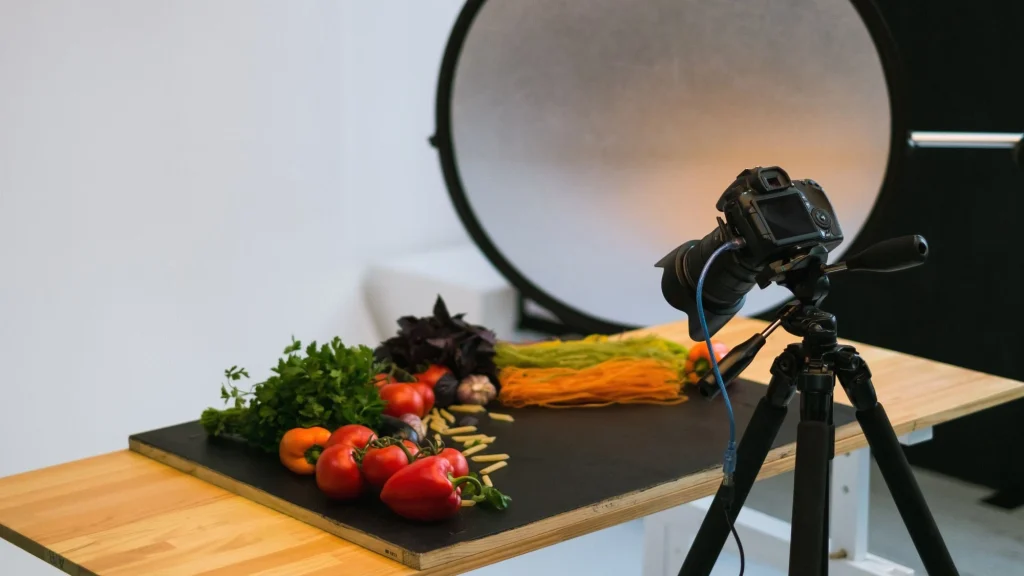
Understanding client expectations early will save you from painful learning experiences later. Here is what brands and ecommerce businesses consistently demand.
Consistent lighting and color accuracy. Every image in a batch should look like it was shot under identical conditions. Inconsistent lighting or color shifts between frames signal amateur work and create problems when products appear together on a website.
Platform compliance. Amazon, Shopify, Etsy, and other marketplaces have strict image requirements. Pure white backgrounds, minimum resolution standards, specific aspect ratios, and file size limits. Clients expect you to know these rules without being told.
Fast turnaround. Ecommerce brands operate on tight launch schedules. They expect edited images within days, not weeks. Your ability to deliver quickly, especially during product launch seasons, directly affects whether clients come back.
Clean client communication. Respond to client briefs promptly. Ask clarifying questions upfront instead of guessing. Provide realistic timelines and stick to them. Share revision policy details before the project starts. Professional client communication is as important as photography skill.
Multiple deliverables. Clients often need the same product shot in different formats: square crops for Instagram, landscape for website banners, vertical for Pinterest, and isolated cutouts as digital assets for ads. Build this flexibility into your workflow from the start.
Technical workflow skills. Beyond photography itself, clients and agencies hiring product imaging specialists expect proficiency in tethered shooting, color management across devices, organized file naming conventions, and structured delivery of final assets. These workflow skills matter as much as your creative eye.
Running a Product Photography Business
If you plan to freelance or start a studio, you need to treat this as a business from day one. Photography talent alone will not pay the bills.
Pricing. Choose a pricing structure that fits your workflow: hourly rates, per-image pricing, or project-based flat fees. Per-image pricing is standard in e-commerce photography. Day rates work better for larger brand campaigns. Our product photography pricing guide breaks down current market rates in detail.
Contracts and usage licensing. Always use a contract. Define scope of work, number of images included, revision rounds, delivery timelines, and usage rights. Usage licensing is especially important. A brand using your images in paid digital marketing campaigns should pay more than one using them only on their website.
Business admin. Register your business, set up proper invoicing, track expenses, and set aside money for taxes. Consider liability insurance, especially if you work on-site at client locations. These are not exciting tasks, but they protect your income and your reputation.
Product Photography Career Paths Compared
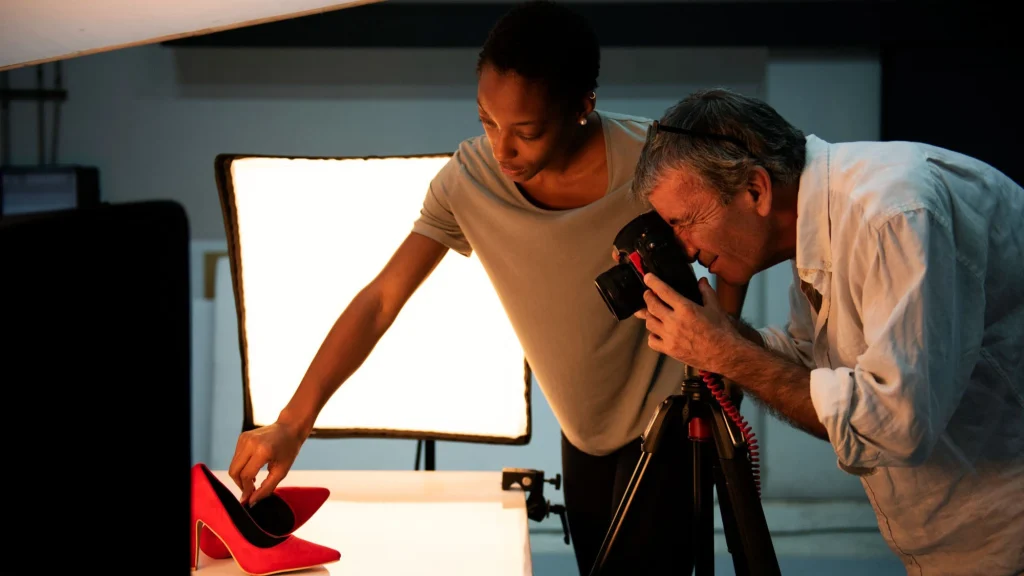
There is no single way to build a career as a product photographer. Here are the most common paths, each with different trade-offs.
Freelance Product Photographer
Maximum flexibility, variable income. You choose your clients, set your rates, and control your schedule. But you are responsible for marketing, client acquisition, and every administrative task. Income can be unpredictable, especially in the first two years.
In-House Photographer
Steady paycheck and predictable schedule. You work for one company, shooting their product line consistently. Benefits often include health insurance and paid time off. The trade-off is less creative variety and limited control over projects. Senior photographers at large ecommerce companies can earn well above the national average.
Studio Owner
Highest earning potential but also the highest risk. As a studio owner, you manage space, equipment, staff, and client relationships. Some studio owners eventually hire associate photographers and scale beyond their own shooting capacity.
Photography Educator
An option for experienced photographers who enjoy teaching. Online courses, workshops, mentorship programs, and speaking engagements can generate significant secondary income alongside active shooting work.
Tips to Succeed as a Product Photographer
Invest in lighting before cameras. This is the single best product photography career tip I can give. A modest camera with excellent studio lighting will produce better results than an expensive camera with poor light. Master one-light setups first, then add complexity.
Build relationships, not just a portfolio. Repeat clients are the foundation of a sustainable photography business. Deliver excellent work, communicate clearly, and make yourself easy to work with. Long-term brand partnerships are worth far more than one-off freelance gigs.
Stay current with marketplace requirements. Amazon updates its product image guidelines regularly. Shopify and other platforms evolve their recommended image specs. Knowing these standards inside out makes you more valuable to ecommerce clients.
Learn basic product styling. You do not need to be a professional stylist, but understanding how to arrange and present products in a frame gives you an edge. Styling directly affects how compelling a product image feels to the viewer.
Track visual trends. The visual standards brands expect evolve constantly. What looked cutting-edge two years ago can feel dated today. Follow industry publications, study brand campaigns you admire, and keep your work current.
How AI Is Changing Product Photography
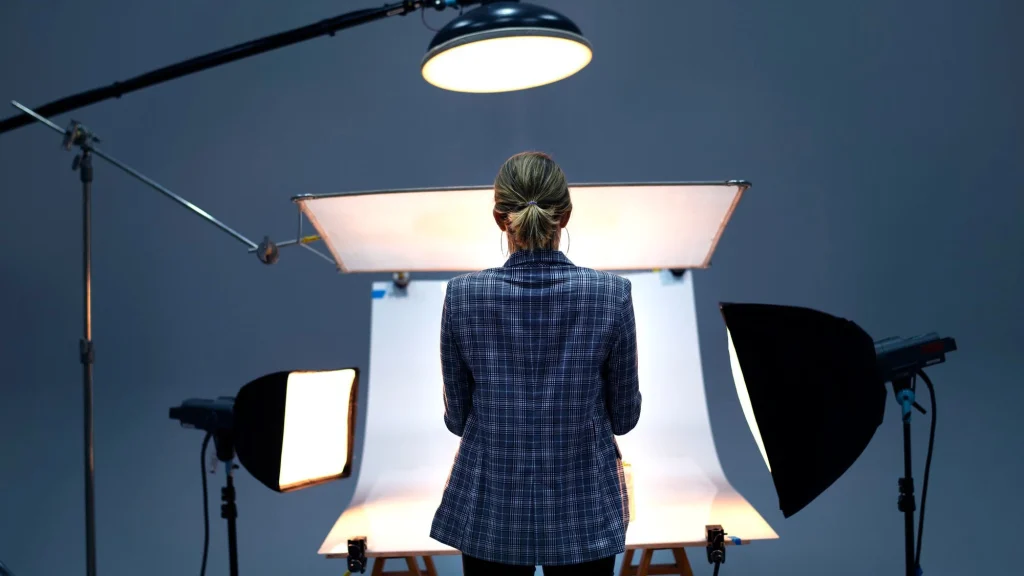
AI tools are already reshaping parts of the product photography workflow. Background removal, basic retouching, and even some lifestyle composite generation can now be handled by AI software. If your only offering is simple cutout shots on a white backdrop, that part of the market is getting squeezed. We explored this shift in depth in our article on whether photography will be replaced by AI.
But AI still struggles to consistently reproduce accurate textures, lighting nuances, material feel, and true-to-life color that meets regulatory and marketplace compliance standards. It cannot replace the creative direction behind a styled lifestyle shoot. And it certainly cannot build a relationship with a brand or understand their evolving visual identity across seasons.
AI is actually increasing demand in certain areas. Brands need more original photography to differentiate themselves from competitors using generic AI-generated imagery. Luxury goods brands, regulated industries, and companies selling products where texture and detail matter still require skilled human photographers with real studio lighting setups.
The photographers who will succeed long-term are those who use AI tools to speed up their workflow while offering creative value that software cannot replicate. Think of AI as a tool in your kit, not a replacement for your skill set.
Common Mistakes New Product Photographers Make
Buying expensive gear before learning lighting. A $3,000 camera body will not fix poor lighting. Spend your early budget on lights, modifiers, and learning materials. Camera operation skills matter, but lighting mastery matters more.
Building a weak, unfocused portfolio. A portfolio with 50 mediocre images across random product types hurts more than it helps. Curate ruthlessly. Show 10 to 15 excellent images that represent the kind of work you want to be hired for.
Underpricing to get experience. Working for free or near-free occasionally is fine for portfolio building. But making it a habit trains clients to expect low rates and undercuts your long-term earning potential. Know your value and price accordingly.
Skipping contracts. Verbal agreements lead to disputes. Even for small projects, a simple contract protects both you and the client. Define deliverables, timelines, and payment terms in writing every time.
Ignoring post-production workflows. Many beginners focus entirely on shooting and treat editing as an afterthought. Post-production is where good shots become great deliverables. Whether you handle editing yourself or delegate it, build a reliable editing workflow early.
How Long Does It Take to Become a Product Photographer?

Timelines vary based on your starting experience, how much time you invest, and your local market. But here is a realistic roadmap that works for most people.
Month 1 to 3: Learn fundamentals. Study lighting, composition, and camera settings. Practice shooting household products in a DIY setup. Take online photography courses if you need structured learning.
Month 3 to 6: Build your portfolio. Shoot mock projects, experiment with different product categories, and refine your editing process. Start assembling your online portfolio website.
Month 6 to 12: Land your first paying clients. Start local, pitch small businesses, and take on introductory projects. Begin booking paid work consistently even if the rates are modest.
Year 2+: Specialize. Identify the product categories and client types where your work is strongest. Raise your rates as your portfolio and reputation grow.
Year 3+: Premium positioning. Many photographers begin charging premium rates after several years of consistent work, strong client relationships, and a clear niche. This is not guaranteed, but those who treat photography as a business and invest in their specialization reach this stage reliably.
Frequently Asked Questions
Do you need a degree to become a product photographer?
No. A formal degree in photography or visual arts can help, but it is not required. Most successful product photographers build their careers through self-directed learning, mentorship, and hands-on practice. Your portfolio and results matter far more than credentials.
Can you do product photography as a side hustle?
Absolutely. Product photography is one of the most side-hustle-friendly photography niches because you can shoot on your own schedule, work from a home studio, and take on projects without long on-location commitments. Many full-time product photographers started this way.
What products pay the most for photography?
Luxury goods, high-end jewelry, cosmetics, and tech products typically pay the highest rates. These categories demand advanced lighting techniques, meticulous post-production effects, and often include usage licensing fees that add to the total project value.
How does product photography compare to other photography careers?
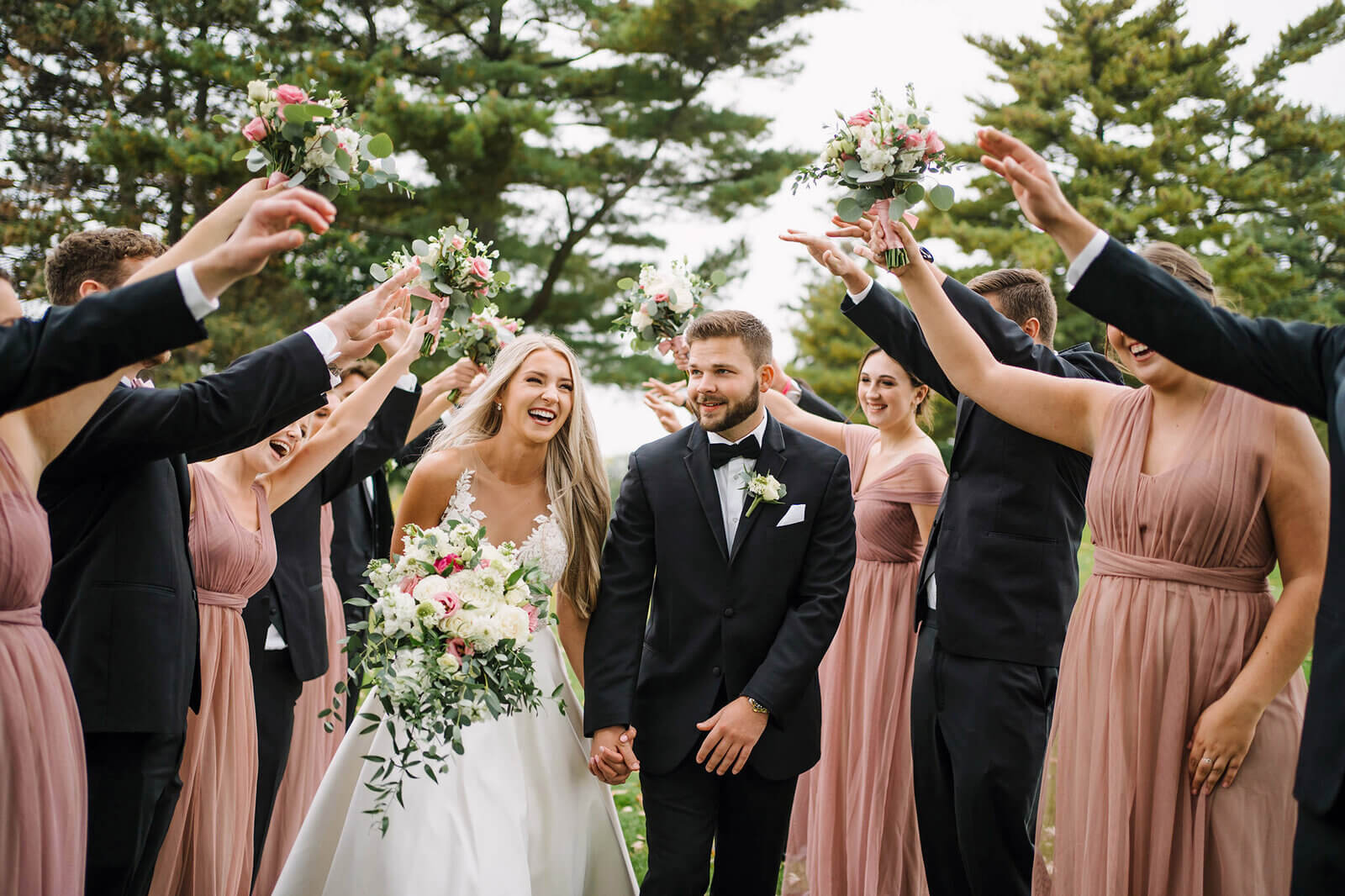
Product photography offers more predictable income and scheduling than wedding or event photography. It involves less travel than editorial or real estate photography. The trade-off is less variety in your day-to-day shooting and more studio-based work. For photographers who value consistency and scalability, it is one of the strongest niches to specialize in.
What is the difference between product photography and commercial photography?
Product photography is a subset of commercial photography. Commercial photography covers any photography done for business purposes, including advertising, corporate headshots, and architectural shoots. Product photography specifically focuses on photographing products for marketing, ecommerce, and advertising use.
Can product photographers work remotely?
Yes, to a large extent. If you have a home studio setup, most ecommerce product photography can be done remotely. Brands ship products to you, you shoot and edit, and deliver files digitally. Some projects require on-location shoots at a client warehouse or showroom, but the majority of work happens in your own space.
Do I need a studio to start?
Not at all. Many successful product photographers started in a spare room, garage, or even on a kitchen table near a window. A dedicated studio space becomes important as your volume and client expectations grow, but it is not a prerequisite for getting started or booking your first clients.
Final Thoughts
A product photography career is not a shortcut to easy money. But for people who enjoy technical creativity and have the discipline to run a business, it remains one of the most stable and scalable photography paths available today.
Start with simple equipment. Master lighting before spending on expensive cameras. Build a focused portfolio that showcases real technical ability. Treat client relationships as seriously as your camera skills. And invest in efficient workflows, including knowing when to delegate editing, so you can grow without burning out.
That is what turns product photography from a hobby into a long-term business.