Have you ever taken a photo of your car and thought, Why does this look nothing like real life?
Car photography is harder than it looks. Shiny paint, moving shots, night meets, and dark interiors can quickly ruin a photo, especially if you are using the wrong camera.
The good news? You do not need expensive gear to get started.
A solid beginner camera can help you capture sharper photos, cleaner reflections, better low-light shots, and smooth video without spending a fortune. It also makes learning photography much easier.
In this guide, you will find the best beginner cameras for car photography under $1000. We will cover image quality, autofocus, video features, lens options, and ease of use to help you choose the right camera for your style and budget.
Editorial Note: This article is written as a research-based buyer guide, not a lab-tested review. It uses official specification pages, public review coverage, and buyer-intent analysis. Amazon listings, prices, ratings, and availability change frequently; verify live Amazon pages before purchasing
Affiliate Disclosure: This article may contain affiliate links. If you buy through these links, we may earn a small commission at no extra cost to you.
Best Beginner Camera for Car Photography
If you’re new to car photography, you want a camera that feels easy but still delivers sharp results.
Under $1000, the Canon EOS R50 is the best all-around pick. It has a 24.2MP APS-C sensor, fast Dual Pixel autofocus, and clean 4K video. It works well for both parked cars and rolling shots without much effort.
And if you shoot fast-moving cars, the Canon EOS R10 is better. It offers up to 15 fps burst shooting and stronger subject tracking. For long-term lens growth, the Sony a6400 stands out with its reliable autofocus and huge E-mount lens system.
Here’s a quick breakdown of the top beginner choices:
| Category | Camera | Why it wins |
|---|---|---|
| Best overall | Canon EOS R50 | Best balance for beginner car photos, details, and social video. |
| Best for action | Canon EOS R10 | Faster burst speed and vehicle detection make it stronger for moving cars. |
| Best lens ecosystem | Sony a6400 | Sony E-mount offers broad first-party and third-party lens options. |
| Best Nikon pick | Nikon Z50II | Modern Nikon APS-C option with vehicle-aware subject detection. |
| Best color/style | FUJIFILM X-T30 II | Great for static car portraits, color, and editorial-style images. |
| Best for video creators | Sony ZV-E10 | Best for car reels, walkarounds, and YouTube/TikTok content. |
| Best stabilized budget kit | OM-D E-M10 Mark IV | Compact, stabilized, and affordable for handheld static work. |
| Best ultra-budget | Canon EOS R100 | Lowest-cost mirrorless entry point for static car photos. |
| Best compact Nikon creator kit | Nikon Z30 | Small Nikon kit for beginner photo/video work. |
Comparison Table
| Camera | Best For | Sensor | Speed | Video |
|---|---|---|---|---|
| Canon EOS R50 with RF-S 18-45mm Kit | Best overall beginner camera for car photography | 24.2MP APS-C | Up to 15 fps electronic / 12 fps electronic first-curtain | 4K up to 30p |
| Canon EOS R10 with RF-S 18-45mm Kit | Best for moving cars and action under $1000 | 24.2MP APS-C | 15 fps mechanical / 23 fps electronic | 4K and Full HD options |
| Sony Alpha a6400 with 16-50mm Kit | Best Sony option for autofocus and lens ecosystem | 24.2MP APS-C | 11 fps | 4K/30p |
| Nikon Z50II with 16-50mm Kit | Best Nikon beginner option for color, handling, and subject tracking | 20.9MP APS-C | Up to 30 fps electronic / 11 fps mechanical | 4K up to 60p with crop |
| FUJIFILM X-T30 II with 15-45mm Kit | Best for color, style, and static car portraits | 26.1MP X-Trans APS-C | Fast stills performance | 4K/30p and Full HD high-speed modes |
| Sony ZV-E10 with 16-50mm Kit | Best for car photography plus reels, YouTube, and TikTok | 24MP APS-C | Good casual stills performance | 4K/30p |
| OM SYSTEM / Olympus OM-D E-M10 Mark IV | Best stabilized budget camera for handheld car photography | 20MP Micro Four Thirds | Beginner-friendly stills performance | 4K video |
| Canon EOS R100 with RF-S 18-45mm Kit | Best ultra-budget mirrorless option | 24.1MP APS-C | 6.5 fps continuous shooting | Cropped 4K/24p and Full HD up to 60p |
| Nikon Z30 with 16-50mm Kit | Best compact Nikon creator kit under $1000 | 20.9MP APS-C | Up to 11 fps | 4K up to 30p |
Buyer’s Guide: What Makes a Camera Good for Car Photography?
If you’re serious about car photography, don’t start with megapixels or brand hype. Cars are one of the hardest subjects you can shoot.
They reflect light, hide detail in shadows, and move in unpredictable ways. Your camera should handle that without fighting you.
Here’s what actually changes your results.
1. Autofocus and subject tracking
Autofocus matters when shooting rolling cars, panning shots, car meets, or handheld detail shots. Look for phase detection AF with continuous AF (AF-C). Even better if the camera has subject or vehicle detection.
For rolling shots, tracking matters more than lens quality. You want the focus to stick to the car while you pan and shoot bursts. Weak autofocus = missed shots, no matter what you use.
2. APS-C vs Micro Four Thirds
APS-C gives better low-light performance and stronger background blur. That helps cars stand out from busy streets.
Micro Four Thirds is smaller and lighter. It also gives a deeper depth of field and often stronger stabilization.
3. Lens ecosystem
Lenses shape your results more than the body. You’ll use different focal lengths for different shots:
- Wide (16–24mm): full car + environment
- Standard (35mm): natural storytelling
- Short tele (50–85mm): clean car portraits
- Telephoto (100mm+): compression and detail shots
Sony E-mount has the widest lens support and best third-party options. Micro Four Thirds is strong for compact setups. Canon RF-S and Nikon Z DX are still growing in budget lens options.
4. Burst speed for action
For parked cars, the burst rate is irrelevant. For motion work, you need three things working together:
- High frame rate (fps)
- Deep buffer memory
- Fast sensor readout to reduce rolling shutter
For rolling shots, you’re often shooting in AF-C + continuous burst mode while panning. A camera like the Canon EOS R10 performs better here because it maintains tracking while sustaining higher frame rates.
5. Stabilization
Stabilization is not about freezing motion. It’s about controlling micro-shake. There are two systems:
- IBIS (In-body Image Stabilization) shifts the sensor
- OIS (Optical Image Stabilization) moves lens elements
Micro Four Thirds systems often combine both effectively, giving you up to several stops of stabilization for handheld static shots.
Stabilization does not counter subject motion. A moving car still needs a fast shutter speed, usually 1/500 or faster, depending on speed.
6. Screen and viewfinder
A flip screen helps with low angles and creative framing. It’s great for wheels, bumpers, and vertical shots.
An EVF helps in bright light and gives better exposure control. It also makes reflections easier to judge before you shoot.
7. Video capability
Modern car photography overlaps heavily with video content. You’re not just looking at resolution. You should care about:
- Bitrate (affects compression quality in motion)
- 4K oversampling (reduces moiré and improves sharpness)
- Log profiles (S-Log, C-Log, F-Log for grading flexibility)
- 8-bit vs 10-bit color depth (affects grading latitude)
For social content, 4K 30fps is the baseline. For smoother motion, 60fps helps with rolling shots and cinematic playback. A microphone input also matters if you’re capturing exhaust sound or commentary.
9 Best Beginner Cameras for Car Photography Under $1000
Below are 9 beginner-friendly cameras under $1000 that actually work for car photography.
Each pick is based on real shooting needs like autofocus for moving cars, lens options, and low-light performance, so you can quickly choose the right setup without guesswork.
Let’s break down the best options so you can see what fits your style and budget.
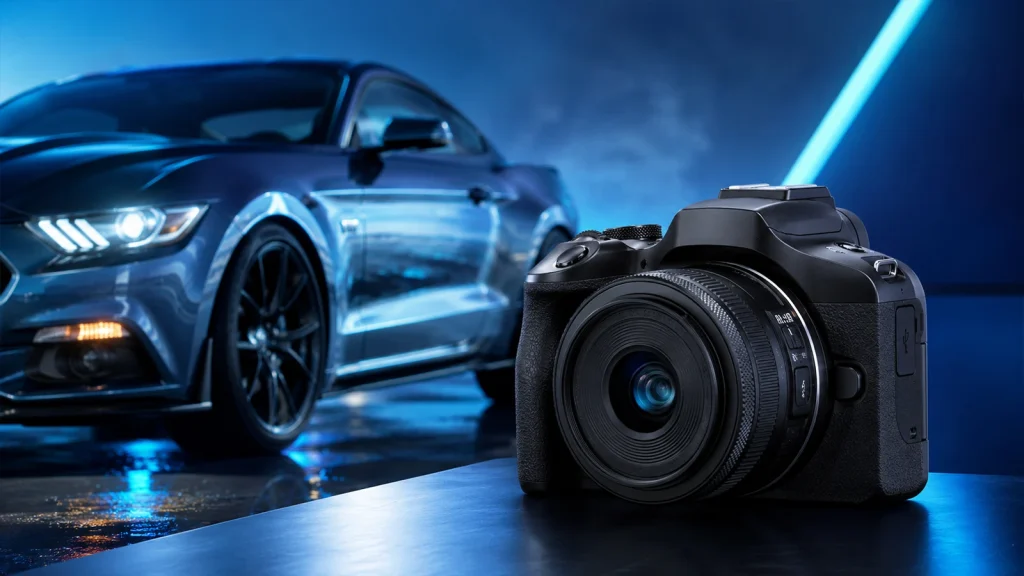
1. Canon EOS R50 with RF-S 18-45mm Kit – Best overall beginner camera for car photography
| Field | Details |
|---|---|
| Best for | Best overall beginner camera for car photography |
| Approx. price positioning | Usually under $1000 with a kit lens |
| Sensor | 24.2MP APS-C |
| Autofocus | Dual Pixel CMOS AF II |
| Burst/speed | Up to 15 fps electronic / 12 fps electronic first-curtain |
| Video | 4K up to 30p |
If you want a simple first camera for car photography, the Canon EOS R50 is one of the safest picks under $1000. It’s light, easy to use, and gives sharp, clean images without a learning curve.
The 24.2MP APS-C sensor captures strong detail in paint, reflections, and body lines, so your shots already look polished with minimal effort.
Why it works for car photography
Think of a real car shooting. You’re walking around the car, changing angles, going low for wheel shots, and stepping back for full frames.
- The R50 handles that smoothly.
- It works best for parked cars, car meets, showrooms, and slow rolling shots.
- Canon’s Dual Pixel CMOS AF II keeps focus locked on the car, so you can focus on framing instead of settings.
- The RF-S 18-45mm kit lens covers wide shots and basic detail work. DIGIC X processing keeps the camera fast and responsive, and uncropped 4K video helps for reels and walkarounds.
Review and beginner experience
This camera, the Canon EOS R50, feels simple in a good way. You don’t spend time fighting settings.
Autofocus does most of the work, so you can focus on light and composition.
Image quality is clean straight out of the camera, good for social media, thumbnails, and basic client work.
The only real weakness is low light. The kit lens struggles at night or in dark garages. A fast prime lens later fixes that easily.
Pros and Cons
| Pros | Cons |
|---|---|
| Easy for beginners | No in-body stabilization |
| Fast and reliable autofocus | Kit lens weak in low light |
| Flip screen for low angles | Limited RF-S lens options |
| Sharp 24.2MP APS-C sensor | Smaller lens ecosystem |
| Good 4K video support |
Who should buy it?
Pick the Canon EOS R50 if you want your first real camera for cars that just works.
It’s great for parked cars, meets, social content, and beginner rolling shots without making things complicated.
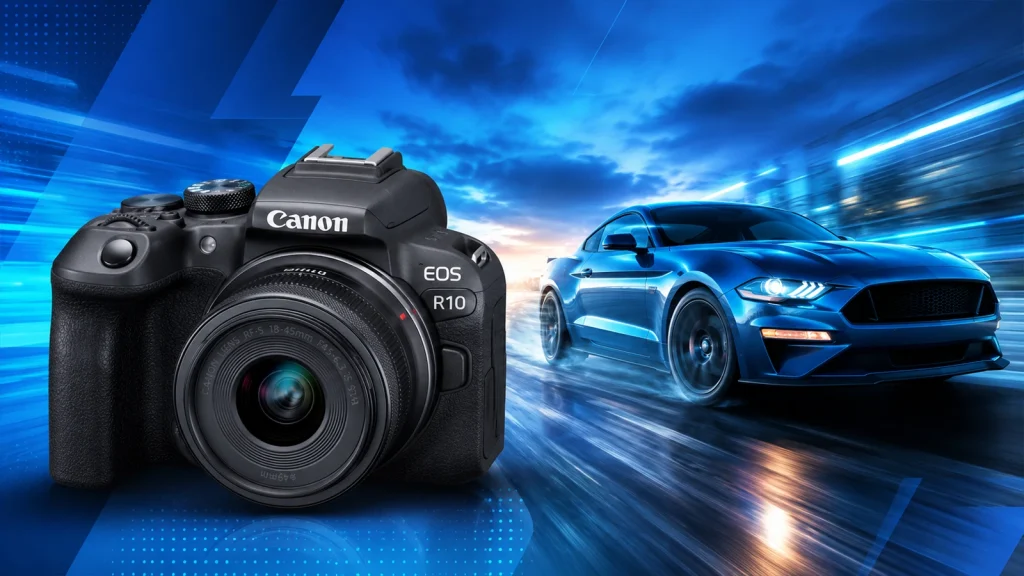
2. Canon EOS R10 with RF-S 18-45mm Kit – Best for moving cars and action under $1000
| Field | Details |
|---|---|
| Best for | Best for moving cars and action under $1000 |
| Approx. price positioning | Often around or under $1000, depending on kit/sale |
| Sensor | 24.2MP APS-C |
| Autofocus | Dual Pixel CMOS AF II with vehicle detection |
| Burst/speed | 15 fps mechanical / 23 fps electronic |
| Video | 4K and Full HD options |
If the Canon R50 feels like a safe starter, the Canon EOS R10 is the one you pick when cars start moving. It’s built for speed.
Canon lists up to 15 fps mechanical and 23 fps electronic shooting, plus subject detection for people, animals, and vehicles. That alone makes it much stronger for action-focused car photography.
The 24.2MP APS-C sensor keeps details sharp, so even fast shots still hold clean edges and good color.
Why it works for car photography
Ask yourself this. Are you only shooting parked cars? Or do you want motion, speed, and energy in your shots?
- The R10 is made for the second one.
- It works best for rolling shots, track days, autocross, highway pulls (from safe spots), and panning practice.
- Its autofocus system tracks moving cars more confidently than most beginner bodies in this range. You also get faster burst shooting, which means more chances to catch the perfect frame when the car moves through your scene.
Review and beginner experience
This camera pushes you a bit more, but that’s a good thing if you want to grow. You start learning real camera control here. Things like:
- Servo AF for moving subjects
- Fast shutter speeds like 1/1000 for freezing motion
- Slower speeds like 1/60–1/125 for panning blur
- Continuous burst shooting while tracking a car
It feels less “automatic” than the R50, but that’s exactly why it helps you improve faster in automotive photography.
The tradeoff is the learning curve. You’ll need time to understand AF modes and timing. But once it clicks, your hit rate on moving cars improves a lot.
Pros and Cons
| Pros | Cons |
|---|---|
| Strongest action performance in this list | Can push close to $1000 with kit |
| Vehicle detection helps with moving cars | No in-body stabilization |
| High burst rate for fast sequences | AF settings take time to learn |
| Good ergonomics for manual control | Smaller lens ecosystem than Sony E |
| Solid hybrid photo and video performance |
Who should buy it?
Pick the Canon EOS R10 if you don’t just want parked car photos. It’s for people who want motion, speed, and real automotive action. Rolling shots, track days, and panning practice are where this camera really starts to stand out.
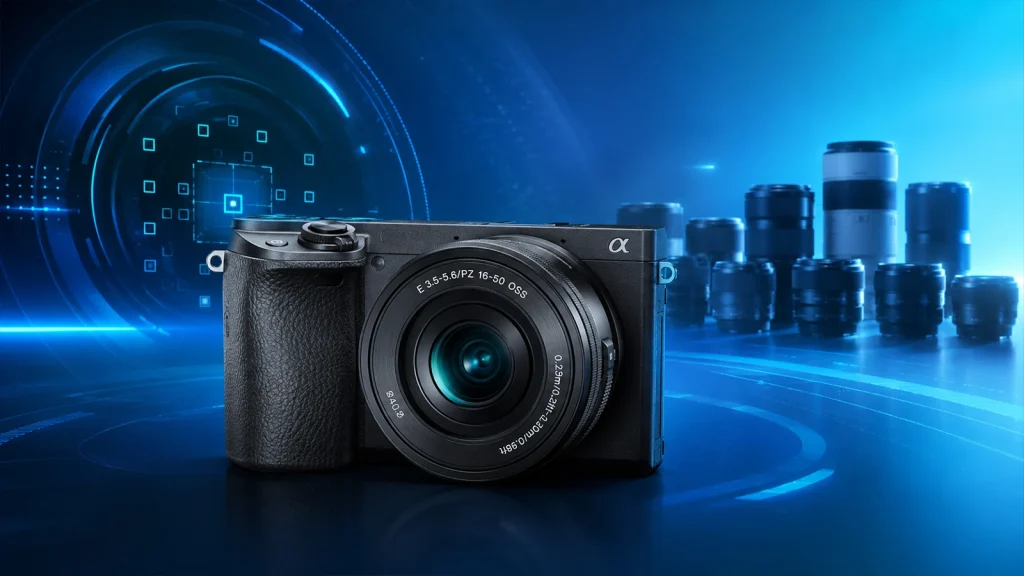
3. Sony Alpha a6400 with 16-50mm Kit – Best Sony option for autofocus and lens ecosystem
| Field | Details |
|---|---|
| Best for | Best Sony option for autofocus and lens ecosystem |
| Approx. price positioning | Often under $1000 with a kit lens |
| Sensor | 24.2MP APS-C |
| Autofocus | Real-time AF and object tracking |
| Burst/speed | 11 fps |
| Video | 4K/30p |
If you want a camera system that can grow with you, the Sony a6400 is one of the best choices under $1000.
The biggest reason is Sony’s massive E-mount lens ecosystem. You get access to affordable primes, sharp zooms, and strong third-party lens support.
The 24.2MP APS-C sensor, 11 fps burst shooting, and Real-time Tracking AF also make it great for both photos and video.
Why it works for car photography
Car photography needs lens flexibility. Sometimes you need a wide lens for garage shots. Other times, you want a tighter lens for clean side profiles or detail shots. This is where the a6400 stands out. Sony E-mount gives you lens options for almost every style:
- Wide lenses for interiors and full-car shots
- 35mm primes for natural car-meet photos
- 50mm to 85mm lenses for compressed, cinematic angles
The autofocus is also very reliable. It tracks moving subjects smoothly and keeps up well during rolling shots or quick angle changes.
Review and beginner experience
The a6400 feels fast, compact, and easy to carry around, and meets or shoots. Image quality looks sharp and clean, even for social media, blogs, and small client work.
The downside is the menu system. It can feel confusing at first. The 16-50mm kit lens is also more of a starter lens than a creative one, so many users upgrade later for sharper images and better low-light results.
Pros and Cons
| Pros | Cons |
|---|---|
| Huge lens ecosystem | Menus feel complex at first |
| Reliable autofocus and tracking | No in-body stabilization |
| Compact and travel-friendly | Kit lens is average |
| Strong 4K video support | Older body design |
| Excellent long-term upgrade path |
Who should buy it?
Choose the Sony a6400 if you want long-term flexibility and plan to upgrade lenses over time.
It’s ideal for beginners who want a camera system that can grow into more serious automotive photography later.
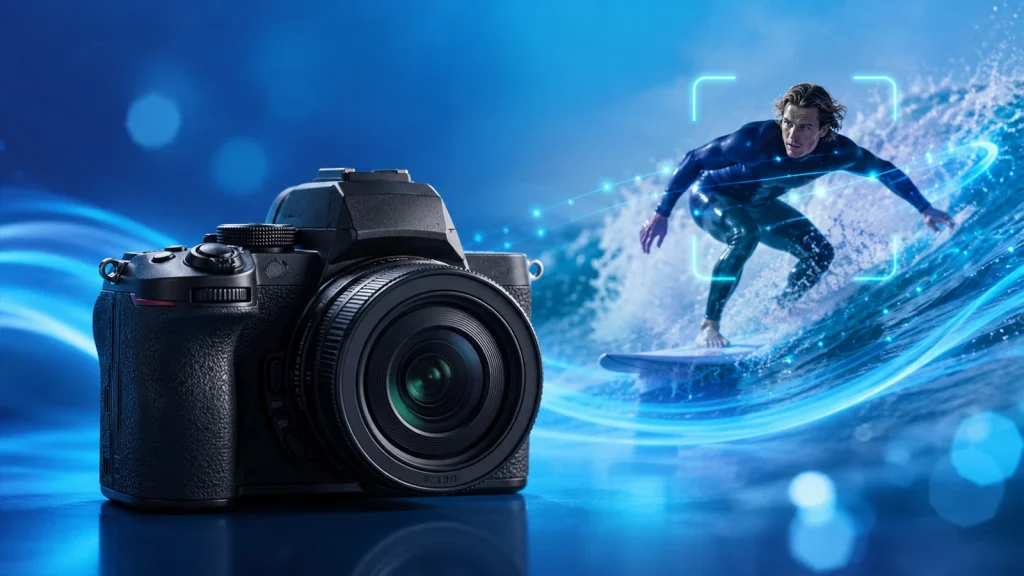
4. Nikon Z50II with 16-50mm Kit – Best Nikon beginner option for color, handling, and subject tracking
| Field | Details |
|---|---|
| Best for | Best Nikon beginner option for color, handling, and subject tracking |
| Approx. price positioning | Body under $1000; kit pricing varies |
| Sensor | 20.9MP APS-C |
| Autofocus | Subject detection, including vehicles |
| Burst/speed | Up to 30 fps electronic / 11 fps mechanical |
| Video | 4K up to 60p with crop |
If you like Nikon colors and want a camera that feels comfortable from day one, the Nikon Z50II is a strong beginner choice.
It uses a 20.9MP APS-C sensor with Nikon’s EXPEED 7 processor, giving you fast autofocus, solid image quality, and smooth performance. It also includes vehicle subject detection for moving cars.
Why it works for car photography
Car photography depends heavily on color and lighting. Paint reflections, sunset tones, chrome details, and shadow recovery all matter.
The Z50II handles those scenes well. Nikon colors look rich and natural, especially for outdoor shoots and golden-hour car photos.
The 16-50mm kit lens is also practical. The wide end works for interiors and garage shots, while 50mm gives cleaner three-quarter angles and tighter compositions.
Vehicle tracking helps during rolling shots, though results still depend on shutter speed, lighting, and technique.
Review and beginner experience
The Z50II feels comfortable right away. The grip is solid, the controls are easy to understand, and the electronic viewfinder helps a lot in bright sunlight.
Compared to the Nikon Z30, this feels more complete for still photography.
The main drawback is the Nikon DX lens ecosystem. It’s improving, but still smaller than the Sony E-mount when it comes to affordable native lenses.
Pros and Cons
| Pros | Cons |
|---|---|
| Strong Nikon color science | Smaller lens ecosystem than Sony |
| Fast EXPEED 7 processor | No in-body stabilization |
| Vehicle subject detection | Kit price can exceed $1000 |
| Comfortable grip and controls | Fewer budget DX lens options |
| EVF helps in bright light |
Who should buy it?
Choose the Nikon Z50II if you want a beginner camera that feels comfortable, modern, and photography-focused. It’s a great fit for car meets, parked cars, rolling shots, and creators who prefer Nikon colors and handling.
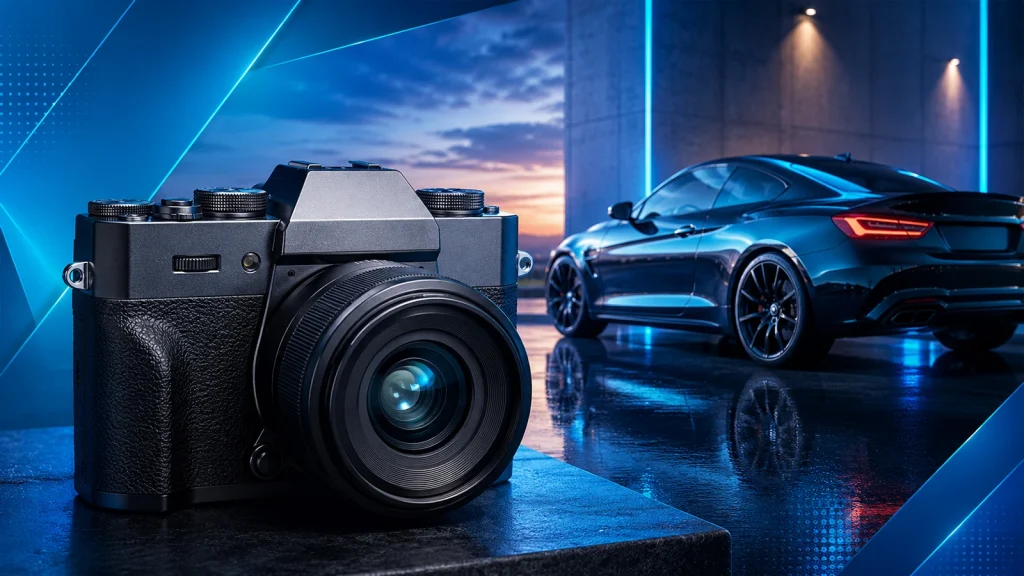
5. FUJIFILM X-T30 II with 15-45mm Kit – Best for color, style, and static car portraits
| Field | Details |
|---|---|
| Best for | Best for color, style, and static car portraits |
| Approx. price positioning | Often near the $1000 line, depending on kit/sale |
| Sensor | 26.1MP X-Trans APS-C |
| Autofocus | Hybrid AF with face/eye detection and tracking |
| Burst/speed | Fast stills performance |
| Video | 4K/30p and Full HD high-speed modes |
If you care more about mood, color, and cinematic-looking car photos, the Fujifilm X-T30 II stands out immediately. Its 26.1MP X-Trans CMOS 4 sensor and Fujifilm Film Simulations give photos a polished look straight out of the camera.
For static car portraits, night city shots, editorial-style details, and Instagram-ready color, it is one of the most enjoyable options under or near $1000.
Why it works for car photography
Automotive photography is highly visual. Paint color, reflections, neon light, sunset gradients, leather interiors, and background atmosphere matter.
The X-T30 II handles those scenes beautifully. Fujifilm’s Film Simulations help beginners create stylish JPEGs without heavy editing, which is perfect for Instagram, blogs, and quick uploads.
The 15-45mm kit lens works well for full-frame shots, interiors, and detail photos, though many users later upgrade to fast prime lenses for stronger background blur.
Review and beginner experience
The X-T30 II is not the best action camera here, and it lacks in-body stabilization.
However, it is excellent for a beginner who wants to learn photography as a craft. The physical dials make shutter speed and exposure feel tangible, and the colors can look polished with less editing.
The 15-45mm kit lens is compact, but car photographers will eventually want a prime lens, such as a 23mm, 35mm, or 50mm equivalent, for better subject separation and cleaner detail shots.
Pros and Cons
| Pros | Cons |
|---|---|
| Excellent color science and Film Simulations | No in-body stabilization |
| Sharp 26.1MP APS-C sensor | Not ideal for fast action |
| Stylish and compact body | The kit lens feels basic |
| Great for static car portraits | Autofocus is weaker than Sony or Canon |
| Fun manual-style controls |
Who should buy it?
Choose the Fujifilm X-T30 II if you want beautiful static car photos with strong color, mood, and style without spending hours editing.
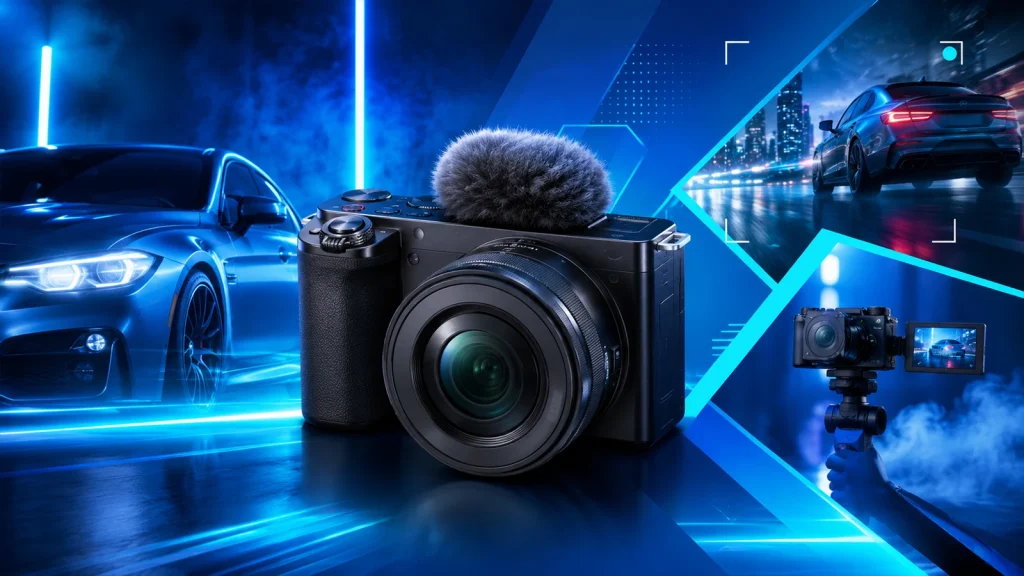
6. Sony ZV-E10 with 16-50mm Kit – Best for car photography plus reels, YouTube, and TikTok
| Field | Details |
|---|---|
| Best for | Best for car photography plus reels, YouTube, and TikTok |
| Approx. price positioning | Usually under $1000 with a kit lens |
| Sensor | 24MP APS-C |
| Autofocus | Sony E-mount autofocus system |
| Burst/speed | Good casual stills performance |
| Video | 4K/30p |
If your goal is not just photos but full car content creation, the Sony ZV-E10 is one of the most practical beginner cameras under $1000.
It uses a 24MP APS-C sensor, shoots 4K/30p video, and works with Sony’s huge E-mount lens system. It is clearly built for video-first creators, not traditional DSLR-style shooting.
Why it works for car photography
Think beyond still photos. Most car creators today shoot walkarounds, cold starts, interior clips, rolling reels, and behind-the-scenes content.
That is exactly where the ZV-E10 fits in. It works best for:
- car reels and TikTok clips
- dealership walkarounds
- interior and detail videos
- POV driving-style content (stationary setups)
Pair it with a wide zoom or a small prime lens, and it becomes a lightweight car content setup you can carry anywhere.
Review and beginner experience
The ZV-E10 is good for video and easy front-screen shooting, but weaker for still photos since it has no EVF, which hurts in bright light.
The a6400 is better for photography. The ZV-E10 is better for beginners who care more about video and plan to grow into Sony E-mount lenses later.
Pros and Cons
| Pros | Cons |
|---|---|
| Excellent for hybrid photo + video | No electronic viewfinder |
| Strong Sony E-mount lens support | Less comfortable for pure photography |
| Compact and travel-friendly | Kit lens is basic |
| Great for reels, Shorts, and TikTok | Not ideal for bright outdoor still shooting |
| Good value under $1000 |
Who should buy it?
Choose the Sony ZV-E10 if you are building a car content channel. It is perfect for creators who want both photos and videos, especially for social media platforms like Instagram Reels, TikTok, and YouTube Shorts.
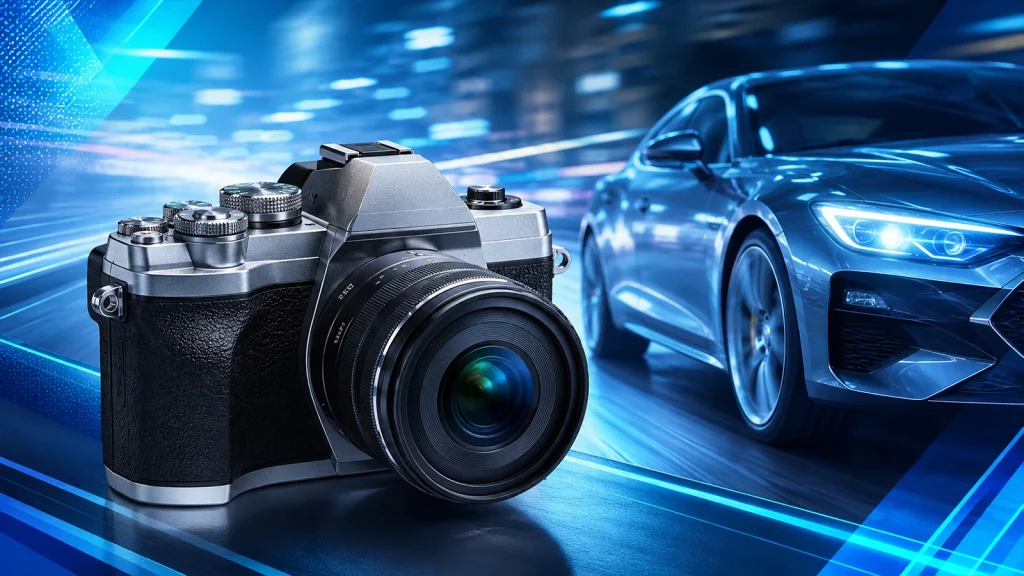
7. OM SYSTEM / Olympus OM-D E-M10 Mark IV – Best stabilized budget camera for handheld car photography
| Field | Details |
|---|---|
| Best for | Best stabilized budget camera for handheld car photography |
| Approx. price positioning | Often under $800-$900 with a kit lens |
| Sensor | 20MP Micro Four Thirds |
| Autofocus | Contrast AF system |
| Burst/speed | Beginner-friendly stills performance |
| Video | 4K video |
If you want a small, light camera that you can carry all day, the OM-D E-M10 Mark IV is a smart budget pick. It uses a Micro Four Thirds sensor with strong in-body stabilization, which helps a lot when you shoot handheld.
It is not the fastest for action, but it is very useful for static car work.
Why it works for car photography
- Car photography often involves handheld shooting at dusk, in garages, or around shiny surfaces where using a tripod is inconvenient.
- The E-M10 Mark IV lets you shoot slower shutter speeds while keeping static cars sharp. That is useful for interiors, badges, paint details, and parked car scenes.
- The small Micro Four Thirds system also keeps everything compact, so you can carry multiple lenses without feeling heavy.
Review and beginner experience
Not the best choice for fast-moving cars since the autofocus isn’t as strong as Canon, Nikon, or Sony systems.
But for static car shots, travel, car meets, and budget learning, it works really well. Micro Four Thirds also has a solid, affordable lens ecosystem.
The tradeoff is depth of field and low light. APS-C cameras generally give better background blur and cleaner high ISO performance with the right lens.
Pros and Cons
| Pros | Cons |
|---|---|
| Strong in-body stabilization | Not ideal for fast-moving cars |
| Very compact and lightweight | Smaller sensor than APS-C |
| Affordable lenses available | Less background blur |
| Easy to carry for long shoots | Autofocus is less advanced |
| Good for handheld static shots |
Who should buy it?
Choose the E-M10 Mark IV if you want a lightweight, stabilized, budget-friendly camera mainly for parked cars, interiors, and learning photography without carrying heavy gear.
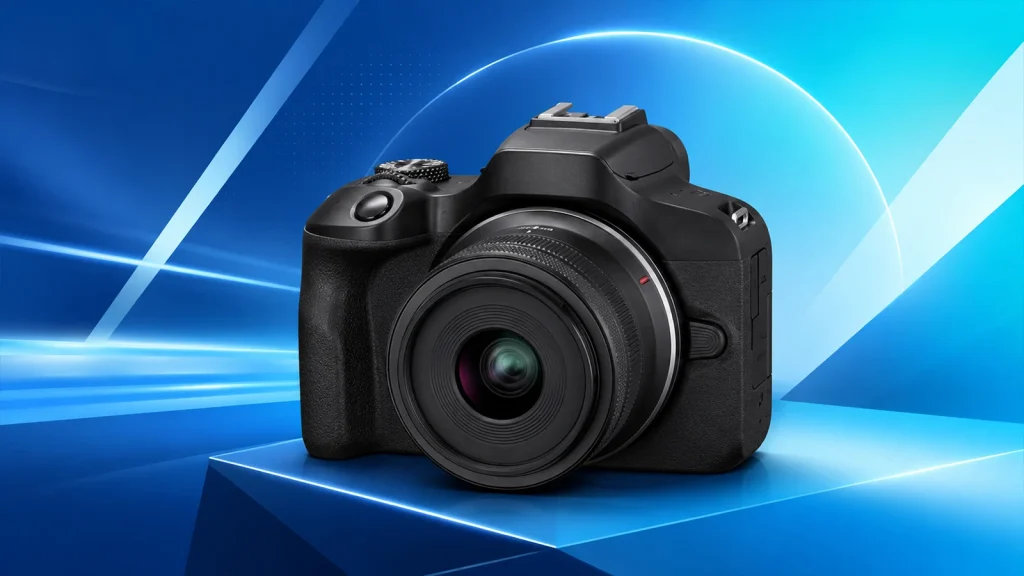
8. Canon EOS R100 with RF-S 18-45mm Kit – Best ultra-budget mirrorless option
| Field | Details |
|---|---|
| Best for | Best ultra-budget mirrorless option |
| Approx. price positioning | Commonly, one of the lowest-priced mirrorless kits |
| Sensor | 24.1MP APS-C |
| Autofocus | Dual Pixel CMOS AF |
| Burst/speed | 6.5 fps continuous shooting |
| Video | Cropped 4K/24p and Full HD up to 60p |
If you just want to get into car photography with the lowest possible cost, the Canon EOS R100 is the entry point. It gives you a 24.1MP APS-C sensor, Canon color science, and interchangeable lenses, all in a very simple body.
It is basic, but it gets the job done for learning.
Why it works for car photography
A beginner does not always need the most expensive camera. This camera is not about speed or advanced features. It is about learning the fundamentals. You can still shoot:
- Parked cars
- Dealership listings
- Basic car meet coverage
- Simple social media photos
The APS-C sensor is the key upgrade over a phone. You get better depth, cleaner detail, and real lens control. That matters when you start learning angles, reflections, and framing cars properly.
Review and beginner experience
The R100 feels very stripped down. No touch screen, slower burst shooting, and limited video features.
But that simplicity can actually help beginners focus on composition instead of settings.
Where it struggles is in action. Moving cars, rolling shots, and low-light performance are not its strengths. It is clearly designed for static shooting and learning basics first.
Pros and Cons
| Pros | Cons |
|---|---|
| Very affordable mirrorless entry point | Fixed non-touch screen |
| 24.1MP APS-C sensor | Not ideal for action or video-heavy work |
| Simple controls for learning basics | You may outgrow it faster than the R50 |
| Small and lightweight | |
| Good enough for static cars and blog images |
Who should buy it?
Choose the Canon EOS R100 only if your budget is your main limit. It works best for parked cars, simple content, and beginners who just want to move beyond smartphone photography without spending much.
9. Nikon Z30 with 16-50mm Kit – Best compact Nikon creator kit under $1000
| Field | Details |
|---|---|
| Best for | Best compact Nikon creator kit under $1000 |
| Approx. price positioning | Usually under $1000 with kit lens |
| Sensor | 20.9MP APS-C |
| Autofocus | Hybrid AF |
| Burst/speed | Up to 11 fps |
| Video | 4K up to 30p |
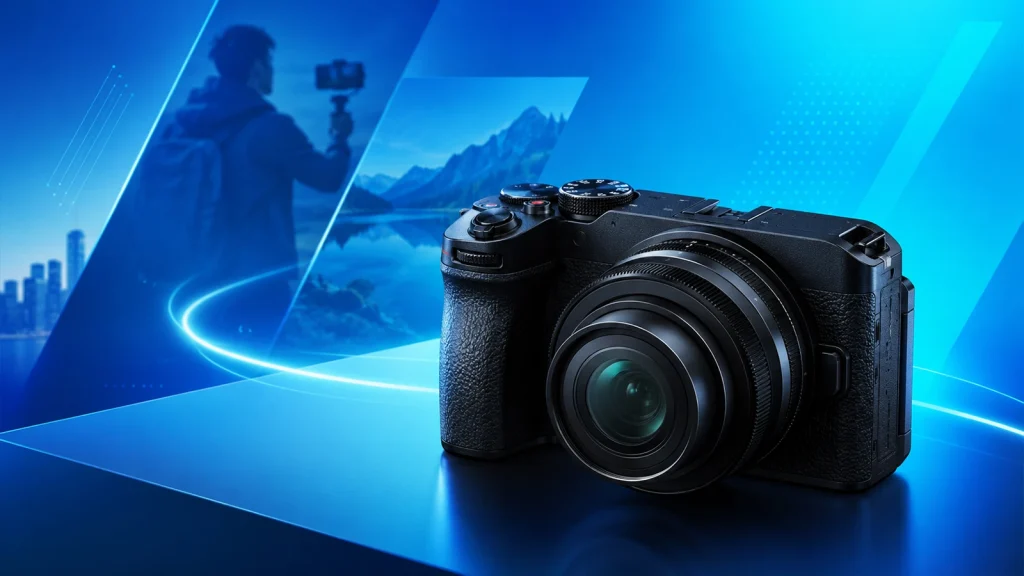
If you want a small Nikon camera mainly for car content and travel-friendly shooting, the Nikon Z30 is a simple and lightweight option.
It uses a 20.9MP APS-C sensor, shoots 4K video, and keeps things minimal with a clean, screen-based design.
There is no viewfinder here, but that helps keep the body small and easy to carry.
Why it works for car photography
The Z30 is best when your focus is on content, not heavy photography setups. It works well for:
- car walkaround videos
- detail and interior shots
- social media reels and short clips
- casual parked car photography
The 16-50mm kit lens also includes stabilization, which helps smooth handheld shots when you are moving around a car. It won’t freeze motion, but it does reduce small shakes in static scenes.
Review and beginner experience
The Z30 feels very simple and beginner-friendly. You mainly use the rear screen, which makes it feel similar to a phone but with better image quality and lens control.
For photography in bright sunlight, the lack of a viewfinder can be a challenge. You may struggle a bit with framing in harsh outdoor light.
Pros and Cons
| Pros | Cons |
|---|---|
| Very compact and lightweight | No electronic viewfinder |
| Strong for video and social content | Hard to use in bright sunlight |
| APS-C image quality | Older autofocus system |
| Stabilized kit lens | Not ideal for fast action |
| Usually budget-friendly under $1000 | Limited for advanced photography |
Who should buy it?
Choose the Nikon Z30 if you want a small, simple Nikon setup mainly for car videos, reels, and casual photography without needing a viewfinder.
Recommended Beginner Lenses and Accessories for Car Photography
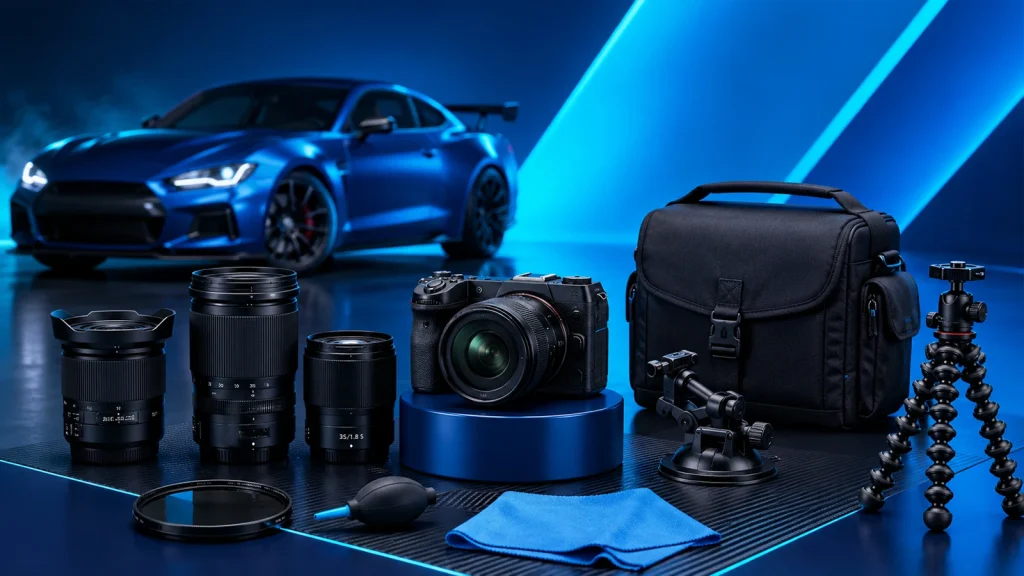
Most beginners get better results by keeping the camera body simple and spending more time on lenses, filters, and basic gear. That is where the real improvement happens. A good setup doesn’t need to be expensive, just smart.
Here’s a clear breakdown of what actually helps:
| Item | Why it matters |
|---|---|
| Kit zoom lens | Best beginner lens. It covers a wide range of short telephoto lenses, which helps you learn framing, distance, and storytelling before committing to primes. |
| 35mm-equivalent prime | Perfect for natural-looking car meet shots, side profiles, and environmental scenes. Feels close to what the eye sees. |
| 50mm-equivalent prime | Great for details like badges, wheels, and interiors. Also gives stronger background blur for cleaner subject separation. |
| Telephoto zoom | Ideal for track days, compressed angles, and shooting from a safe distance without disturbing the scene. |
| Circular polarizer | One of the most important tools in car photography. Cuts reflections on paint and glass, and makes colors look deeper and cleaner. |
| Tripod | Essential for night shoots, light painting, dealership inventory work, and any low ISO static setup. |
| Extra battery and SD card | Car meets and travel shoots run long. You don’t want to miss shots because of storage or power limits. |
Beginner tip: Don’t rush into buying lenses. Shoot at least 500 to 1000 photos with your kit lens first. Then review your best shots and check your focal lengths in editing software.
Here’s the simple pattern:
- If most of your best shots are wide, go wider next time
- If you keep cropping in for details, move toward a 50mm prime or telephoto
- If you like both, a zoom lens upgrade makes more sense
That small habit saves money and gets you to better results faster.
Beginner Car Photography Settings
| Scenario | Mode | Aperture | Shutter | ISO | Tip |
|---|---|---|---|---|---|
| Parked car portrait | Aperture Priority or Manual | f/4 to f/8 | 1/125 sec or faster handheld | ISO 100-800 | Use a lower ISO and watch reflections. |
| Detail shots | Aperture Priority | f/2 to f/5.6 | 1/125 sec or faster | ISO 100-1600 | Focus carefully on badges, wheels, stitching, or lights. |
| Rolling car/action | Shutter Priority or Manual | f/4 to f/8 | 1/500 to 1/2000 sec to freeze motion | Auto ISO if needed | Use continuous AF and burst mode. |
| Panning shot | Shutter Priority | f/8 to f/11 if light allows | 1/30 to 1/125 sec | ISO 100-400 | Practice smooth movement and expect many misses. |
| Night static car | Manual + tripod | f/5.6 to f/8 | 1-10 sec on tripod | ISO 100-400 | Use a tripod, timer, and avoid touching the camera. |
| Interior shot | Aperture Priority | f/4 to f/8 | 1/60 sec or faster with stabilization | ISO 400-1600 | Use wide lens and clean the interior first. |
Final Verdict
For most beginners under $1000, the Canon EOS R50 is the best all-around camera. It’s simple, reliable, and great for car meets, parked car shots, detail work, and basic video.
If you want better performance for fast-moving cars, the Canon EOS R10 is the stronger choice. For long-term lens growth and ecosystem strength, the Sony a6400 stands out.
If color and style matter most for static car photography, the Fujifilm X-T30 II is a great pick. Budget buyers can look at the Canon R100 or OM-D E-M10 Mark IV. Choose based on what you shoot most, not just specs.
FAQs
Is a full-frame camera necessary for car photography?
No. APS-C and Micro Four Thirds cameras can produce excellent car photos. For beginners under $1000, lens choice, light, reflections, location, and editing skill matter more than full-frame sensor size.
Is a phone enough for car photography?
A modern phone can be good for quick social posts, but a dedicated camera gives better lens flexibility, depth control, low-light options, RAW files, and long-term learning potential.
Should I buy a camera body or a better lens first?
If you do not own a camera, buy a beginner kit first. After learning, invest in a lens that matches your style. For car photography, a circular polarizer and a good prime lens can make a bigger visual difference than a small camera body upgrade.
Which is better for car photography, Canon or Sony?
Canon is often easier for beginners and has very strong autofocus. Sony has a broader E-mount lens ecosystem. Choose Canon if simplicity and ease of use matter most; choose Sony if lens flexibility and long-term system depth matter most.
Do I need image stabilization for car photography?
Stabilization is helpful for static handheld shots and low-light detail photos, but it does not freeze moving cars. For moving cars, shutter speed and autofocus are more important.
Can these cameras shoot dealership inventory photos?
Yes. For inventory work, prioritize consistency: use a tripod, the same focal length, clean backgrounds, controlled light, and repeatable angles. Any of the recommended cameras can work if the workflow is disciplined.