
The 2026 e-commerce product photo editing trends revolve around realism, creativity, automation, and innovation to meet online shoppers’ demand and expectations. Their requirements have generated immersive experiences, emotionally resonating visuals, brand-specific custom editing, storytelling-based editing, etc.
The rise of AI and automated editing is at its peak and evolving; businesses and brands are taking conscious steps regarding it, as those tools lack situational judgment and precision.
E-commerce photo editing builds powerful visuals, boosts visibility, engagement, and conversion. Professional photo editors ensure products appear natural and trustworthy to support the brand’s campaign and help reduce returns.
What you’ll learn in this article
- 1 Why Should E-commerce Businesses Follow Product Photo Editing Trends?
- 2 Top 16 E-commerce Product Photo Editing in 2026
- 2.1 1. E-commerce Product Listing Image Editing
- 2.2 2. 360° Photos and 3D Product Visualization / Interactive Spin Editing
- 2.3 3. AI-Powered Editing and Automation
- 2.4 4. Photos Optimized for Mobile-First / Social-Format
- 2.5 5. Augmented Reality (AR) / Virtual Try-On / Context Placing
- 2.6 6. Product Photo Manipulation
- 2.7 7. Packshot Product Photo Editing
- 2.8 8. High-end Retouching & Enhancing
- 2.9 9. Ghost Mannequin
- 2.10 10. Reflections & Shadow Adjustment
- 2.11 11. Product Image Masking
- 2.12 12. Color Correction and Color Grading
- 2.13 13. Complex Clipping Path
- 2.14 14. Object Removal and Replacement
- 2.15 15. Minimalist Image Editing Trend
- 2.16 16. Sustainability & Eco-Friendly Editing Workflows
- 3 Top 5 Product Photo Editing Tips for E-commerce
- 4 Is There Any Difference Between Photo Editing Styles and Photo Editing Trends?
- 5 How Online Photo Editing Courses Teach Photo Editing Trends?
Why Should E-commerce Businesses Follow Product Photo Editing Trends?
E-commerce businesses should follow product photo editing trends to make products appear trendy, modern, and suitable to viewers’ preferences, creating a long-lasting and credible impact, taking a competitive advantage of online competition, and ensuring steady & sustainable growth. Inside the overgrown competition, e-commerce sellers can make safe business with quality and trendy product images.
According to a 2026 blog by Stray Partners titled A 12-year analysis for new product launches, it is stated that every year, 30,000 new products are launched, but 83% fail within 18 months. To avoid being within that 83%, following industry trends to display products comes in handy. It ensures products appear high-quality and in their best light in front of the customers.
How Do Product Photo Editing Trends Impact Online Sales?
Product photo editing trends impact online sales by shaping customers’ perspectives on the product and the brand. Professionally edited, on-trend photos catch viewers’ attention fast while displaying products’ features, quality, and benefits. They boost buyers’ confidence in the product and persuade them to make the purchase, and increase conversion rates for the online sellers.
Other ways in which product photo editing trends drive online sales are as follows.
- Build a powerful and consistent brand identity
- Increase product visibility and click-through rates
- Improve engagement on social and mobile platforms
- Lower return rates with realistic product visuals
- Support seasonal campaigns and storytelling
How are AI Product Photo Editing Tools Failing to Fit into Modern Product Photo Editing Trends?
AI product photo editing tools fail to fit or meet modern product photo editing trends through missing precision and the creative essence of the modern trends. AI editors struggle with nuanced lighting, similar color combinations, realistic textures, etc, which often fall short to fulfill brand-specific visual creation; rather, they create generic results. Though AI editing has improved a lot, still, visual emotional depth, precision, human judgment, and custom solutions require manual editing from expert image editors, which machines can’t replicate.
Top 16 E-commerce Product Photo Editing in 2026
The top 16 e-commerce product photo editing trends in 2026 are active because of 2 crucial factors: public requirements and photo editing software features. Photographers, photo editors, photo retouchers, advertising and marketing agencies, professionals, and businesses that deal with a large amount of images seek for faster and better ways to edit images. As a result, product image editing trends rise; among those, the 16 e-commerce product image processing trends are as follows.
1. E-commerce Product Listing Image Editing
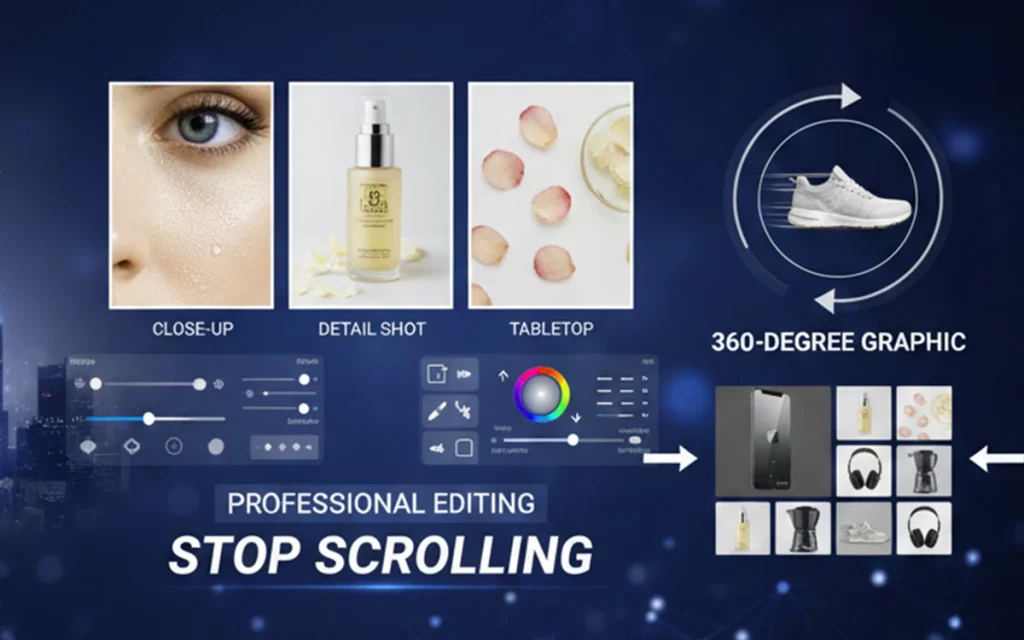
E-commerce product images include hero images, close shots, detail shots, tabletop, 360-degree graphics, etc. From the hero shots introducing the products to other shots moving viewers to paying customers, e-commerce image editing makes sure your images shine professionally and makes viewers stop scrolling or switch to competitors.
Why does product image and listing image editing work
- Helps position the subject accurately
- Creates a long-lasting first impression
- Makes the foreground appear eye-catching
- Follows the required image size and quality
- Make images more appealing for viewers to click
2. 360° Photos and 3D Product Visualization / Interactive Spin Editing
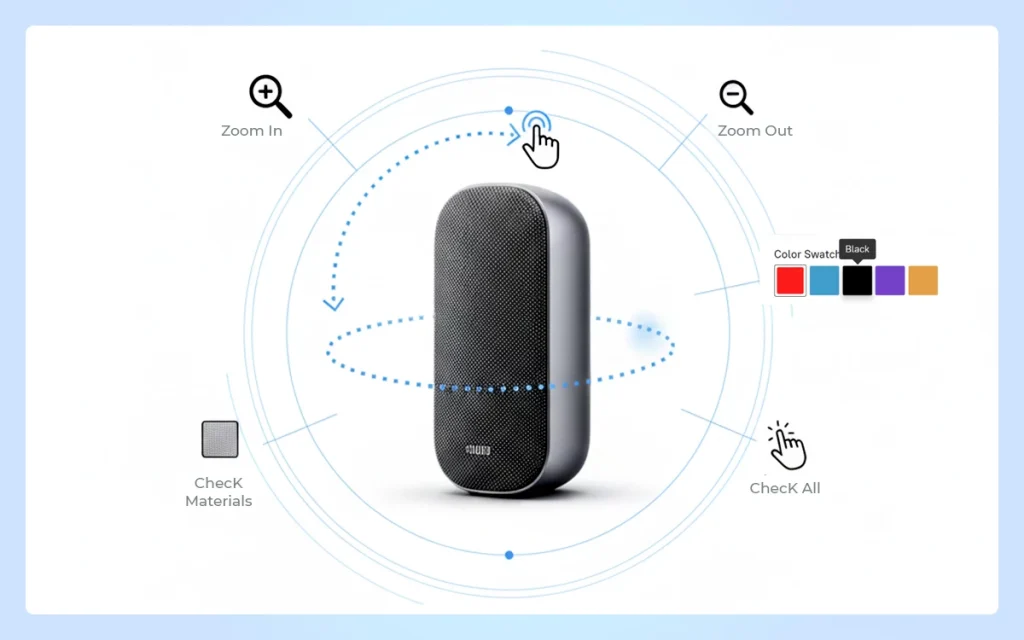
360° product images and 3D product visualization / interactive spin editing have created a stir among the viewers for some time. These types of images allow viewers to check products however they want, zooming in, zooming out, rotating at different angles, checking materials and colors for confirmation. Such interaction builds trust among the potential buyers and boosts product engagement by simulating real-world perception.
Why 360° photos and 3D product visualization / interactive spin editing work
- Gives immersive shopping experiences
- Delivers visual clarity and eliminates confusion
- Boost customer confidence and reduce returns
- Maximize click-through and engagement rates
3. AI-Powered Editing and Automation
AI-driven editing tools have empowered the editing process. They can both work upon instruction and automatically work on subjects, remove backgrounds, and enhance photos. Though concerns over precision on automated editing escalate, image editors make sure to oversee the editing process with a manual approach for faster workflow, brand consistency, and professional-grade quality output.
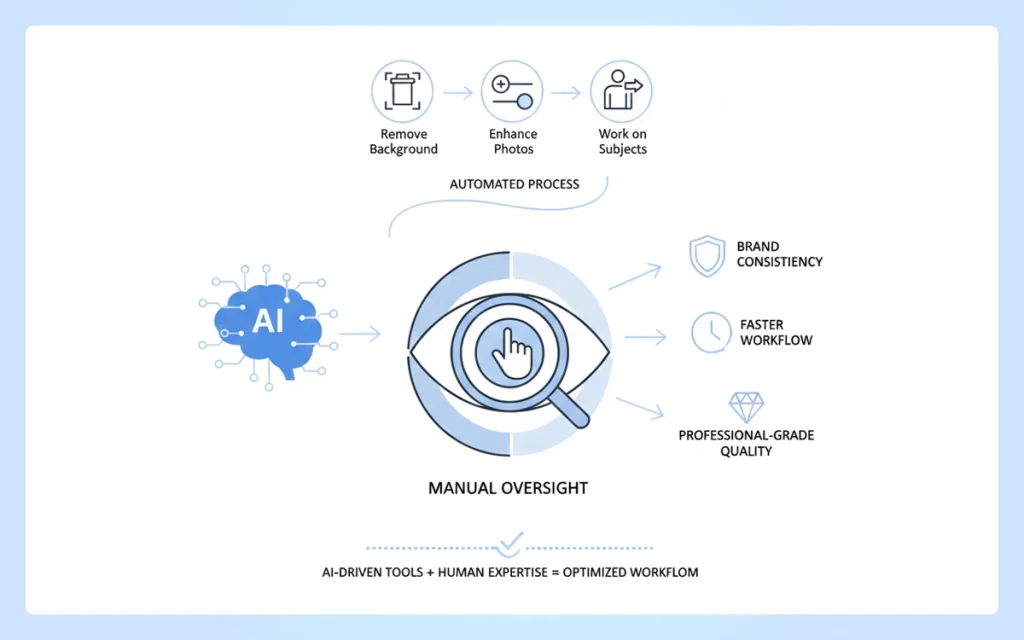
Why AI-powered editing and automation work
- Saves ample time in repetitive work
- Ensures consistent product presentation
- Reduces production costs for e-commerce stores
- Frees editors to focus on creative refinement
4. Photos Optimized for Mobile-First / Social-Format
Product photos are now moulded towards more mobile-first and social formats for online shoppers’ purchasing convenience. As mobile commerce and online shopping dominance is spreading, such images appear frequently on social media, load first, and reach niche-relevant audiences faster. Image editors maintain aspect ratio, size, and compression aligned with all screens, regardless of the viewing platform e-commerce to social media.
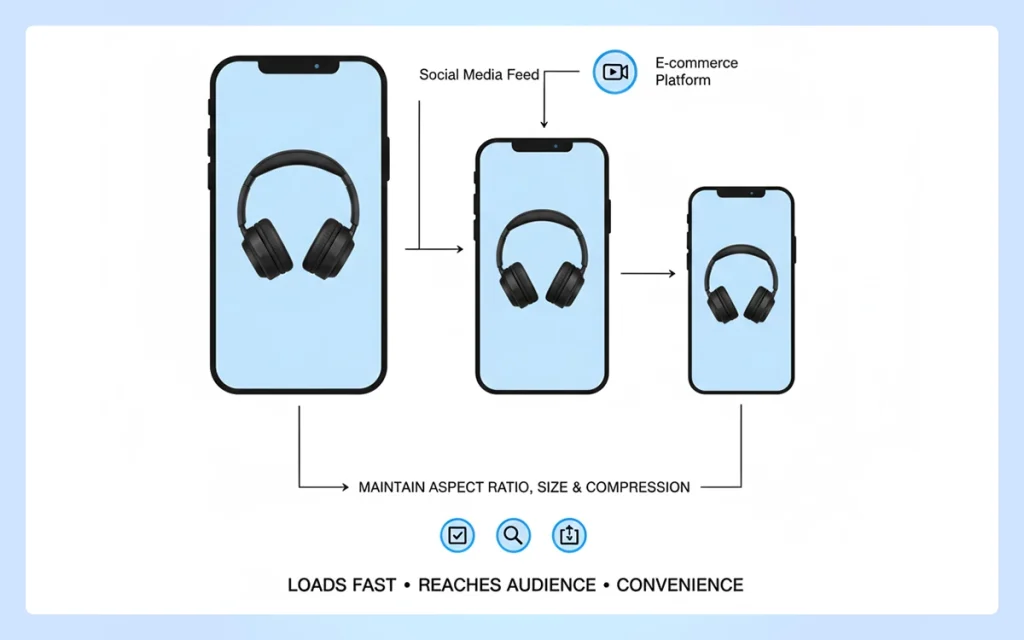
Why mobile-first/social-format images work
- Keeps product visuals sharp and responsive
- Enhances mobile user experience
- Increases conversion from social media ads
- Improves SEO and faster page loading
5. Augmented Reality (AR) / Virtual Try-On / Context Placing
AR photo editing or virtual try-on is the editing process where 3D visuals are placed into real environments. This trend has become popular as it lets customers “try” products virtually in their preferred spots; for example, furniture placement in the drawing room or testing a shade of lipstick. Such editing trends require editors’ creativity, blending with advanced-level technology for viewers to experience.
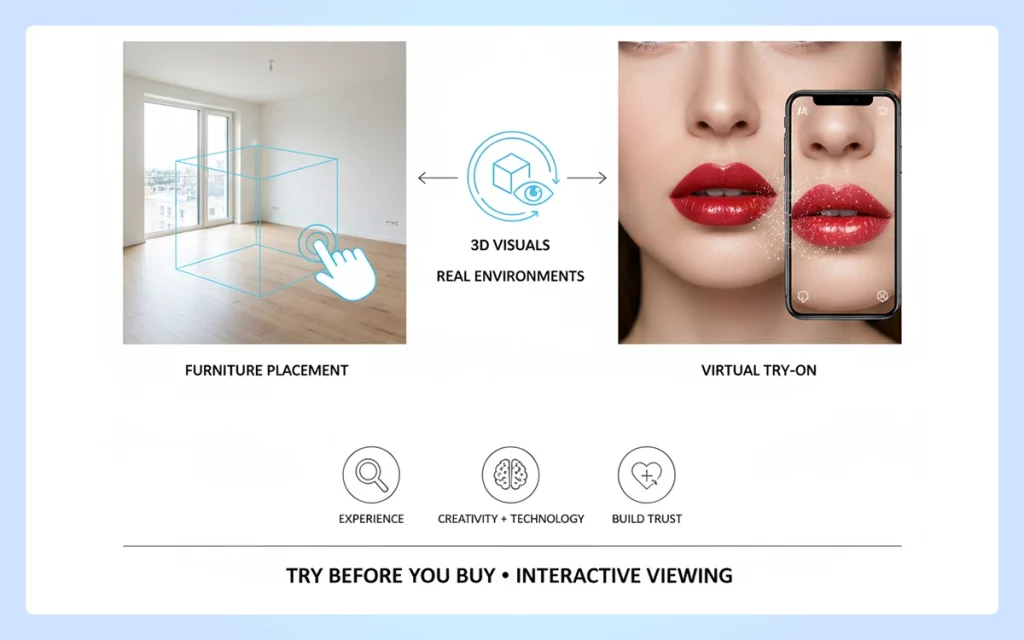
Why AR/virtual try-on/context placing photo editing work
- Creates interactive experiences
- Allow customers to visualize before buying
- Creates product reliability and assurance for the long term
- Builds trust by reducing bunce
6. Product Photo Manipulation
Product photo manipulation is the process of combining real-world scenarios with imagination to design a creative and surreal output of the product. Image manipulation has now evolved earlier than before, and from time to time, different trends have swept over, for example, Gen Z are drawn to images having holograms, data distortion, and glowing edges as they provide a futuristic look.

Why product photo manipulation works
- Creates a psychological impact on the viewers
- Makes the product appear reliable and powerful
- Influences viewers to purchase
- Has a longer-lasting impact
7. Packshot Product Photo Editing
Packashot product photo editing is editing images having packages, levels, and information of manufacturing/making, ingredients/elements for viewers to make informed decisions. This type of editing is always trendy as it makes the subject clear, obvious, and recognizable. It assures viewers by making them aware of the behind-the-scenes process in the text version for clarity.
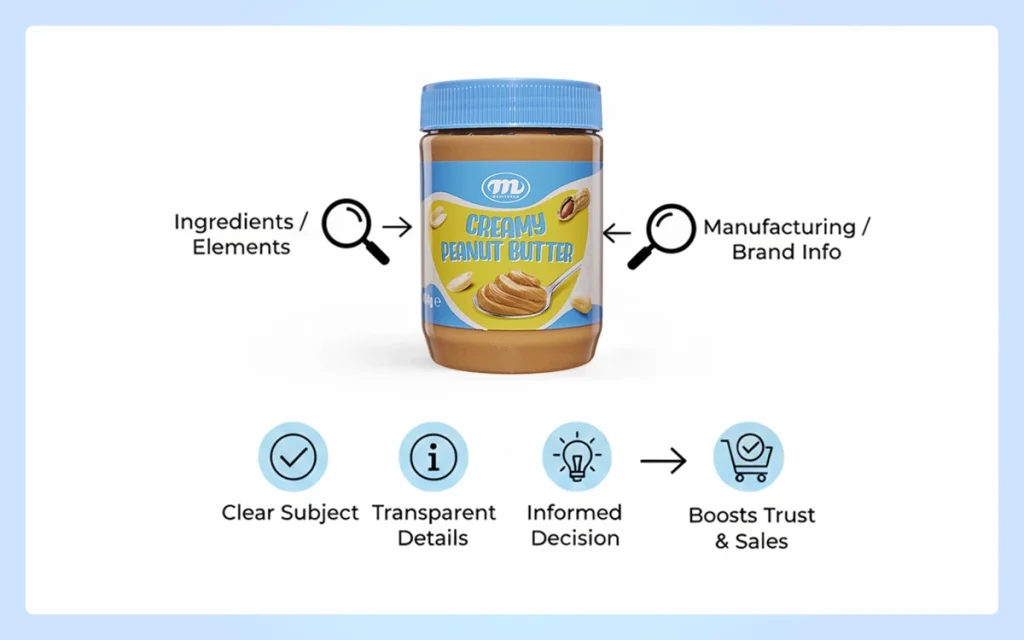
Why does packshot product image editing work
- Make the viewers know the product
- Presents the details accurately
- Allows reading the information
- Helps answer people’s curiosity
- Gives a lifestyle depiction of usage
8. High-end Retouching & Enhancing
High-end Retouching & Enhancing refers to the advanced, custom, critical Photoshop work to create a business-specific, creative, and outstanding look of products. Retouching enhances a product’s image’s convincing capability. High-end retouch is used in commercial photo shoots, fashion and glamour photoshoots, especially for model photoshoots.
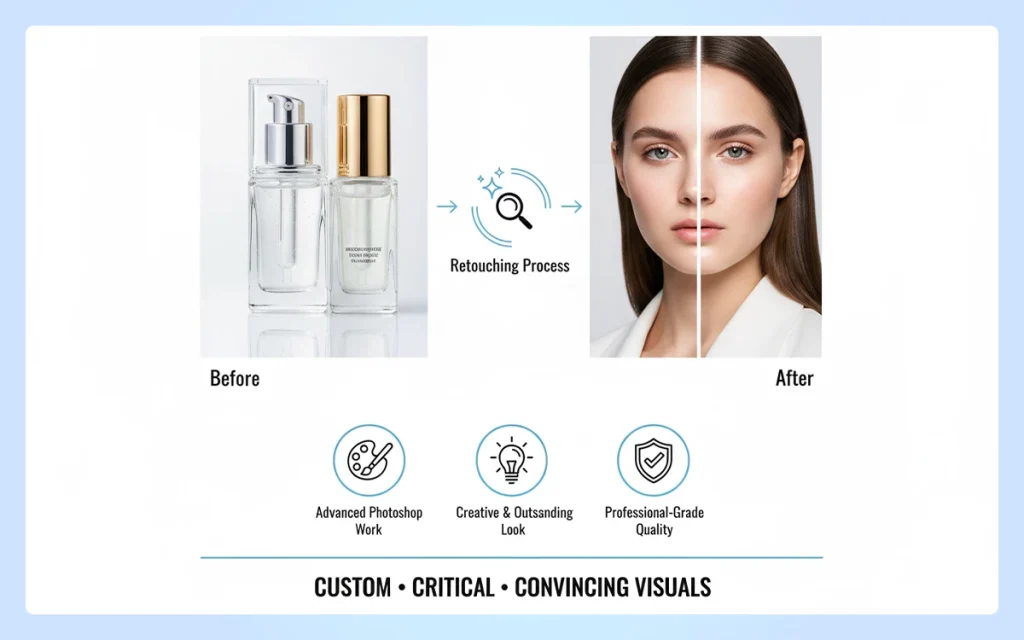
Why is high-end retouching and image-enhancing work
- Beautify products in a creative and artistic way
- Eliminates products visibility difference with the original look
- Eliminate distractions to make the subject appear majestic
- Encourage viewers to make a purchase
9. Ghost Mannequin
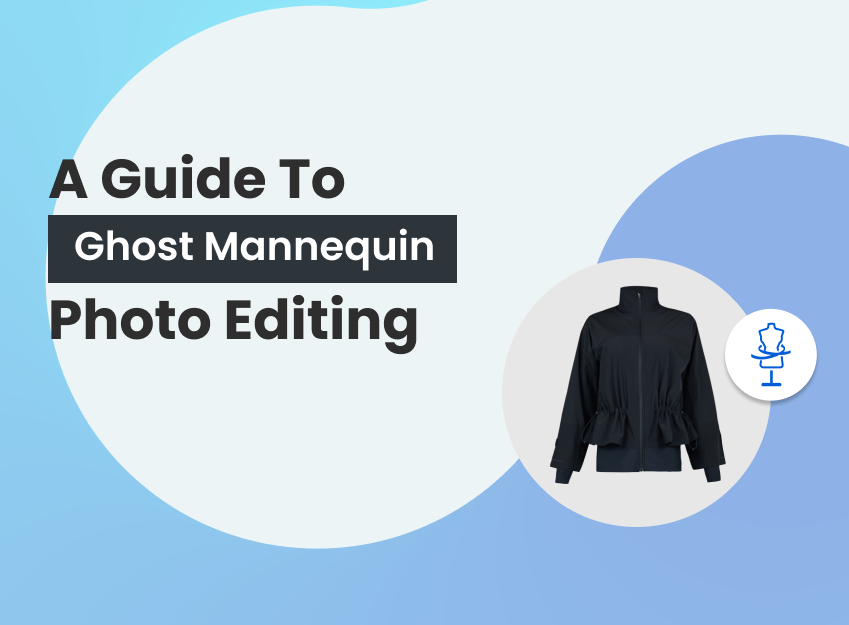
Ghost mannequin, also called invisible mannequin, 3d mannequin, hollow man effect, etc, is a clothing image processing technique to show that it is worn by an invisible body. For creating a realistic and professional appearance, and convincing buyers without comparing, the trend of the ghost mannequin effect is always trending.
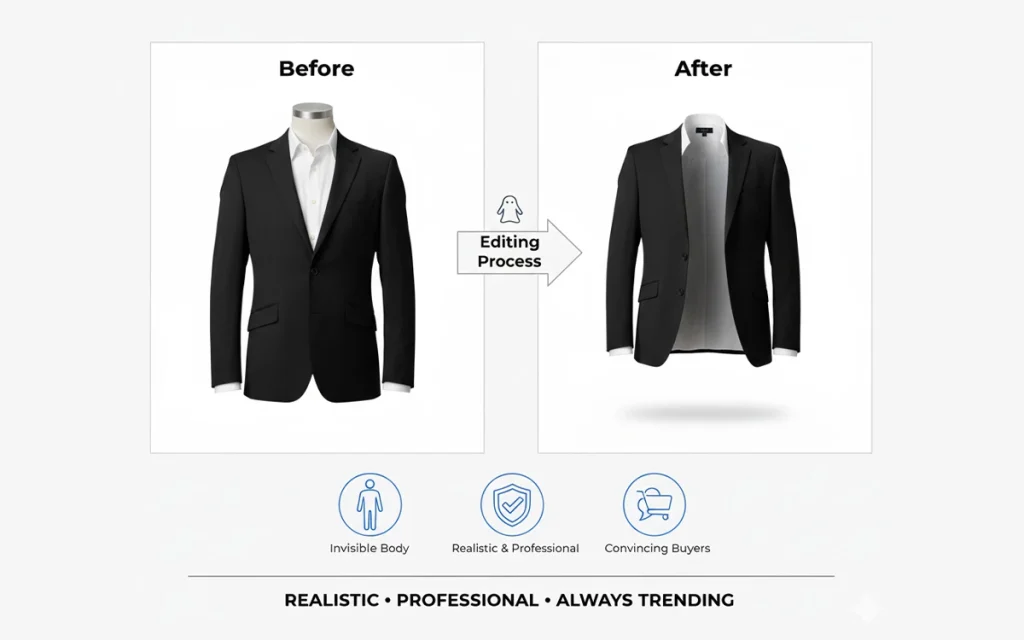
Why ghost mannequin works
- Captures viewers’ attention without comparison
- Create volumes & a realistic vibe
- Offers a clear, transparent body shape
- Helps viewers visualize the cloth
10. Reflections & Shadow Adjustment
Reflection and shadow adjustment is a non-destructive image processing techniques to make products appear realistic. The trend of artificial shadow and reflection, adding or removing, makes an ecommerce product convincing enough to convert.
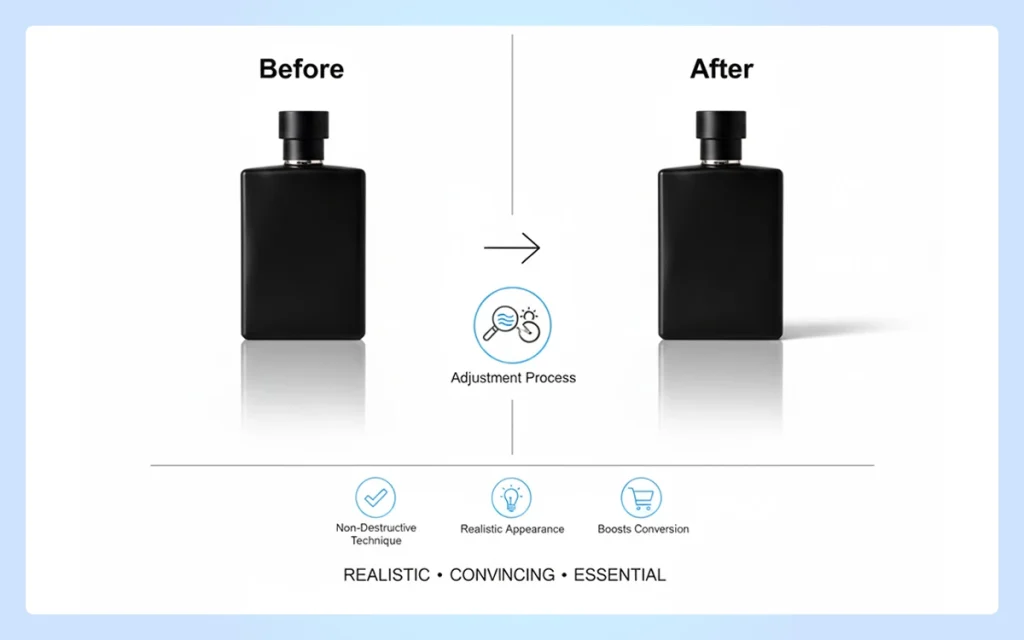
Why shadow and reflection adjustment work
- Make products appear similar to real-life
- Highlights the product by shading or reflecting
- Create high-quality and authentic product images
- Dominates the surroundings with a light, shady effect
11. Product Image Masking
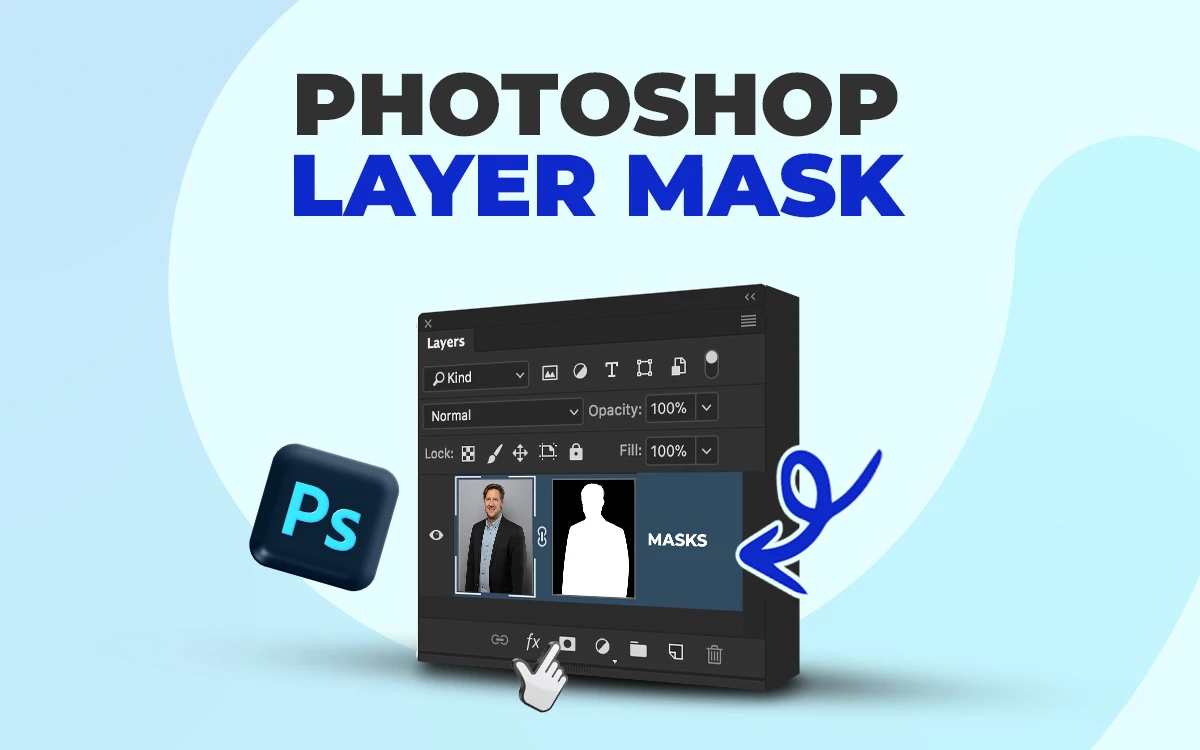
Image masking is a non-destructive graphical work of partially editing product photos. Product images having hair, fur, or soft pointy edges are difficult to edit and ruin the full picture, requiring masking to selectively control editing. Editing allows users to creatively show products in their best light.
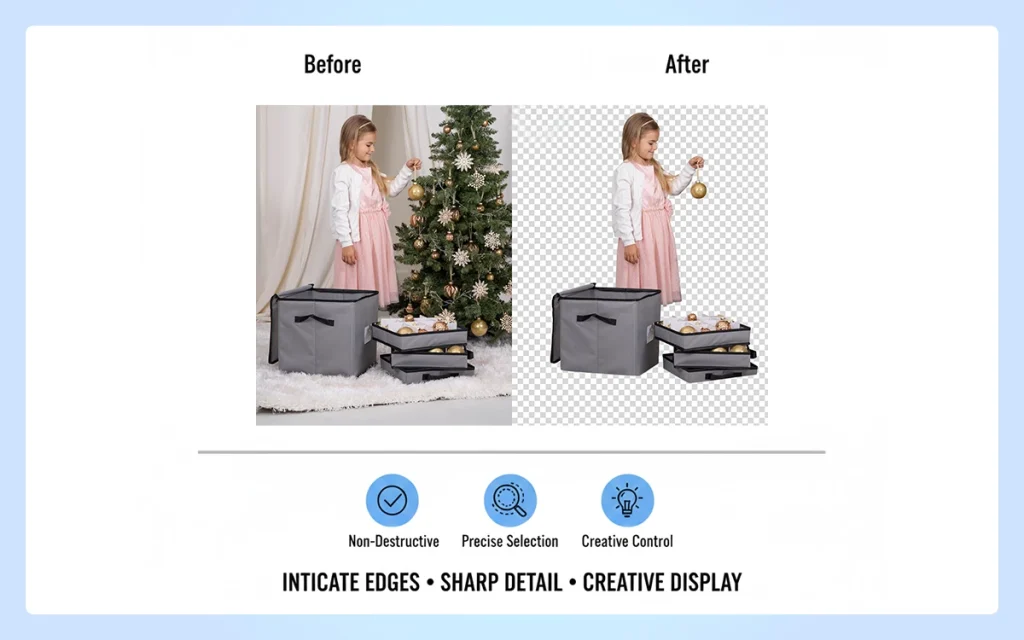
Why product image masking works
- Allows control of editing portions
- Isolate edges with complete precision
- Separates images from the background
- Selective hiding and revealing in an image
12. Color Correction and Color Grading
Color correction and color grading are the color adjustment work in images to make them appear natural and purposeful. Color correction comes first, followed by color grading during post-production. Professionally applied colors help eliminate viewers’ confusion, build trust in the product and brands, creating client loyalty along the process.
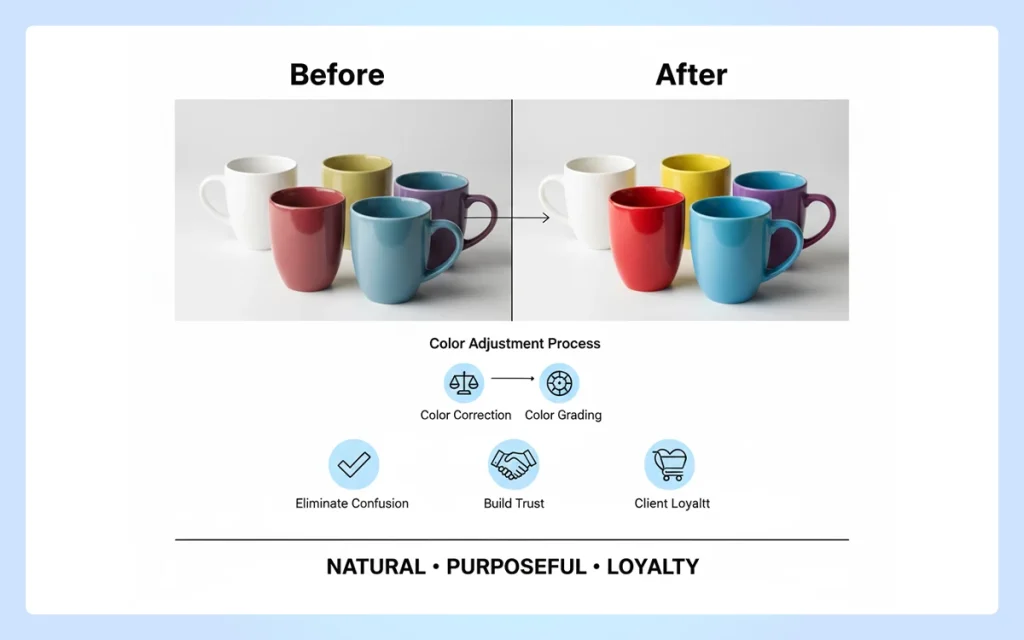
Why color correction and color grading work
- Retains hue, tint, tone, and shade to adjust the product’s appearance
- Fix color casts, brightness, and shadows to maintain the scene
- Neutralize incorrect color formation
- Shows color variations of a single product
13. Complex Clipping Path
Complex clipping path is applied to products that have complex and intricate shapes and designs, which aren’t easy to clip and call for advanced-level techniques and skills. Products such as chandeliers, furniture, and groups of people require complex clipping to make products stand out.
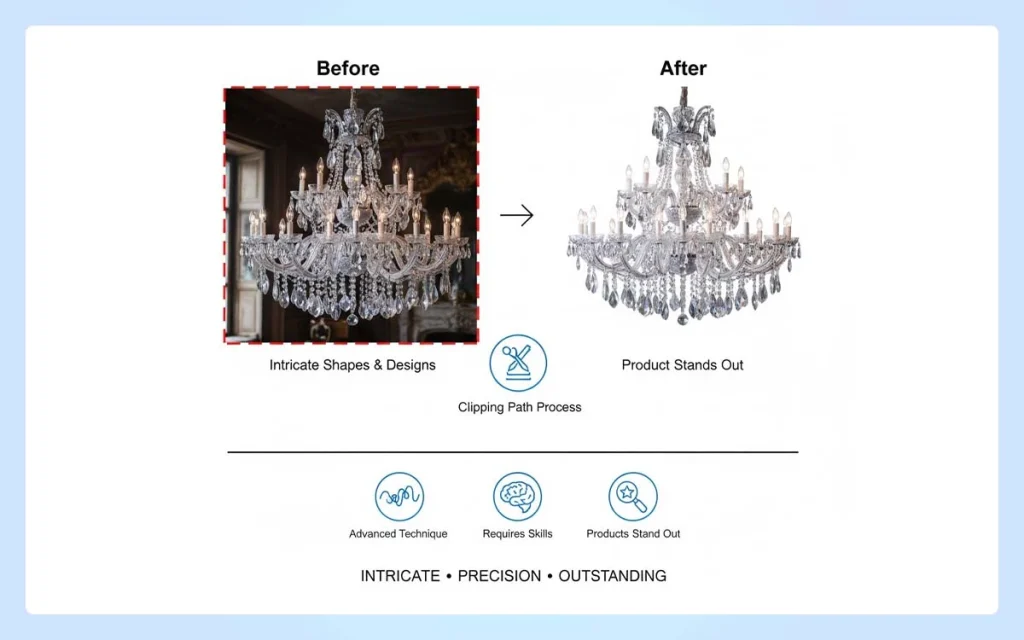
Why does complex clipping path work
- Brings out the subjects’ actual shape clean
- Separates the product image from the background
- Makes the product image available to use anywhere
- Is available to fulfill the platform-specific requirements
14. Object Removal and Replacement
Object removal and replacement is an image processing technique to eliminate overpowering products or accessories from the image, and if necessary, add relevant products. Unnecessary objects occupying the scenery or cluttered scenery distract viewers. Object removal helps viewers stay in tune with the seller’s purpose; it convinces them to buy.
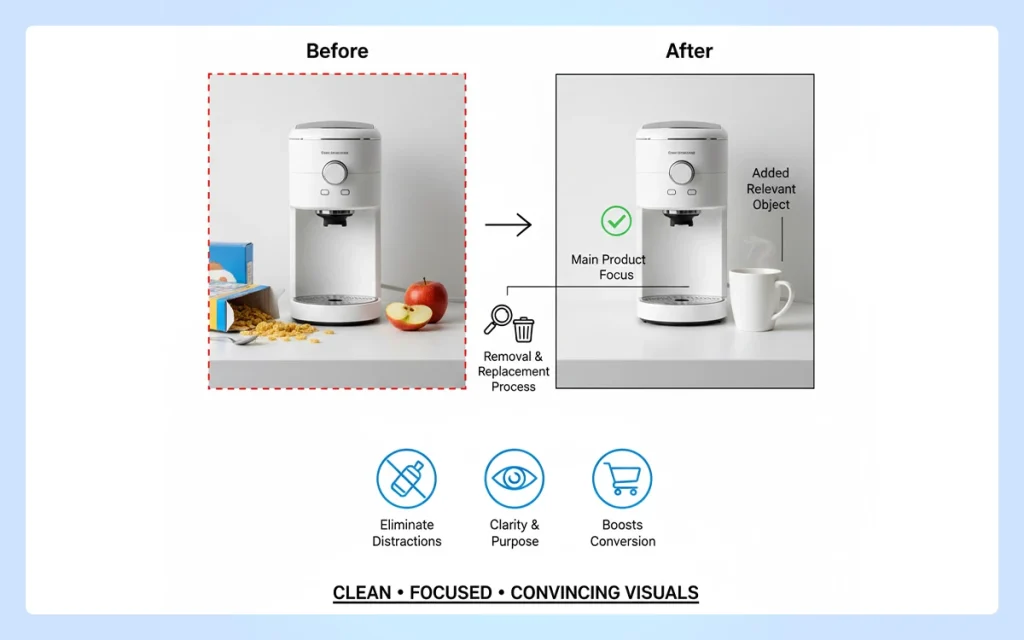
Why object removal and replacement work
- Replaces unwanted objects
- Removes objects and fills up the gap
- Makes images clean and distraction-free
- Makes the product images purposeful
15. Minimalist Image Editing Trend
Minimalist photo editing emphasizes the ‘less is more’ theory to attract online shoppers. Nowadays, shoppers look for transparency and authenticity keeping this in mind, photo editors incorporate natural light, realistic tones, and minimal retouching during their workflow. It reflects how products truly appear, forming an emotional connection with customers.
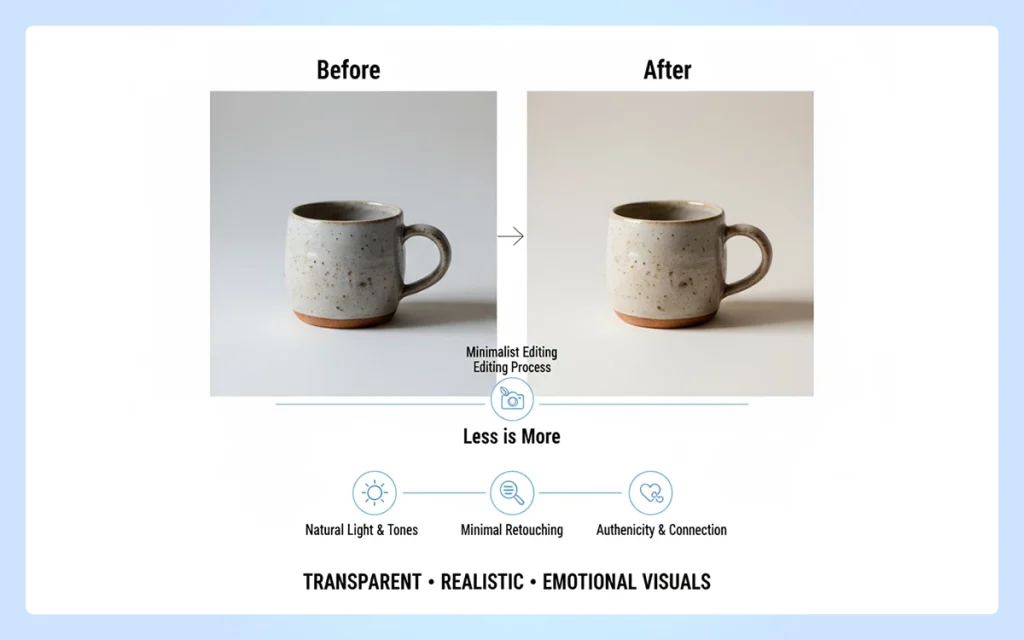
Why minimal photo editing trend work
- Delivers a soft, organic visual experience
- Builds trust with realistic product visuals
- Reduces over-editing that can mislead customers
- Support consumers’ demand for brand authenticity
16. Sustainability & Eco-Friendly Editing Workflows
Eco-friendly editing encourages digital efficiency — using remote workflows, minimal reshoots, and cloud-based collaboration to reduce environmental impact. Brands are adopting greener editing methods as sustainability becomes a core e-commerce value.

Why sustainability & eco-friendly editing trend work
- Minimizes waste and saves resources from reshoots
- Promotes responsible production practices
- Aligns with eco-conscious consumer expectations
- Enhances brand reputation for sustainability
Top 5 Product Photo Editing Tips for E-commerce
The top 5 product photo editing tips for e-commerce are as follows.
- Maintain natural lighting and realistic colors: Edit product images, keeping the natural lighting and appearance as much as possible. Today’s shoppers prioritize the actual look and offerings of a product. The fewer visual differences between physical and digital views a product has, the more reliability and conversion potential it contains.
- Use consistent backgrounds for brand cohesion: Keep the brand purpose and outlook in your photos; follow the style, but make sure it doesn’t compromise your brand value. Highlight products maintain uniformity with a consistent background across digital platforms for clean and professional product presentation.
- Optimize for multiple platforms: Always strategize for multi-platform display. Optimize product photos for all the platforms where your target audiences spend most of their time: marketplaces, social media, and mobile. Make sure images are clear and uniform to look across all displays, and load first.
- Follow trends and styles for product image editing: Incorporate 2026 trends in your photos, such as hyper-realism, macro detailing, and 360° perspectives. Traditional photo editing or styles always work, but following trends convinces your viewers that you are informed and active, which builds their confidence in your products, resulting in engagement, traffic, and conversion.
Is There Any Difference Between Photo Editing Styles and Photo Editing Trends?
There is a key difference between photo editing style and photo editing trends, which is their purpose and duration. Image editing styles are like consistent visual patterns that specify a brand’s identity. Image editing trends are a new way or direction that arises based on people’s preferences, behavior, and requirements.
Other differences between photo editing style and photo editing trends are as follows.
| Topics | Photo Editing Style | Photo Editing Trend |
|---|---|---|
| Origin | Derive from choice | Derive from demand |
| Duration | Lasts for some time and even becomes timeless | Trends last for a while and frequently change |
| Goal | Establishes recognition | Brings attention |
| Implementation | Brand, custom, or user-specific | Covers the industry |
What are the Photo Editing Styles for 2026?
Photo editing styles blend visuals, story with the latest creative trends to make the photos eye-catching, stylish, yet fulfilling. 6 popular photo editing styles for 2026 are as follows.
1. Hyperrealistic Visuals
Hyper-realism photos are high-resolution and extreme lifelike images that focus on meticulous details with a subtle interplay of light and shadow. Such images contain maximum clarity with cinematic lighting, which makes intricate details appear lifelike yet balanced.
2. 360° Immersive Edits
360-degree photo edits show a wide-angle view of images, allowing viewers to get the full picture. This emerging editing style changes flat images into panoramic and interactive experiences. These types of images contain multiple images stitched together to create a real-life scene for the products.
3. Macro & Detail-Focused Photography
Macro and detail-focused photography are mostly used in e-commerce product photography as they highlight fine textures, colors, and materials of the product. As viewers can see the products in detail, check the interior, exterior, and learn about features, detail-focused images are always on trend.
4. Bold & Vibrant Colours
Use of bold and bright colors exhibits energy, vibrancy, and emotion in visuals. Editing style has incorporated various hues, rich contrasts, and colorful lighting through the color correction and color grading techniques to attract viewers’ attention.
5. Retro & Vintage Film Look
Retro and vintage styles stand for a timeless editing approach, with film grain, muted palettes, and textures that convey an old look, warmth, and a nostalgic feeling. Such a look connects viewers to their past or specific memories with authenticity and emotional attachment.
6. Moody & Cinematic Tone
Moody and cinematic tones in photography styles are dominant in 2026 as well; the moody tone is depicted through shadow, desaturation, and contrast, and cinematic tones are created through specific lighting, color grading, etc. Combining both, you get an emotion-driven story in the visuals.
How Online Photo Editing Courses Teach Photo Editing Trends?
Online photo editing courses teach photo editing trends through real-time editing, practical demonstration, and making trend-specific assignments in the tutoring sessions. Instructors show new tools, features, and updates on photo editing software, AI techniques, automated solutions, and demanded presets and templates.
Expert photo editors combine video tutorials, live workshops, downloadable presets, and feedback sessions in their photo editing courses to help learners. Those materials include case studies, before-and-after examples, and project-based learning for students to understand trends evolving and applications.
The structured modules, composition, color theory, and trend-driven techniques like AI retouching, natural lighting, and 3D visualization, etc, altogether help students stay more in-tune with the learning process and grasp the photo editing trends.